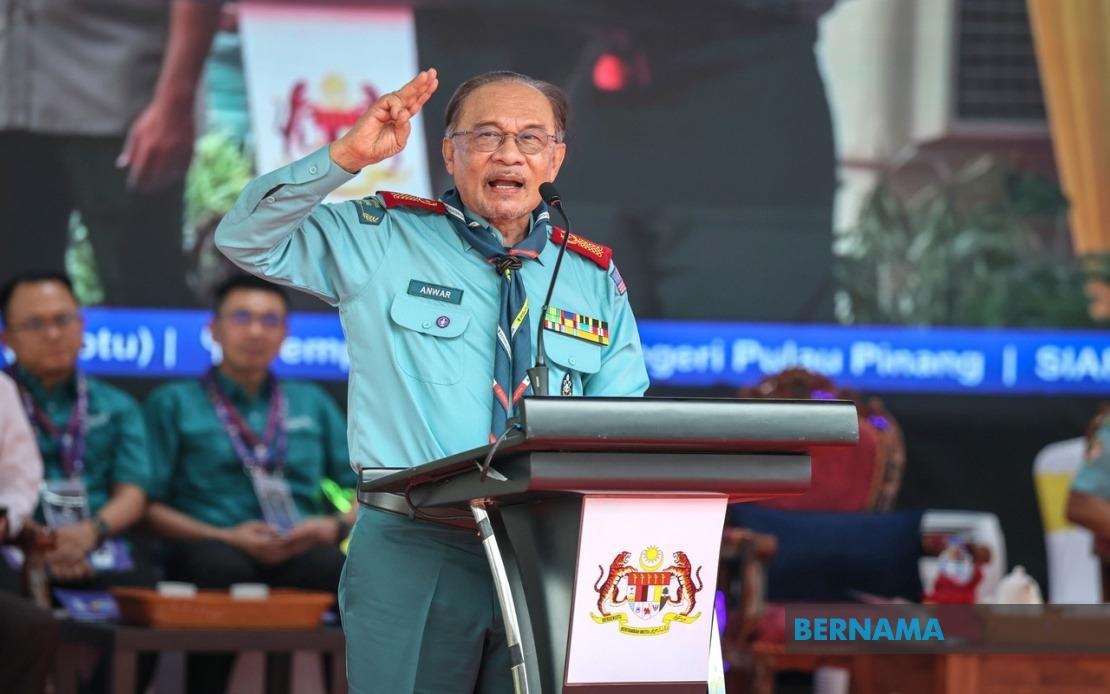
Prime Minister Datuk Seri Anwar Ibrahim has articulated a vision of national success that extends far beyond spreadsheets and innovation indices, insisting that sustainable progress requires investing in human character as much as infrastructure. Speaking at the 15th Malaysian Scouts Jamboree (MYJAM15) in Batu Kawan on August 29, Anwar positioned youth development as central to Malaysia's future trajectory, arguing that technological prowess and economic metrics offer an incomplete measure of societal achievement.
Anwar's remarks, made before an audience that included Penang Chief Minister Chow Kon Yeow and Chief Scout Datuk Prof Dr Mohd Zin Bidin, reflected a broader concern about the quality of Malaysia's human capital as the nation navigates rapid digitalisation. The Prime Minister cautioned that educational institutions from primary schools through universities must do more than transmit academic knowledge—they must intentionally cultivate virtues such as discipline, service-mindedness, and accountability to family, community, and nation. This framing positions moral education not as peripheral to development but as foundational to it.
The timing of these comments carries significance within Malaysia's political and social context. As Southeast Asia's technology adoption accelerates and artificial intelligence reshapes employment landscapes, policymakers across the region grapple with questions about preserving social cohesion and cultural identity amid rapid change. Anwar's intervention suggests that Malaysia's leadership views the challenge not primarily through the lens of economic competition but through concern about generational character and social stability. His questioning—"What is the meaning of development if our children are not instilled with spirit, education, discipline and love?"—invites reflection on whether growth divorced from values represents genuine progress.
Central to Anwar's argument is a particular conception of education's purpose. Rather than positioning schooling primarily as a pathway to employment or competitive advantage, he frames it as preparation for responsible citizenship. The emphasis on instilling "a spirit of service" signals an expectation that Malaysia's youth should view their qualifications not as personal possessions to be monetised but as capabilities to be deployed for collective benefit. This articulation, while idealistic, reflects concerns within Malaysian society about youth engagement and social contribution.
The Prime Minister also addressed what educational scholars term the "dual challenge" facing developing nations: preserving cultural identity while embracing technological transformation. In Malaysia's specific context, where a multicultural society contains multiple heritage traditions, this challenge proves particularly acute. Anwar's assertion that young Malaysians "must not neglect their cultural roots and values" serves multiple audiences—it reassures traditionalists concerned about cultural erosion while implicitly warning technology enthusiasts that progress unmoored from heritage risks social fragmentation. The notion that technological adaptation and cultural preservation are complementary rather than antagonistic represents a middle-path approach consistent with Anwar's broader political positioning.
The event itself—MYJAM15, running from August 29 through September 4 and attracting over 5,450 scouts from eleven countries including South Korea, Indonesia, Singapore, and Sri Lanka—provided Anwar with a platform to illustrate these themes through concrete example. Scouting's emphasis on character development, teamwork, and service aligns neatly with the Prime Minister's discourse about non-academic dimensions of youth formation. That the jamboree brought together international participants from across Asia underscored the universality of concerns about youth development while simultaneously positioning Malaysia as a convener and thought leader on these questions.
Particularly noteworthy is Anwar's emphasis on unity in diversity as a leadership imperative for Malaysia's emerging generation. Malaysia's multicultural composition creates both distinctive strengths and genuine challenges; youth who navigate religious, ethnic, and cultural difference effectively become, in Anwar's framing, better-equipped leaders for an increasingly complex world. This argument subtly reframes Malaysia's diversity from potential liability into competitive advantage—suggesting that Malaysian youth who master cross-cultural collaboration possess capabilities scarce in more homogeneous societies.
The Prime Minister's allusion to 2026 National Day celebrations and his call for youth to "nurture their spirit of patriotism" while preparing for "future tests and challenges" gestures toward an uncertain horizon. Whether interpreted as references to geopolitical volatility, economic disruption, or social fragmentation, Anwar's language implies that Malaysia faces coming difficulties requiring both national cohesion and adaptive capacity. Youth equipped with strong values but flexible thinking, according to this logic, represent the nation's insurance policy against unforeseen disruption.
Historically, MYJAM15's return to Penang after a sixty-year absence—the state last hosted the event in Teluk Bahang in 1966—carried symbolic weight. That year marked a relatively early moment in Malaysia's independence journey; returning to Penang in 2024 represents a full-circle moment reflecting on how far the nation has progressed while raising questions about whether this progress has been accompanied by corresponding development in national character and social bonds. Anwar's remarks seemed intended to pose precisely this diagnostic question.
The substantive claim Anwar advances—that purely material measures of progress mislead—challenges prevailing development paradigms. In Malaysia and across Southeast Asia, governments traditionally emphasise GDP growth, infrastructure expansion, and technology adoption as success markers. Anwar's intervention suggests these metrics matter but require supplementation by indicators of social cohesion, moral development, and civic engagement. Whether Malaysia's bureaucratic apparatus and educational institutions possess mechanisms to systematically cultivate and measure such attributes remains an open question that his remarks, while eloquent, did not directly address.
For Malaysian policymakers and educators, Anwar's message implies a need to examine whether institutional structures support his stated priorities. If schools and universities operate primarily under accountability frameworks focused on test scores and graduation rates, translating the Prime Minister's vision into institutional reality would require substantial recalibration. Similarly, if public discourse continues to measure nations overwhelmingly through economic indicators, shifting perception requires sustained messaging and concrete policy shifts rather than occasional rhetorical emphasis.

