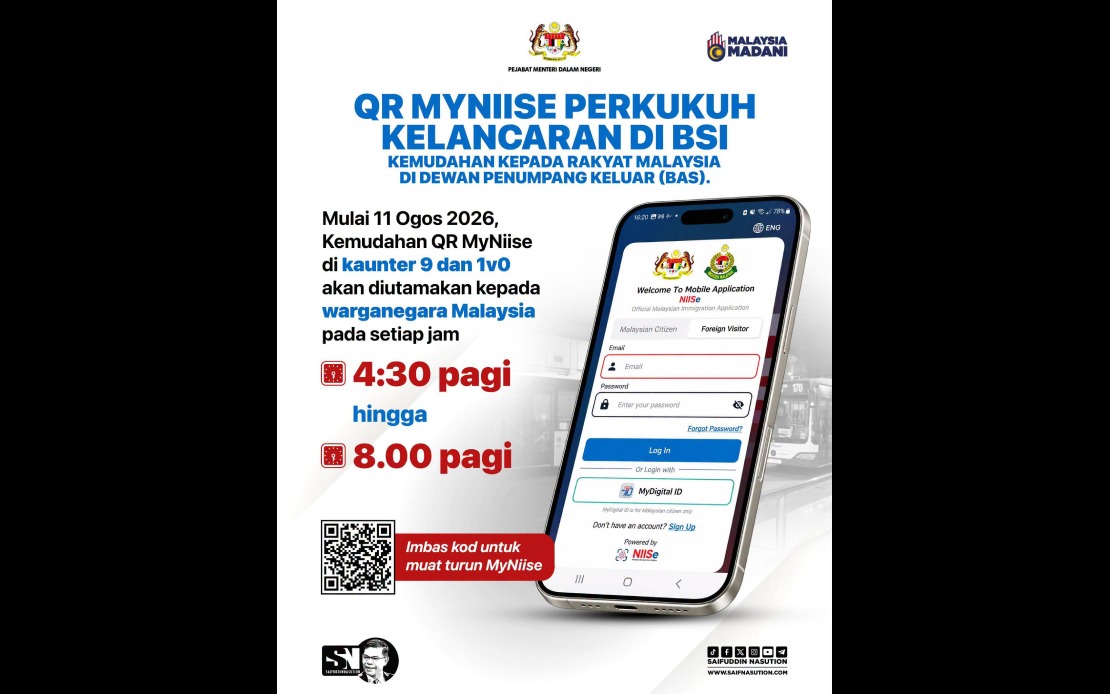
Malaysia has rolled out a dedicated fast-track immigration system for travellers carrying the National Integrated Immigration System (MyNIISe) QR code at Bangunan Sultan Iskandar, the main bus terminal serving the Singapore border crossing. The initiative, which began in August, designates counters 9 and 10 in the Bus Departure Hall as priority lanes operating from 4.30 am to 8 am, a window that captures the bulk of morning commuter traffic heading into Singapore.
Home Minister Datuk Seri Saifuddin Nasution Ismail framed the move as a direct response to the grinding morning congestion that characterises daily cross-border movement through the terminal. Tens of thousands of Malaysians depend on the Singapore route for work, with many departing before dawn to meet strict employment schedules. The compressed timeframe and high volume create bottlenecks that can jeopardise punctuality, particularly during school holidays and peak business seasons when passenger numbers spike further.
The MyNIISe system represents a broader push by the Malaysian government toward digital transformation in border management. Rather than joining conventional queues and presenting physical documents at immigration counters, users with the QR code can expedite processing through a streamlined verification system. This technological layer aims to reduce the administrative burden on immigration officers while speeding up the clearance process for compliant travellers, creating a two-tier system where early adopters gain tangible benefits.
Accessing the MyNIISe platform is straightforward for smartphone users. The application is available across multiple app ecosystems—the Apple App Store, Google Play Store, and Huawei App Gallery—ensuring coverage even for those using Chinese-manufactured devices, which remain popular in Malaysia and Southeast Asia. Once downloaded and activated with biometric or identity verification, the QR code generated can be presented to officers for rapid processing, eliminating manual data entry and document shuffling that consume time in traditional queues.
The timing of this rollout reflects both a structural understanding of cross-border flows and a political recognition of the hardship endured by regular commuters. The 4.30 am start aligns precisely with when the earliest morning buses depart, suggesting coordination with transport operators and immigration planning authorities. By concentrating the benefit during these peak hours, the government maximises the utility of the system where congestion poses the greatest friction, rather than spreading resources across off-peak periods when queues naturally remain manageable.
For Malaysian workers employed in Singapore's finance, petrochemical, and technology sectors, the MyNIISe initiative carries material value. Shaving even five to ten minutes off daily immigration processing translates to meaningful time savings across a working year, with cumulative benefits for punctuality-sensitive employment. Conversely, the system creates an incentive for broader MyNIISe adoption beyond this border context, building the database and operational familiarity that the government requires to expand digital immigration infrastructure at other entry points, including airports and maritime terminals.
The Bangunan Sultan Iskandar facility itself warrants attention as Singapore's primary land gateway. Handling roughly one million cross-border movements monthly, the terminal sits at the intersection of Malaysian domestic infrastructure and regional economic integration. Congestion there reverberates through both nations' logistics networks, affecting just-in-time manufacturing, supply chains, and services. Even modest improvements in throughput offer macroeconomic benefits beyond individual commuter convenience, reducing systemic delays that inflate transportation costs and undermine regional competitiveness.
Yet the initiative also reveals assumptions about digital literacy and device ownership that merit scrutiny. While smartphone penetration in urban Malaysia is high, rural and lower-income commuters may face barriers to accessing and maintaining the MyNIISe application. Reliance on consistent mobile internet connectivity and battery life during transit introduces dependencies that traditional document-based systems avoid. The government's decision to maintain parallel physical queues acknowledges this reality, but risks creating a de facto two-class immigration experience where digital haves enjoy expedited processing while digital have-nots remain in congested conventional lanes.
From a regional perspective, the MyNIISe rollout at this critical juncture signals Malaysia's willingness to modernise border infrastructure ahead of Brunei and other ASEAN partners. Singapore has maintained sophisticated electronic immigration systems for years, and this Malaysian move narrows a capability gap that once favoured the city-state's operational efficiency. As ASEAN continues negotiating integrated mobility frameworks and digital identity standards, Malaysia's proactive steps position it as an implementer rather than a laggard, with potential diplomatic and commercial advantages.
The sustainability of this initiative hinges on several factors. Continued server reliability, cybersecurity vigilance, and regular updates to the MyNIISe platform are prerequisites for maintaining user confidence and operational integrity. Immigration officers at Bangunan Sultan Iskandar must receive adequate training to work seamlessly with both digital and traditional verification methods, preventing bottlenecks at the technology-human interface. Additionally, feedback mechanisms should capture data on usage patterns and user satisfaction to inform refinements and potential expansion to other peak hours or border crossings.
Looking forward, the MyNIISe priority clearance system at Bangunan Sultan Iskandar represents an early test case for how Malaysia envisions future border management. Success here—measured in reduced wait times, higher user adoption, and minimal system failures—would strengthen the case for deploying the system at other critical junctures. For the roughly 400,000 Malaysians commuting regularly to Singapore, this initiative offers a tangible incentive to engage with government digital infrastructure while demonstrating that technological modernisation can translate into practical, daily quality-of-life improvements.

