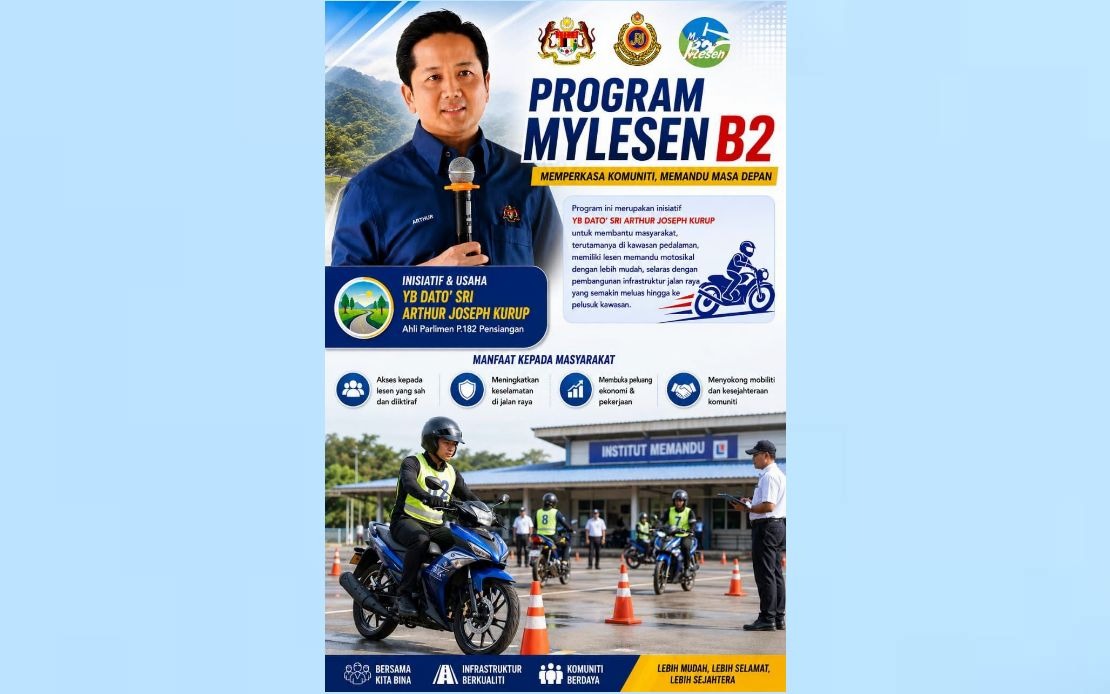
The MyLesen B2 initiative has resumed its operations in Pensiangan, Sabah, addressing a significant accessibility challenge that has long confronted rural motorcyclists seeking to obtain valid riding licences. The programme aims to eliminate the burden of lengthy travel to urban driving schools, a particular hardship for residents in remote areas where motorcycle ownership is widespread but formalised licensing remains problematic. By decentralising licence acquisition services, the initiative represents a targeted intervention to improve compliance with Malaysia's road traffic regulations whilst simultaneously recognising the economic and social realities of rural life in East Malaysia.
Pensiangan Member of Parliament Datuk Seri Arthur Joseph Kurup, who also holds the portfolio of Natural Resources and Environmental Sustainability Minister, announced the programme's return with emphasis on its role in supporting young people and underserved communities. The initiative explicitly targets youths and others who have yet to obtain formal motorcycle credentials, a substantial demographic in rural Sabah where informal transport remains prevalent. Kurup framed the intervention not merely as administrative convenience but as foundational infrastructure for economic participation, arguing that valid licensing documentation opens employment avenues and legitimises economic activity that might otherwise remain in the informal sector.
The licensing pathway maintained by MyLesen B2 preserves institutional integrity by requiring all participants to complete mandatory training courses and pass standardised examinations. This approach balances accessibility with safety assurance, ensuring that geographical proximity to services does not compromise testing rigour or knowledge standards. The emphasis on thorough preparation underscores an understanding that rural licensing must meet identical safety benchmarks as urban programmes, thereby maintaining national standards whilst expanding geographical reach. Participants receive guidance throughout the qualification process, reflecting a recognition that many rural applicants may lack familiarity with bureaucratic procedures or licensing terminology.
The programme specifically targets residents aged between 16 and 63 who have never previously held a driving licence, a criterion that captures a significant demographic in areas where formal licensing uptake has been historically low. This age bracket reflects practical reality—youths represent the most likely new riders, whilst the upper age limit acknowledges that older residents may seek formal credentials for the first time, perhaps prompted by changing economic circumstances or regulatory enforcement. By opening access across this entire spectrum, the initiative recognises diverse entry points into the licencing system rather than assuming a single typical applicant profile.
Road safety emerges as a central justification for the programme's expansion into rural areas. Pensiangan and similar regions have historically experienced proportionally higher motorcycling accident rates, partly attributable to prevalence of unlicensed riders unfamiliar with formalised road traffic regulations. Enhanced awareness of licensing laws and standardised training in safe riding practices constitute direct interventions against these patterns. By bringing formal licensing infrastructure to rural communities, policymakers attempt to reduce the gap between regulated and unregulated road use, thereby improving safety outcomes across the entire user population.
The economic dimensions of licence acquisition deserve particular emphasis for Malaysian and Southeast Asian readers. In rural Sabah, motorcycle riding licences function simultaneously as safety credentials and economic enablers. Valid documentation permits legal employment in sectors requiring formal licensing, access to insurance frameworks, and participation in formal economic activity. For young people in particular, obtaining a MyLesen B2 credential represents a concrete step toward economic formalisation and employment opportunity. The programme's positioning explicitly links licensing acquisition to broader development outcomes, framing administrative compliance as a pathway toward prosperity.
The permanence of acquired credentials adds substantial value to the initiative. Once obtained, a MyLesen B2 licence remains valid for the licensee's lifetime, subject only to ongoing compliance with prevailing regulations. This durability distinguishes formal licensing from temporary or renewal-dependent alternatives, providing confidence that the effort of obtaining credentials yields lasting benefit. For residents in economically marginal circumstances, the security of knowing that formal credentials will endure justifies the effort of participation in training and examination processes.
Registration procedures have been deliberately simplified and localised through two access points: the Pensiangan Parliamentary Service Centre and the Sook State Assemblyman's Service Centre. This dual-location approach ensures geographic accessibility and reduces travel burden for prospective participants. The integration of the programme into existing parliamentary and assemblyman infrastructure leverages established administrative networks rather than requiring entirely new institutional frameworks. Such practical integration reflects sophisticated understanding that programme success depends on removing not only the examination barrier but also the preliminary administrative hurdles that may deter rural applicants.
The MyLesen B2 expansion into Pensiangan carries implications beyond Sabah itself. Rural accessibility to licensing services remains a challenge across Malaysia and the broader Southeast Asian region, where motorcycles function as primary transport for populations dispersed across geographically extensive areas. The Pensiangan model, if successful and replicated, could inform rural licensing policy across multiple jurisdictions. Malaysia's experience implementing decentralised licensing approaches provides valuable evidence regarding the feasibility and outcomes of bringing formalised credentials to geographically dispersed populations—evidence increasingly relevant as Southeast Asian nations pursue development strategies that balance urbanisation with rural economic participation.
The initiative reflects evolving policy recognition that safety, formalisation, and development objectives intersect at the point of service delivery. Rather than assuming that residents should navigate bureaucratic systems designed for urban contexts, the programme reconstructs systems around rural realities. This approach acknowledges that regulatory compliance ultimately depends on accessibility, and that sustainable safety improvements require understanding the practical circumstances of those whom regulations seek to govern. For rural motorcyclists in Pensiangan and comparable communities, the programme's return promises not merely administrative convenience but access to the formal credentials increasingly essential for economic and social participation.

