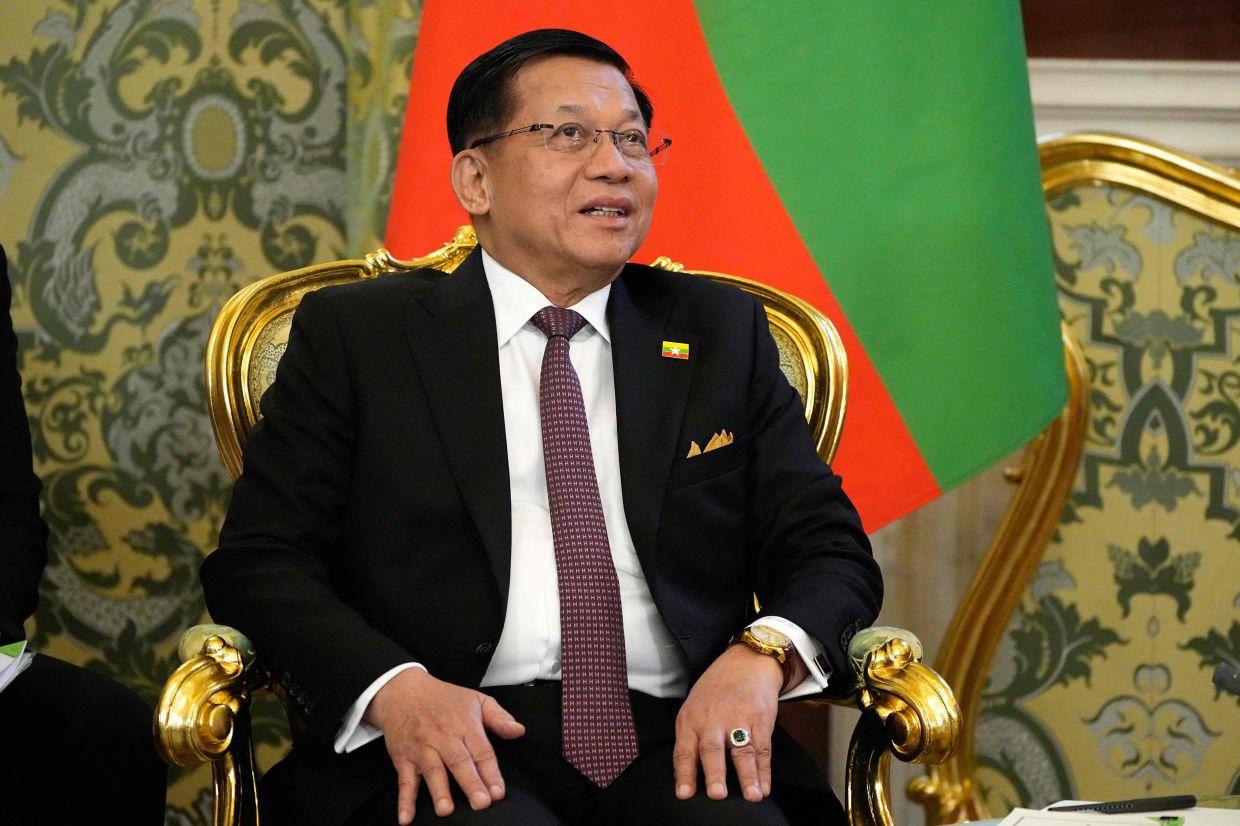
Myanmar's military leader Min Aung Hlaing is set to make an official visit to Cambodia in early September, the Cambodian Senate confirmed this week, marking the latest stop on an extensive international tour that observers view as a carefully orchestrated campaign to secure diplomatic recognition as Myanmar's legitimate ruler.
The visit announcement follows trips Min Aung Hlaing has already undertaken to Russia, China, India, Thailand, Laos and several other nations since his election as president in April, each carefully timed and choreographed to project an image of normalcy and legitimacy despite the turbulent circumstances surrounding his assumption of power. Cambodian officials including Kuy Sophal, Minister of the Royal Palace, and Chin Ketna, a senior figure in the National Committee for Organising National and International Festivals, have begun inspecting potential venues to host the Myanmar leader, signalling that Phnom Penh is treating the occasion as a significant diplomatic engagement.
The Cambodian Senate has framed the visit as an opportunity to strengthen friendship and bilateral cooperation between the two Southeast Asian neighbours. Chea Thyrith, spokesperson for the Senate president, emphasised that the visit would deepen existing ties and foster mutually beneficial collaboration across multiple sectors. However, this official characterisation sits uneasily alongside growing international concern about Myanmar's human rights record and the circumstances that brought Min Aung Hlaing to his current position.
The military leader's ascent has been marked by profound controversy and widespread condemnation from democracy advocates and international observers. His administration orchestrated a coup in 2021 that removed Aung San Suu Kyi, Myanmar's democratically elected leader, from office and subsequently detained her alongside thousands of activists, dissidents and civilian protestors. Human rights organisations have documented serious allegations of extrajudicial killings, torture and arbitrary imprisonment on a massive scale, painting a picture of systematic repression that has alarmed regional governments and international bodies.
This troubling backdrop explains why Min Aung Hlaing's diplomatic circuit has attracted considerable criticism from civil society groups and international observers. Many analysts view his carefully planned state visits as a calculated strategy to normalise his rule and secure international acceptance of a regime that took power through force. The April election in which he claimed the presidency has been widely derided as a facade for continued military control, with no genuine democratic legitimacy whatsoever. Each foreign visit therefore becomes another brick in an architecture of perceived legitimacy that critics argue he desperately needs.
Asean's own position on Myanmar has reflected this tension, with the organisation excluding Myanmar from summit meetings as a consequence of the coup and the junta's failure to implement the bloc's five-point consensus for restoring civilian democracy. This exclusion represents a significant diplomatic setback for Min Aung Hlaing, making his cultivation of individual bilateral relationships with Asean member states and other nations all the more strategically important. Cambodia's willingness to host him sends a signal within regional diplomatic circles, even if it falls short of a full restoration of Myanmar's standing.
Kin Phea, president of the International Relations Institute of Cambodia, has suggested a more nuanced reading of the visit, arguing that it represents a mutual effort to strengthen relations rather than serving solely as a vehicle for legitimising the Myanmar leader. He noted that Cambodia itself attempted to broker solutions during its Asean chairmanship in 2022, positioning itself as a constructive mediator in the Myanmar crisis. This diplomatic tradition may partly explain Phnom Penh's receptiveness to hosting Min Aung Hlaing.
Yet Kin Phea also acknowledged the underlying reality that such visits do bolster Min Aung Hlaing's standing as a head of state, regardless of the troubled origins of his authority. He suggested that Cambodia might offer lessons from its own historical experience with national reconciliation and peace-building, though he cautioned that genuine progress toward democracy in Myanmar would ultimately depend on developments within the country itself rather than on external validation through state visits.
Crucially, Kin Phea highlighted that individual countries' diplomatic engagement with Min Aung Hlaing remains distinct from Myanmar's status within the Asean institutional framework. The bloc's five-point consensus on Myanmar continues to set the terms for any restoration of Myanmar's full participation in regional forums. No amount of bilateral visits to individual member states, including Cambodia, can unilaterally override this collective Asean position or determine whether Myanmar will be welcomed back to summit meetings.
This distinction matters significantly for Southeast Asian countries seeking to balance diplomatic courtesy with principled stands on democratic governance. Malaysia and other Asean members have struggled with how to engage with Myanmar given the junta's intransigence and apparent unwillingness to work toward the democratic transition outlined in the five-point consensus. Cambodia's hosting of Min Aung Hlaing neither signals an Asean-wide shift in policy nor does it represent an endorsement from the broader region.
For Malaysian policymakers and observers, the Myanmar situation remains emblematic of deeper challenges facing Asean cohesion and the organisation's capacity to enforce its own principles. The visit also highlights how individual member states may pursue bilateral relationships that run counter to collective positions, creating ambiguity about the organisation's true stance on democratic backsliding within its ranks.

