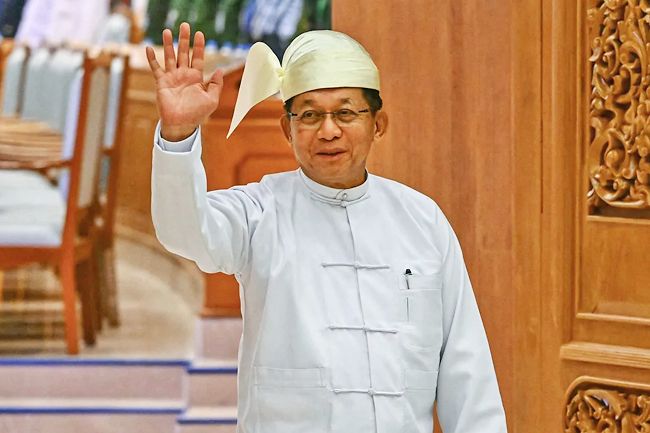
Myanmar's military leader Min Aung Hlaing is set to visit Bangkok for talks with Thai Prime Minister Anutin Charnvirakul on August 6 and 7, according to Thailand's Foreign Minister Sihasak Phuangketkeow. The meeting represents a significant diplomatic engagement at a time when Bangkok is intensifying efforts to bring the military-ruled nation back into the mainstream of Southeast Asian affairs following its 2021 coup that ousted democratically elected leader Aung San Suu Kyi.
The planned visit comes after high-level discussions among ASEAN foreign ministers in Manila, where Sihasak indicated that candid conversations had taken place about how to facilitate Myanmar's return to full participation within the regional bloc. While Myanmar technically remains an ASEAN member state, it has been formally excluded from the organization's major meetings and decision-making processes since the junta seized power more than three years ago, creating an awkward diplomatic limbo that has tested the unity of Southeast Asia's premier regional organization.
Thailand's prominent role in pushing for Myanmar's reintegration reflects its unique geographic and humanitarian circumstances. The country shares an extensive border with Myanmar, which has descended into civil conflict following the coup, and currently hosts millions of Myanmar refugees who have fled violence and economic collapse. This position gives Bangkok both incentive and credibility to engage with Naypyidaw, though it has simultaneously exposed fault lines within ASEAN over how to handle a member state controlled by a military junta that overturned electoral results.
Sihasak's characterization of the engagement as part of a "dual-track approach" reveals Bangkok's pragmatic strategy. Rather than making reintegration conditional on full compliance with ASEAN's five-point peace plan—which remains the formal framework for Myanmar's rehabilitation—Thailand is pursuing immediate bilateral solutions to pressing cross-border issues while maintaining diplomatic channels for longer-term reconciliation. The foreign minister specifically identified transnational crime, online scams, and drug trafficking as urgent matters requiring direct government-to-government cooperation, issues that directly affect Thai citizens and require cooperation from Myanmar authorities regardless of political considerations.
Yet Sihasak's acknowledgment that ASEAN members must recalibrate what constitutes "progress" in Myanmar's transition signals realistic expectations about the pace of change. The question of whether allowing the UN-appointed ASEAN special envoy access to detained former leader Aung San Suu Kyi constitutes meaningful progress, or whether reduced violence along the Thai-Myanmar border represents success, illustrates how far below traditional democratic benchmarks the regional organization is willing to calibrate its measurement of improvement. This recalibration reflects ASEAN's pragmatic acceptance that the Myanmar junta is unlikely to restore democracy in the near term.
The recent elections in Myanmar, which installed Min Aung Hlaing as president while maintaining military control over governance, were heavily circumscribed and widely viewed internationally as lacking legitimacy. However, Thailand and some ASEAN members see even this controlled electoral process as a potential opening for dialogue with Myanmar's armed ethnic groups and pro-democracy opposition movements. Bangkok hopes the junta's efforts to present a semblance of civilian governance might create space for negotiations with various stakeholders, though skeptics question whether such controlled elections signal genuine political opening.
Sihasak's suggestion that Thailand could help facilitate dialogue between the Myanmar junta and ethnic armed organizations positioned along the Thai-Myanmar border represents a potential contribution that the Thai government believes could incrementally build confidence and stability. These ethnic groups have long histories of autonomy in border regions and maintain complex relationships with both the central Myanmar government and Thai authorities. By positioning itself as a neutral facilitator, Bangkok seeks to create what it describes as "building blocks" toward broader regional stability, even if such efforts cannot immediately resolve Myanmar's fundamental political crisis.
The continuing evolution of ASEAN's Myanmar policy also reflects broader institutional challenges. Philippine Foreign Minister Theresa Lazaro noted that the bloc is considering appointing a permanent, long-term special envoy to Myanmar rather than rotating the position annually among member states. The acknowledgment that the current yearly rotation system has proven ineffective reveals frustration with how institutional limitations have hampered ASEAN's ability to engage meaningfully with Myanmar's complex political situation. A permanent envoy would provide continuity and deeper familiarity with Myanmar's stakeholders, potentially enabling more sophisticated diplomatic engagement.
This institutional reconsideration itself demonstrates how Myanmar's crisis has strained ASEAN's traditional consensus-based approach and forced members to acknowledge that some issues require sustained, dedicated attention rather than routine diplomatic rotations. The proposed change also suggests that Bangkok and Manila, among others, believe Myanmar's reintegration will be a prolonged process requiring consistent institutional commitment rather than episodic diplomatic gestures.
For Malaysian observers, Thailand's diplomatic initiative carries implications for regional stability and ASEAN's broader coherence. Malaysia, as a fellow ASEAN member with its own strategic interests in Southeast Asian stability, has navigated the Myanmar question carefully, and Bangkok's pragmatic engagement model offers insights into how individual members balance principle with regional pragmatism. The outcome of these diplomatic efforts will significantly influence whether ASEAN can maintain its claim to be a meaningful regional organization or whether member state divisions over Myanmar will further erode its collective influence.

