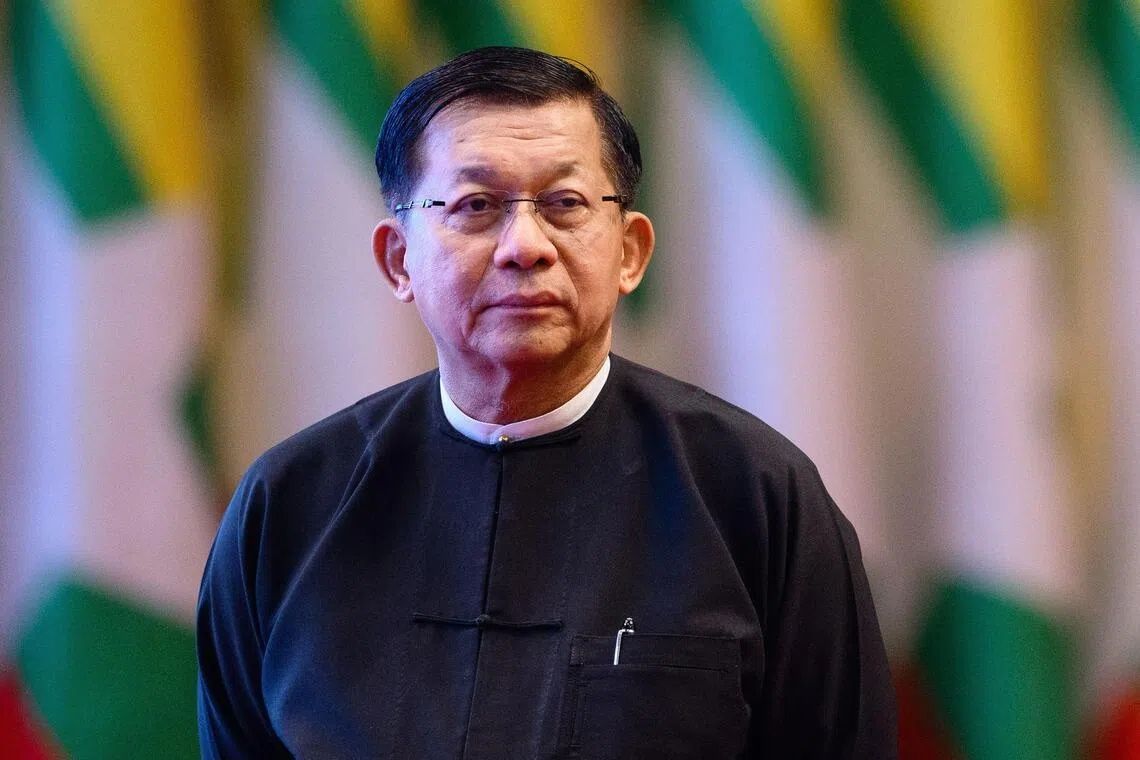
Myanmar's ex-junta chief Min Aung Hlaing is set to arrive in Thailand on Thursday, marking his first official visit to a neighbouring country since shedding his military uniform for civilian attire earlier this year. The diplomatic journey underscores his administration's systematic effort to re-establish Myanmar's position within the regional community, a goal that carries profound implications not only for Southeast Asia's stability but also for the future trajectory of governance across the region.
The 2021 military coup orchestrated by Min Aung Hlaing dismantled a decade of democratic progress, removing democratically elected leader Aung San Suu Kyi from power. That intervention has precipitated an ongoing civil conflict that has claimed more than 100,000 lives according to independent estimates, creating a humanitarian catastrophe that has destabilised the entire border region and displaced countless civilians. In April of this year, Min Aung Hlaing transitioned from his role as senior general to president through elections that international observers and democracy advocates roundly dismissed as choreographed exercises designed to mask military rule with a veneer of civilian legitimacy.
Thailand has emerged as the primary architect of Myanmar's diplomatic rehabilitation within Asean, recognising that prolonged isolation serves neither regional interests nor stability. The kingdom has spearheaded bilateral engagement while simultaneously working through Asean channels to gradually reintegrate Myanmar's leadership into regional forums. This initiative reflects Bangkok's pragmatic calculation that engagement offers more leverage than ostracism, particularly given Thailand's acute vulnerabilities to Myanmar's instability. The bloc suspended Myanmar's participation in high-level summits following the coup, though Myanmar's foreign minister was permitted to attend an informal regional meeting in Thailand last month, signalling a subtle shift in the consensus around re-engagement.
Min Aung Hlaing's diplomatic calendar in recent months reveals a calculated strategy to restore international credibility through selective engagement with strategic partners. He has undertaken official visits to India and China, both nations with substantial geopolitical interests in Myanmar's stability, followed by a trip to Laos, another Asean member state. Each journey serves to demonstrate that Myanmar retains international relationships and that his government operates within recognised diplomatic frameworks. The Thursday visit to Bangkok represents the culmination of this deliberate sequencing, positioning Thailand as the critical gateway for his broader reintegration into regional institutions.
Paralleling these diplomatic manoeuvres, the Myanmar regime has permitted Suu Kyi, who remains under house arrest, to meet with a representative from the International Committee of the Red Cross on Monday—her first documented encounter with a foreign official since her detention. This carefully orchestrated concession appears designed to soften international criticism ahead of Min Aung Hlaing's Thailand visit, suggesting that the administration is acutely aware of the reputational costs associated with maintaining detention of the democracy icon. Such gestures, though limited, indicate acknowledgement that legitimacy requires at least cosmetic attention to humanitarian and political concerns.
However, Myanmar's approach to Asean's peace framework reveals the fundamental paradox underpinning its diplomatic strategy. The bloc's five-point consensus, established to facilitate dialogue with all conflict parties and halt military hostilities, has been consistently rejected by Myanmar's leadership. Analyst David Mathieson characterises this contradiction as reflecting "zero-sum logics"—Min Aung Hlaing simultaneously seeks recognition as a responsible regional partner while categorically refusing the diplomatic instruments designed to achieve genuine reconciliation and peace. This stance exposes the hollow nature of much of the diplomatic engagement, suggesting that the junta seeks international acceptance without substantive commitment to addressing the underlying conflict or its humanitarian dimensions.
Thailand's motivations for hosting and legitimising Min Aung Hlaing are grounded in concrete security concerns that extend beyond abstract principles of governance. The porous 2,400-kilometre border shared by Thailand and Myanmar has become a conduit for violence, with military clashes regularly spilling across international lines. Thailand currently shelters approximately two million Myanmar nationals, many fleeing conflict, creating an immense humanitarian and social burden. Beyond these direct security challenges, Bangkok grapples with organised crime networks that operate from Myanmar's ungoverned borderlands, including cyber-scam operations targeting Thai citizens and Southeast Asian countries more broadly, as well as sophisticated drug trafficking organisations whose activities destabilise Thai communities.
During Monday's press briefing, Thailand's Foreign Minister Sihasak Phuangketkeow explicitly flagged cybercrime networks as a priority issue that Bangkok intends to raise during the upcoming bilateral discussions. The minister's statement also welcomed the Red Cross meeting with Suu Kyi while calling for Myanmar authorities to undertake "further positive steps" toward lasting peace—language that carefully balances diplomatic courtesy with implicit criticism. Thailand's dual messaging reflects the delicate equilibrium Bangkok must maintain between encouraging Myanmar toward responsible governance while avoiding rhetoric that might provoke isolation of a government with which engagement is deemed essential.
The ceremonial dimensions of Min Aung Hlaing's Bangkok visit underscore Thailand's commitment to treating him as a legitimate head of state. According to Thai officials, he will be received with full honours at Government House, including a formal honour guard, before conducting private bilateral meetings with Prime Minister Anutin Charnvirakul. The itinerary encompasses a state dinner and business forum, signalling that Thailand views economic engagement as integral to the normalisation process. The two governments are expected to execute a memorandum of understanding focused on labour cooperation, reflecting Thailand's substantial interests in Myanmar labour migration and bilateral workforce development.
The international human rights community and civil society organisations have strongly objected to Thailand's diplomatic courtesies toward Min Aung Hlaing. The International Criminal Court has issued an arrest warrant against him for crimes against humanity stemming from military operations against Myanmar's Rohingya Muslim minority and broader conflict-related atrocities. Multiple Western nations have imposed targeted sanctions against him and his administration. Justice For Myanmar, a prominent advocacy organisation, issued a statement condemning Thailand's diplomatic overtures, asserting that conferring legitimacy on Min Aung Hlaing through state-level recognition undermines accountability for documented crimes and perpetuates impunity.
This tension between strategic engagement and accountability reflects a broader regional dilemma facing Southeast Asian governments. Asean's foundational commitment to non-interference in member states' internal affairs has often functioned as a shield protecting governments from external pressure on human rights and governance standards. Yet Myanmar's civil war and humanitarian catastrophe have tested this principle to breaking point, forcing member states to balance traditional diplomatic norms against mounting international pressure and humanitarian imperatives. Thailand's approach—conditional engagement coupled with diplomatic pressure on specific issues like cybercrime—represents an attempt to navigate this contradiction, though critics contend it amounts to rewarding instability and violence with legitimacy.
For Malaysian observers and policymakers, Myanmar's trajectory carries significant implications. Southeast Asia's stability depends substantially on predictable governance and respect for regional norms. Malaysia, as a fellow Asean member with its own border security concerns and substantial Myanmar diaspora communities, has stakes in both regional stabilisation and accountability for grave crimes. The question of how Asean manages Myanmar's reintegration will establish precedents for how the bloc responds to future governance crises and international pressure, potentially reshaping the organisation's capacity to respond coherently to members' internal conflicts. Thailand's diplomatic initiative, while pragmatically justified, represents a gamble that engagement can moderate Min Aung Hlaing's behaviour—a wager with regional consequences extending well beyond bilateral relations.

