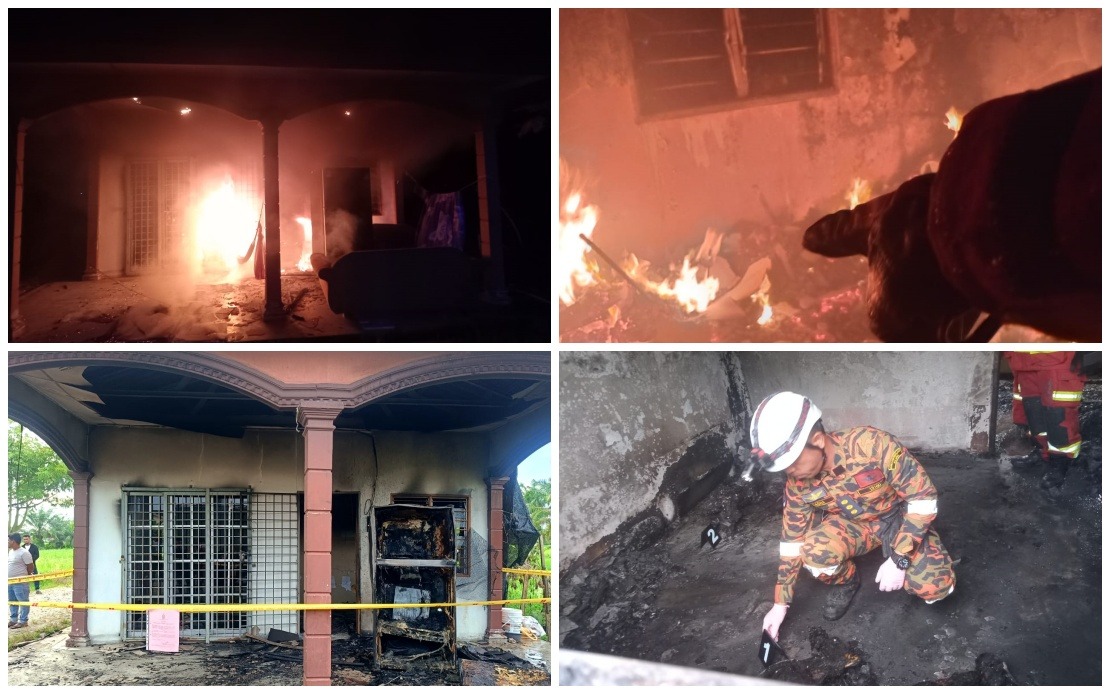
A tragic house fire in the early hours of Thursday morning claimed three lives in Taman Serai Maju, Bagan Serai, Perak, leaving the surviving spouse with serious burn injuries. The deceased victims have been identified as Mohd Yunus Nor Ali, 27, alongside his two young sons Muhammad Woheed Mohd Yunus, aged 6, and Mohamad Aheed Mohd Yunus, aged 3. All three were Myanmar refugees. The victims' wife, Saniya Jahan Juma Abul Kasim, 24, also a Myanmar refugee, sustained thermal burns to her hands and feet and has been hospitalized for treatment.
According to Perak Fire and Rescue Department (JBPM) director Datuk Sayani Saidon, emergency services received the distress call through the MERS 999 line at 5.17 am, with the first response vehicle arriving at the residential location just thirteen minutes later. The property involved was a standard Class A structure measuring 20 feet by 40 feet, which served as home to seven foreign nationals. Upon arrival, emergency responders found approximately 70 per cent of the dwelling already consumed by flames, creating an intense and hazardous environment for rescue efforts.
The sequence of events that unfolded at the scene painted a harrowing picture of the incident's severity. Saniya Jahan Juma Abul Kasim, having managed to escape the burning residence, provided crucial information to firefighters, indicating that her husband and two children remained trapped inside the structure. This intelligence prompted an immediate and coordinated response from the JBPM team, who initiated their RECEO (Rescue, Extinguish, Confine, Overhaul, Investigate) tactical approach to locate and extract the trapped individuals.
The search and rescue operation yielded tragic results. All three male victims were discovered within the first room that had ignited, already deceased from the effects of the fire. Medical personnel from the Ministry of Health (MOH) who arrived at the scene were unable to revive any of the victims. The wife, having sustained thermal injuries, received preliminary medical attention at the scene before being transported via Emergency Medical Rescue Services (EMRS) vehicle to hospital for ongoing care and treatment of her burn wounds.
Firefighters managed to contain the flames by 6.20 am, with the comprehensive emergency response operation concluding at 7.35 am. The deceased victims were subsequently transferred to Royal Malaysia Police (PDRM) custody to facilitate further investigation and documentation procedures. The controlled recovery operation allowed forensic teams to begin preliminary assessments of the incident even as emergency services wound down their immediate response activities.
Investigations into the fire's origin have commenced, with preliminary findings suggesting the blaze originated in the first room where the fatalities occurred. The JBPM forensic team has begun the painstaking process of examining the scene to determine the precise cause of ignition. As of the incident report, the exact catalyst remains undetermined, with investigators working to establish whether the fire resulted from electrical fault, cooking accident, or another domestic source. The comprehensive damage assessment is ongoing, though initial estimates place property losses at a substantial figure.
This tragedy underscores the particular vulnerabilities faced by refugee communities residing in Malaysia. Myanmar refugees, predominantly Rohingya, have sought shelter in Malaysia following persecution in their homeland, yet often occupy crowded residential arrangements in older properties that may not meet contemporary safety standards. Shared housing situations, common among displaced populations with limited economic means, increase the risk profile for occupants, particularly during nighttime hours when escape routes become harder to navigate in smoke-filled conditions.
The incident carries broader implications for residential safety oversight in areas with concentrations of refugee populations. While authorities conduct investigations into this specific incident, questions arise regarding building code compliance, fire safety equipment availability, and emergency preparedness in residential buildings housing vulnerable foreign nationals. The presence of young children in the household adds another dimension to the tragedy, highlighting how displaced families often lack stable housing alternatives and comprehensive safety protections.
For the surviving wife, physical recovery from her injuries represents only the beginning of the trauma she must process. Having lost her husband and both young children in a single catastrophic event, Saniya Jahan Juma Abul Kasim now faces an uncertain future. The psychological and practical challenges confronting refugee survivors of such tragedies often extend far beyond physical healing, encompassing loss of income source, housing security, and family structure within communities already marked by displacement and instability.

