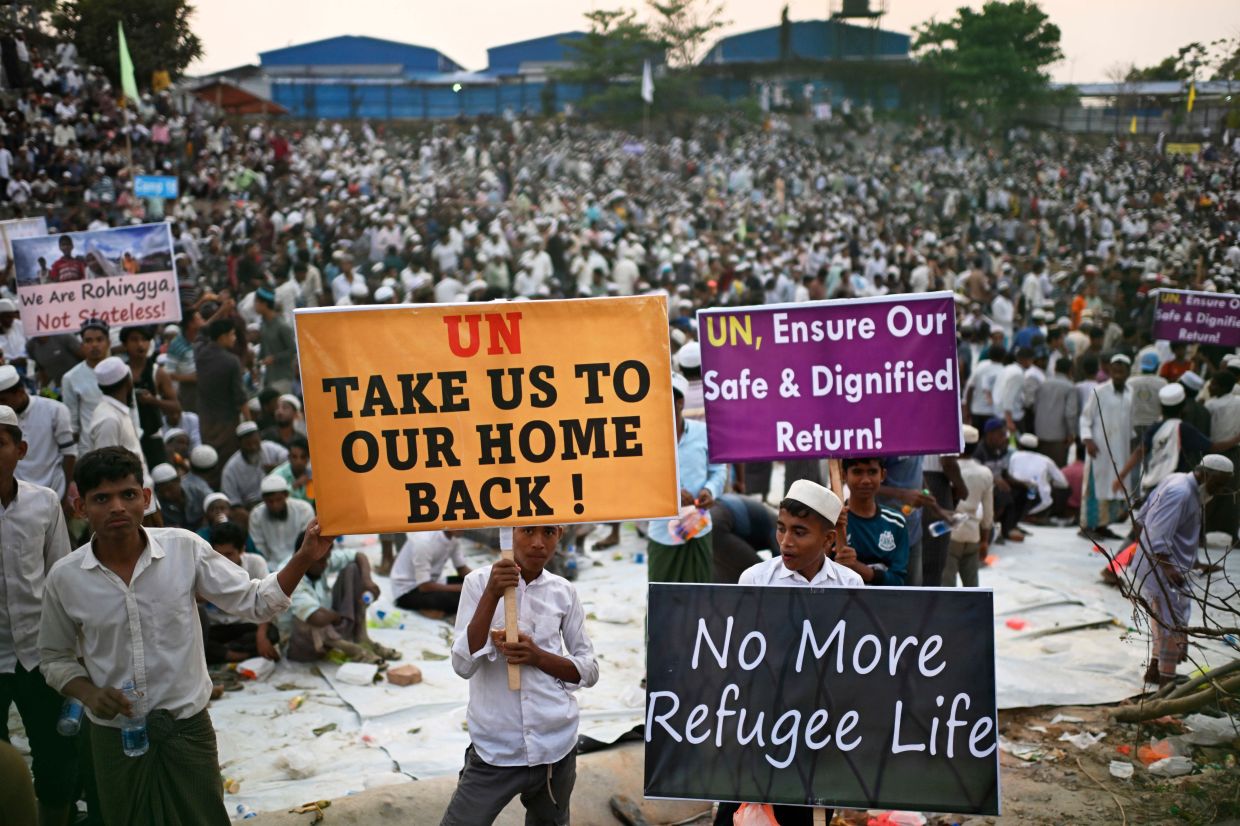
Myanmar's military-controlled government announced on Saturday that it has verified more than 300,000 Rohingya refugees sheltering in Bangladesh camps as legitimate former residents of western Rakhine state, signalling willingness to accept their return once security conditions stabilise. The declaration marks a significant moment in a humanitarian crisis now entering its ninth consecutive year, though the practical pathway to repatriation remains murky and contested.
The verification claim emerged from Myanmar's Ministry of Foreign Affairs as hundreds of thousands of Rohingya continue to languish in sprawling refugee settlements across southeastern Bangladesh. The crisis originated in August 2017 when Myanmar's military launched a brutal crackdown in Rakhine state following insurgent attacks on army posts. That operation displaced more than 700,000 Rohingya across the border, compounding a refugee population that had accumulated over decades from earlier episodes of state-sponsored violence. International investigators and human rights organisations have characterised the 2017 violence as systematic ethnic cleansing and genocide, allegations Myanmar consistently denies.
The government's verification figures warrant careful scrutiny. According to the announcement, Myanmar examined 828,824 Rohingya names submitted by Bangladesh authorities and verified 426,545 individuals as of late July. Of those confirmed, approximately 308,797 were classified as former Rakhine state residents eligible for potential repatriation. However, Myanmar simultaneously identified 113,507 people it could not verify and alleged that 4,241 had involvement in what it termed terrorist activities. The methodology and transparency of this verification process remain opaque, raising questions about its credibility among international observers and humanitarian organisations working in the region.
Myanmar's official position fundamentally denies Rohingya citizenship and national belonging. The country refuses to recognise the Rohingya as one of its 135 constitutionally recognised ethnic minorities, instead describing them as Bengalis to suggest they are illegal immigrants from Bangladesh rather than indigenous inhabitants of Myanmar. This framing underpins Myanmar's entire approach to the crisis and shapes negotiations with Bangladesh and the international community. The government's refusal to acknowledge Rohingya as a distinct ethnic group with historical ties to Myanmar remains a core obstacle to meaningful resolution.
A bilateral repatriation framework theoretically existed since 2018, when Myanmar and Bangladesh agreed to a two-year process for voluntary returns. That timeline has long expired without meaningful implementation. The deterioration of Myanmar's security environment following the military coup in February 2021 essentially halted repatriation efforts. The ouster of Aung San Suu Kyi's democratically elected government triggered widespread armed resistance and fragmented the country's stability. Competing military factions, including the military junta and various ethnic armed organisations, now contest control over significant territories, rendering large areas of Myanmar unsafe for civilian populations.
Rakhine state itself has become increasingly unstable, particularly since 2023 when intense fighting erupted between the military and the Arakan Army, a Rakhine-based ethnic insurgent group seeking regional autonomy. The Arakan Army has captured substantial territory from the military in recent years and now controls much of the state. This ongoing conflict has created a humanitarian catastrophe beyond the Rohingya crisis, with local populations fleeing the violence. Rather than providing security conditions conducive to refugee returns, the deteriorating situation has pushed additional Rohingya and other displaced persons toward Bangladesh and beyond, seeking survival outside Myanmar's borders.
Conditions within the refugee camps themselves have deteriorated markedly, further complicating any prospect of return. Overcrowding, inadequate sanitation, limited educational opportunities, and dependency on humanitarian assistance characterise daily life for nearly one million people crammed into camps in Cox's Bazar district. Simultaneously, international donor fatigue has prompted steep reductions in foreign aid flowing to camps, straining the capacity of humanitarian organisations to meet basic needs. These deteriorating circumstances have become sufficiently desperate that increasing numbers of Rohingya have undertaken perilous maritime journeys toward Malaysia and Indonesia aboard unseaworthy vessels, gambling with their lives against starvation and destitution in camps.
Malaysia has become an unexpected node in the regional Rohingya crisis, hosting tens of thousands of refugees despite lacking formal ratification of the UN Refugee Convention. Prime Minister Anwar Ibrahim stated in late July that Myanmar had agreed to accept 5,000 Rohingya currently residing in Malaysia as part of a repatriation programme. This announcement generated immediate controversy and contradiction from Myanmar's own officials. Han Win Aung, an official from Myanmar's Ministry of Foreign Affairs, subsequently clarified to international media that any repatriation programme would focus exclusively on verified Myanmar nationals held in Malaysian detention centres and explicitly rejected the notion that Myanmar would accept broader Rohingya populations. The discrepancy between Anwar's statement and Myanmar's official position highlighted the fractured nature of negotiations and competing interests among regional players.
Myanmar's narrative minimises the scale of displacement, contesting international estimates of crisis magnitude. The government claims that approximately 540,000 people crossed into Bangladesh following the 2017 violence while more than 200,000 remained in northern Rakhine state, figures substantially lower than international estimates suggesting over one million total displaced persons from the state. This statistical disagreement reflects deeper contestation over responsibility and the fundamental nature of what occurred in 2017. Myanmar's framing emphasises proportionality and limited displacement, whereas international investigations documented systematic violence aimed at destroying the Rohingya presence in Myanmar.
The repatriation impasse reflects the regional geopolitics complicating resolution. Bangladesh, hosting the world's largest refugee camps and bearing disproportionate humanitarian costs, holds limited leverage over Myanmar's military junta. ASEAN's diplomatic protocols historically privilege non-interference in member states' internal affairs, limiting regional institutional pressure on Myanmar. Meanwhile, Myanmar's military government faces no meaningful international consequences for its actions in Rakhine, reducing incentives for genuine accountability or policy change. China and Russia have blocked stronger UN Security Council resolutions, effectively insulating Myanmar from enforcement mechanisms.
For Malaysia and Southeast Asia broadly, the crisis carries particular salience. Maritime migration pressures, security concerns around transnational movements, and humanitarian obligations create competing demands on regional states. Malaysia's historical role as a transit point for irregular maritime migration has positioned it centrally in these dynamics. The prospect of further refugee outflows from Bangladesh camps—whether toward Malaysia, Indonesia, or further afield—presents ongoing regional management challenges absent clear political resolution of the underlying Myanmar situation.
Myanmar's verification announcement, while framed as progress, likely represents strategic positioning rather than genuine movement toward repatriation. By establishing verified populations and reiterating conditional acceptance, the government maintains a facade of reasonableness while ensuring that substantive returns remain indefinitely postponed pending security improvements that appear increasingly unlikely. The Rohingya remain trapped in a limbo spanning nearly a decade, caught between a homeland rendered inaccessible by ongoing violence and regional states unwilling to provide permanent solutions. Unless Myanmar's political trajectory fundamentally shifts toward democratic restoration and genuine reconciliation, the verification exercise will remain largely symbolic, leaving hundreds of thousands of Rohingya in prolonged statelessness.

