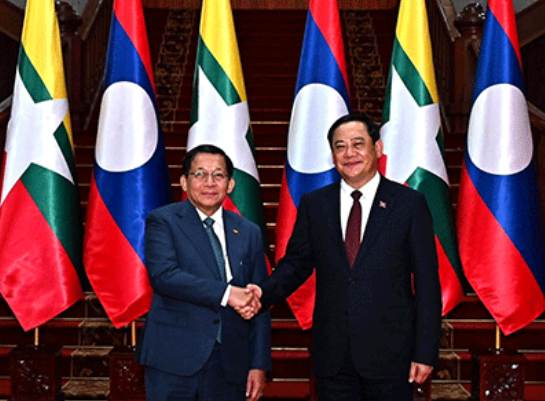
Myanmar's President Min Aung Hlaing travelled to Laos in early July for a three-day state visit that underscored the enduring partnership between two Southeast Asian neighbours navigating complex regional dynamics. The visit, held at the invitation of Lao President Thongloun Sisoulith, coincided with commemoration of 70 years of formal diplomatic relations between Vientiane and Naypyidaw, providing both governments with an opportunity to reaffirm their commitment to deepening bilateral ties across political, economic and security dimensions.
The Myanmar leader arrived in Vientiane on July 3 accompanied by his wife and a high-level delegation, receiving a full state welcome ceremony at the Presidential Palace. The ceremonial reception reflected the symbolic importance both nations attach to the relationship, particularly given the geopolitical positioning of these two mainland Southeast Asian states within the broader region. President Thongloun and his wife, Naly Sisoulith, extended formal greetings that set a collaborative tone for the subsequent engagements, signalling readiness to move beyond ceremonial recognition toward substantive cooperation.
During official talks between the two presidents, representatives from both governments reviewed the existing framework of bilateral cooperation and examined potential avenues for expansion. The discussions ranged across multiple dimensions of the relationship, allowing leaders to assess progress in established agreements while identifying emerging opportunities. Importantly, President Thongloun took the occasion to congratulate Myanmar on conducting general elections and forming a new government, implicitly endorsing the political transition that had taken place in Naypyidaw. His expression of confidence in Myanmar's continued development under President Min Aung Hlaing's leadership carried diplomatic weight, particularly in a regional context where Myanmar's governance trajectory has drawn international scrutiny.
The two governments articulated shared interests in maintaining robust defence and security cooperation, a priority that reflects both nations' concerns about transnational challenges and border stability. Agreement to enhance information sharing and coordinate on border security matters indicates a practical, ground-level commitment to addressing shared vulnerabilities. This dimension of the partnership carries particular significance for Malaysia and other regional states, as stability along the Laos-Myanmar border affects broader Southeast Asian security architecture. The commitment to strengthen collaboration within regional multilateral forums, including Asean, the United Nations, and the Mekong-Lancang Cooperation framework, positions both nations as stakeholders in maintaining rules-based regional order.
Economic dimensions of the partnership received substantial attention, with both sides expressing satisfaction at progress in trade, investment and transport sectors. The energy cooperation element of the declared partnership reflects Myanmar's potential as a hydropower supplier and Laos' established role as a regional energy exporter, creating complementary interests. Labour cooperation agreements suggest recognition of cross-border migration realities and the need for frameworks protecting workers' rights. Educational exchange initiatives represent longer-term investments in people-to-people connectivity that can sustain diplomatic relationships across generations.
Prime Minister Sonexay Siphandone's separate engagement with President Min Aung Hlaing at the Prime Minister's Office underscored the significance accorded to the visit at the highest executive levels. His welcoming remarks and recognition of signed cooperation agreements indicated confidence that the visit would translate into concrete policy implementation rather than remaining confined to diplomatic formalities. The emphasis on consolidating longstanding friendship suggested an appreciation for the durable nature of Laos-Myanmar ties, which have weathered decades of regional transformation and remain grounded in shared cultural and historical moorings.
Parliamentary dimension of the relationship received particular attention during talks with National Assembly President Xaysomphone Phomvihane, who underscored that Laos was the first Asean member state visited by President Min Aung Hlaing for official engagements since assuming office. This protocol detail carried symbolic significance, positioning Laos as Myanmar's preferred first port of call within the regional association. The commitment to strengthen cooperation between the Lao National Assembly and Myanmar's Union Parliament establishes a legislative-level partnership channel that can facilitate dialogue independent of executive-branch dynamics. Xaysomphone's pledge to provide legislative support and monitoring of bilateral agreements acknowledged the critical role parliaments play in ratifying and overseeing implementation of international commitments.
The visit produced tangible institutional outputs in the form of signed cooperation documents, including a memorandum of understanding on tourism cooperation between the respective culture and tourism ministries. This accord recognises the complementary appeal of both nations' cultural assets and archaeological heritage, positioning tourism as a vehicle for economic cooperation and people-to-people exchange. The establishment of friendship city relations between Vientiane and Naypyidaw formalised a sister-cities arrangement that can generate practical cooperation in urban planning, municipal services and cultural programming. These mechanisms, while often understated in diplomatic reporting, create multiple entry points for sustained engagement beyond the level of central government.
The handover of snake antivenom serum from Myanmar to Laos exemplified the humanitarian dimensions of the partnership, addressing public health concerns that transcend borders and affect vulnerable populations in both countries. Such exchanges demonstrate that bilateral cooperation encompasses practical problem-solving alongside strategic considerations. The inclusion of cultural and ceremonial activities, including President Min Aung Hlaing's wreath-laying at the Unknown Soldier Monument and attendance at a traditional Baci ceremony, reflected sensitivity to Lao national symbols and cultural practices, reinforcing narratives of mutual respect and shared historical consciousness.
The planned extension of the visit to Luang Prabang, including tours of temples and UNESCO World Heritage sites, provided the Myanmar delegation with immersive exposure to Lao cultural landmarks while allowing the hosts to showcase their civilisational achievements. Such cultural dimension to state visits serves functions beyond aesthetic appreciation, contributing to mutual understanding and fostering public support for closer bilateral relations among broader populations. For Malaysia and other regional observers, the Laos-Myanmar partnership demonstrates how smaller Asean member states navigate their bilateral relationships while maintaining engagement with major powers and participating in multilateral frameworks.
The visit occurred within the context of broader Southeast Asian diplomatic dynamics, where Laos and Myanmar occupy distinct but interconnected positions within regional hierarchies. Laos, as a landlocked nation heavily dependent on hydropower exports and increasingly integrated into Chinese infrastructure projects, maintains a careful balancing act among regional actors. Myanmar, despite its larger population and resources, faces international isolation in certain quarters due to governance concerns, making strategic partnerships with fellow Asean members especially valuable. The convergence of interests on defence, energy and development cooperation suggests that both nations perceive mutual benefit in deepening institutional ties.
From a Malaysian perspective, the Laos-Myanmar engagement illustrates patterns of deepening bilateral cooperation among Asean members that operate somewhat independently of larger regional dynamics. The emphasis on parliamentary cooperation and implementation of agreements through formal mechanisms suggests maturation in how Southeast Asian nations approach their bilateral relationships, moving beyond ceremonial exchanges toward substantive institutional development. The focus on addressing transnational challenges such as cross-border pollution and irregular migration reflects concerns shared across the region, indicating that bilateral partnerships increasingly incorporate regional problem-solving dimensions.

