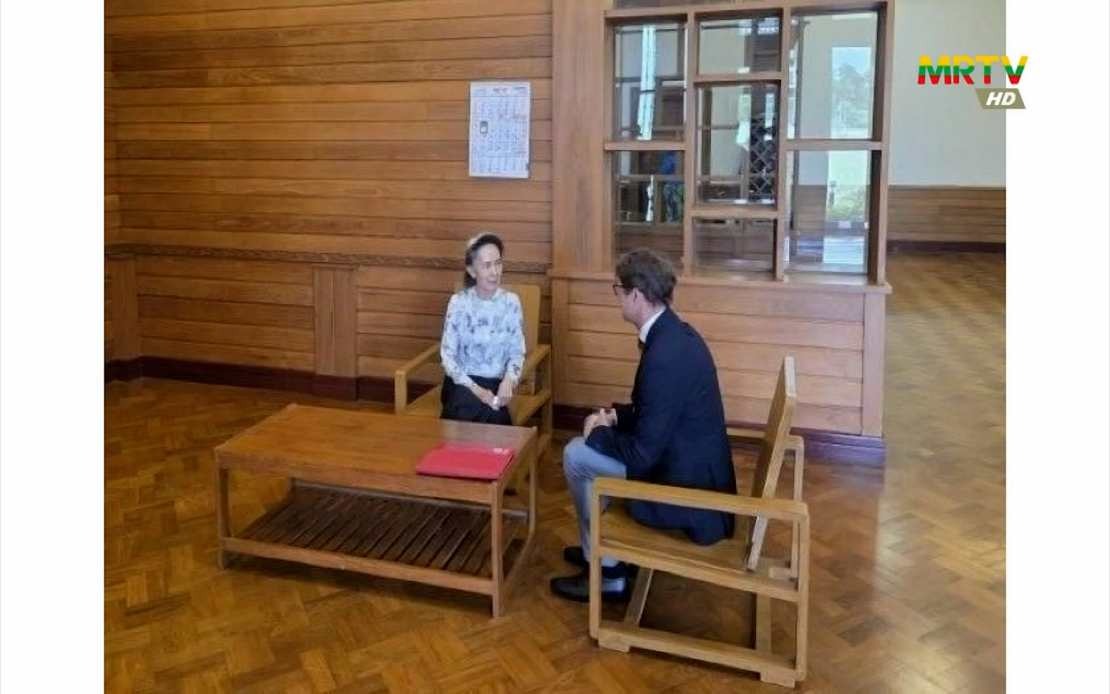
Myanmar's military-backed administration has confirmed that detained former civilian leader Aung San Suu Kyi met with an official from the International Committee of the Red Cross on Monday in the capital city of Naypyitaw, marking one of the first confirmed contacts between the 81-year-old Nobel laureate and foreign representatives since her detention began. Government spokeswoman Khine Khine Soe disclosed the encounter through a Telegram message, along with photographs purporting to show Suu Kyi meeting with Arnaud de Baecque, the ICRC's Resident Representative to Myanmar. The development represents a significant if limited concession to mounting international pressure regarding the transparency of her detention and physical condition.
Suu Kyi has remained in official custody since the military's seizure of power on February 1, 2021, when armed forces dismantled the democratically elected government she led and thrust Myanmar into deepening political crisis. The coup shattered a decade of democratic progress in the Southeast Asian nation and triggered widespread civil unrest, armed resistance, and a humanitarian catastrophe affecting the country's 51 million inhabitants. Since the takeover, her exact location and medical status have remained shrouded in opacity, with international observers and diplomats unable to access her directly or verify claims made by the authorities regarding her wellbeing.
The government distributed four photographs accompanying the announcement. Two depicted Suu Kyi dressed in traditional Burmese clothing seated opposite Baecque within a minimally decorated wood-paneled space containing only basic furniture. A third image offered a rare glimpse into her quarters, showing her beside what appeared to be a birthday cake bearing her name, with household items visible in the background. The fourth photograph showed a closeup of the cake inscribed with "Happy Birthday Aunty Suu 19.6.2026." Reuters could not independently verify either the location or timing of these images, and no earlier versions circulated publicly before the announcement.
The former democracy icon faces multiple convictions spanning allegations of corruption, election fraud incitement, and breaches of state security statutes. Following secretive trials conducted after the coup, military courts initially imposed a 33-year sentence, subsequently reduced to 27 years and then cut by one-sixth in April, leaving approximately 18 years of detention remaining according to her legal representatives. Her supporters and international observers have consistently characterised these prosecutions as politically engineered attempts to eliminate Myanmar's most revered political figure from public life permanently.
Suu Kyi's isolation has weighed heavily on her family. Her son, Kim Aris, disclosed to media outlets in December that he possessed minimal information about his mother's condition, receiving only fragmentary secondhand reports about cardiac, skeletal, and dental health problems while having no direct communication with her for years. He expressed grave concerns that she might pass away without his knowledge, underscoring the family's distress over her prolonged incommunicado status. Such disclosures intensified international concern about her physical and mental condition under prolonged confinement.
Myanmar's junta has persistently declared that Suu Kyi enjoys "good health," yet the government has simultaneously resisted allowing independent outside verification of these assurances. Regional neighbours, particularly members of the Association of Southeast Asian Nations, have escalated diplomatic efforts to secure unhindered access to the detained leader. During an ASEAN foreign ministers gathering in Bangkok last month, Thailand's chief diplomat Sihasak Phuangketkeow explicitly urged Myanmar to permit visits "so that we can be able to verify the claims" of her wellbeing, articulating the region's collective scepticism toward unconfirmed government statements.
In late April, following a military-orchestrated national election that elevated former junta commander Min Aung Hlaing to the presidency, the regime announced that Suu Kyi had been transferred to house arrest, suggesting marginal improvement in her detention conditions. However, the newly constituted military administration has proven reluctant to translate such announcements into substantive international access. When the Philippines formally requested permission for an ASEAN special envoy to visit her in May, authorities declined, illustrating the government's continued resistance to meaningful international oversight despite rhetorical gestures toward normalisation.
Suu Kyi's political trajectory and symbolic importance to Myanmar cannot be separated from her family legacy as the daughter of General Aung San, the revered independence struggle leader whose statue adorns the nation's consciousness. During her previous 15-year period of house confinement under an earlier military junta, she famously delivered rousing addresses to assembled supporters through the metal gates of her residence on Yangon's Inya Lake, transforming her enforced isolation into a powerful symbol of democratic resistance. That historical resonance amplifies the current global concern about her fate and the broader implications for democratic norms throughout Southeast Asia.
The Red Cross visit, while carefully managed through government-approved photography and timing, nevertheless represents a partial breach of the complete information blackout that had previously characterised her detention. The ICRC has traditionally maintained operational presence in Myanmar to monitor humanitarian conditions and provide humanitarian services, granting it some diplomatic latitude within the country. However, the organisation did not immediately provide independent comment on the meeting's nature, content, or its assessment of Suu Kyi's condition, leaving observers unable to assess whether substantive discussions regarding her welfare occurred or whether the encounter constituted primarily a carefully choreographed publicity gesture.
For Malaysia and other ASEAN nations, Suu Kyi's situation remains emblematic of broader anxieties about democratic backsliding and military intervention within the region. Myanmar's coup and the subsequent political trajectory have underscored vulnerabilities in mechanisms for protecting democratic governance and human rights across Southeast Asia. The international community's limited leverage over Myanmar's military authorities, despite significant economic and diplomatic pressure, suggests that regional mechanisms for enforcing accountability and transparency remain inadequate, a concern extending beyond Myanmar to encompass other potential democratic reversals within ASEAN.
The photograph suggesting Suu Kyi's 81st birthday celebration in June 2026 raises additional questions about the regime's intentions regarding her prolonged detention. If the images are authentic and recent, they indicate ongoing confinement rather than imminent release, despite international pressure. Her remaining 18-year sentence, without accounting for potential additional prosecutions or sentence modifications, suggests that Suu Kyi could potentially remain under detention for decades, barring extraordinary political developments or unexpected changes in the junta's approach to democratic restoration and political reconciliation.

