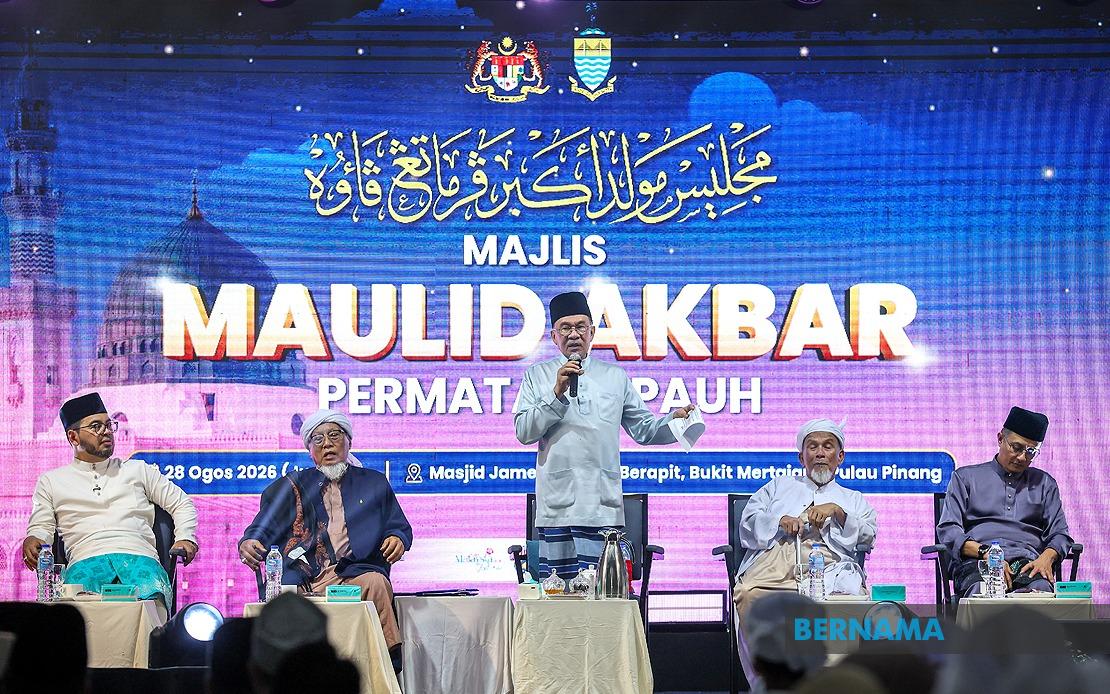
Prime Minister Datuk Seri Anwar Ibrahim has underscored the responsibility of Muslims to demonstrate exemplary conduct across all aspects of daily life, positioning moral character and integrity as essential instruments for gaining societal respect and advancing the nation's development agenda. Speaking at a Maulid Akbar ceremony in Bukit Mertajam during National Day observances, Anwar articulated a vision of Islamic leadership grounded in practical virtue rather than rhetoric, emphasising that the standing of Muslims in society must be earned through consistent evidence of positive behaviour.
According to Anwar, the foundation of this respect lies in tangible actions that reflect Islamic values. He highlighted the importance of demonstrating diligence in work, honouring commitments, maintaining trustworthiness in positions of responsibility, and actively rejecting corrupt practices or dishonest conduct. This framing positions Muslim conduct as a form of religious testimony, where everyday professional and personal behaviour becomes a statement about Islamic principles and their relevance to contemporary Malaysian life.
The Prime Minister's comments reflect a broader strategic emphasis within the current administration on linking moral governance to national development outcomes. By connecting individual ethical behaviour to collective national progress, Anwar has articulated a governance philosophy that situates character development as foundational to economic and social advancement. This approach recognises that institutional policies and technological innovation cannot sustain development without underpinning social values and moral foundations.
Anwar elaborated on the universal appeal of Islamic teachings, describing Islam as fundamentally oriented toward compassion and goodness that transcends religious boundaries. This inclusive framing carries particular significance in Malaysia's multi-religious context, where Muslim-led governance and ethical standards carry implications for inter-communal relations. By emphasising that Muslims must safeguard relationships and prioritise the welfare of all community members regardless of faith background, Anwar positioned moral leadership as a bridge-building exercise rather than a sectarian assertion.
The concept of balance featured prominently in Anwar's address, with the Prime Minister advocating for holistic human development that encompasses spiritual growth, physical wellbeing, intellectual advancement, and material prosperity. Rather than presenting these dimensions as competing priorities, he framed them as mutually reinforcing aspects of a comprehensive development model. This integrated perspective challenges the conventional dichotomy between secular and religious approaches to national development, suggesting instead that sustained progress requires simultaneous cultivation of both material and moral dimensions.
The Malaysia MADANI framework occupied central importance in Anwar's remarks, with the Prime Minister positioning it as fundamentally dependent on moral and character foundations rather than relying solely on policy mechanisms, economic growth trajectories, or technological capabilities. This characterisation suggests that the government views its development agenda as fundamentally constrained by the ethical standards of institutions and individuals implementing policies. Without such foundations, Anwar implied, technological advancement and economic expansion risk becoming hollow achievements disconnected from meaningful improvements in social welfare.
Anwar employed a striking metaphor to convey this relationship, describing the need to "reach for the sky" while remaining "rooted in the earth." This imagery encapsulates the tension between aspirational progress and foundational values, suggesting that ambition without moorings in faith, morality and character risks creating unsustainable or destructive development patterns. The metaphor carries particular resonance in Southeast Asian contexts, where rapid modernisation has frequently generated concerns about the erosion of traditional values and social cohesion.
The role of Islamic scholars in reinforcing these principles received explicit attention from the Prime Minister, who stressed the importance of engaging with religious knowledge and strengthening collaboration between scholars and political leaders. This emphasis on institutional dialogue between religious and secular authorities reflects an approach to governance that incorporates religious perspectives into policy deliberation. By valorising the contributions of Islamic scholars and advocating for their constructive engagement with national leadership, Anwar positioned religious expertise as essential to sound governance rather than marginal to policy processes.
The timing and setting of Anwar's remarks merit consideration within broader Malaysian political contexts. Delivered at a combined Maulid Akbar and National Day ceremony, the address linked Islamic observance directly to patriotic commitment and national development. This positioning reflects efforts within the current administration to frame Islamic practice as compatible with and supportive of secular nationalist frameworks, addressing historical tensions between religious and national identity in Malaysia.
For Malaysian readers, these statements carry implications for understanding the government's approach to addressing corruption, institutional reform, and social cohesion. By grounding anti-corruption efforts in religious and moral imperatives rather than purely legal or administrative mechanisms, Anwar has articulated a vision of governance transformation that operates simultaneously at institutional and individual levels. This approach suggests that combating corrupt practices requires not only structural reforms and enforcement mechanisms but also cultivation of personal integrity among public servants and citizens.
The emphasis on Muslim leadership through moral example also reflects the administration's engagement with regional and international audiences. In Southeast Asia and globally, Muslim-majority nations and communities face ongoing scrutiny regarding governance standards, corruption levels, and human rights records. By articulating a vision of Islamic leadership distinguished by integrity and moral consistency, Anwar positioned Malaysia as advancing an alternative model of Muslim governance responsive to contemporary development challenges while remaining grounded in religious principles.
Anwar's insistence that Malaysia MADANI development must maintain balance between material and moral progress addresses practical challenges facing rapidly modernising societies throughout the region. Economic advancement and technological adoption frequently generate anxieties about cultural displacement and value erosion. By explicitly integrating moral and spiritual development into the national development framework, the Prime Minister acknowledged these concerns while proposing that progress and moral consistency need not remain in tension.

