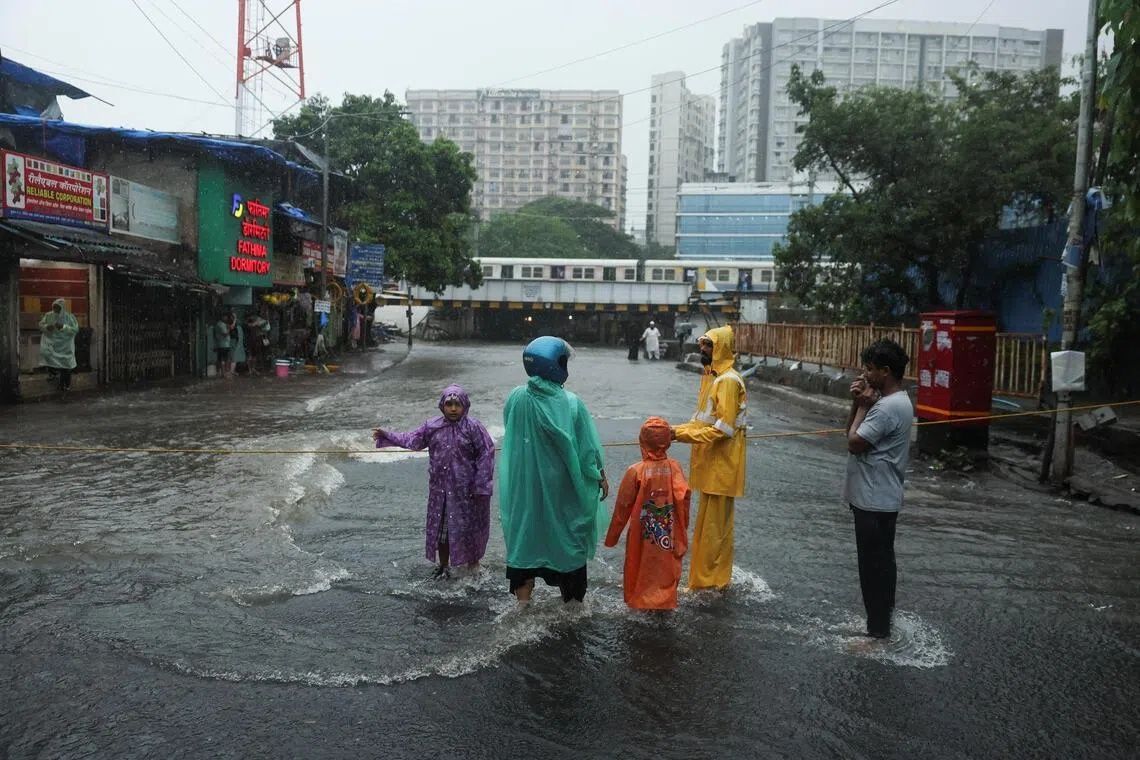
Mumbai's monsoon season has turned deadly once again, claiming two lives in separate infrastructure-related incidents that have reignited fierce political debate over municipal accountability and civic negligence. The India Meteorological Department issued an orange alert for July 3 as the relentless downpour continues to wreak havoc across the sprawling metropolis, with traffic gridlocked, key thoroughfares submerged, and residents warned to avoid all non-essential movement as rainfall is forecast to persist through the coming day.
The first tragedy struck in Chembur on June 30 when a massive tree, uprooted by violent winds accompanying the heavy rain, came crashing down onto a school bus ferrying students from Universal High School and Tilak Nagar School. Rescue teams scrambled to free children trapped within the vehicle using cutting equipment, but despite their swift response, eleven-year-old Vihan Shrivastav succumbed to injuries sustained in the incident. Other students aboard were transported to Zen Hospital and Jain Hospital, where they received treatment for their injuries.
The tragedy prompted immediate expressions of regret from Maharashtra officials, though the responses fell short of satisfying political demands for more stringent accountability measures. Maharashtra minister Ashish Shelar characterised the event as deeply unfortunate, asserting that both the state government and the Brihanmumbai Municipal Corporation bore responsibility for providing comprehensive support to the bereaved family. His statement included a commitment that action would be pursued against culpable officers, yet such assurances have become routine following such incidents, often accompanied by minimal consequences for senior decision-makers.
Local legislators, however, adopted a considerably harder line. After visiting the victim's family to offer condolences, MLA member Rohit Pawar stressed that meaningful accountability cannot rest solely with junior-ranking officials who execute policies formulated by their superiors. He emphasised that the child was an only son, adding emotional weight to his calls for senior bureaucrats to face proportionate consequences. Pawar further probed the adequacy of pre-monsoon infrastructure inspections, questioning whether the pattern of recurring incidents indicated systematic negligence rather than isolated lapses. His intervention reflected growing public frustration with cyclical disaster-response cycles that appear designed more for public relations than genuine preventive measures.
The second fatality underscored the deadly consequences of basic operational oversights. On July 2, Aslam Isak Shaikh, aged 60, fell into an open manhole in Sakinaka while traversing the waterlogged streets. The drainage cover had been removed for routine maintenance without adequate safety barricading—a fundamental precaution that authorities routinely overlook during monsoon season. Shaikh, who was engaged in a mobile phone conversation when the accident occurred, was swept away by the powerful current of accumulated rainwater. Recovery teams conducted a three-hour search operation before locating his body.
This incident provoked equally pointed condemnation from legislators responsible for the area. MLA member Vijay Wadettiwar demanded that authorities file a formal first information report against officials responsible for the lapse, arguing that proper procedures required either securing the manhole or establishing clear barriers during periods of intense rainfall. The removal of such basic safety measures during monsoon season, when water volumes surge unpredictably, represents a recurrent administrative failure that claims lives repeatedly across Indian cities. Wadettiwar's intervention reflected the escalating political costs of such incidents, forcing officials to respond to public outcry with increasingly visible corrective actions.
Parliamentary Speaker Rahul Narwekar acknowledged the incident had been discussed in the Legislative Assembly and promised a comprehensive report, characterising the event as deeply regrettable. Mumbai Mayor Ritu Tawde described the manhole incident as an administrative error and announced compensation of 10 lakh rupees for Shaikh's family, a figure that translates to approximately US$10,455. While financial compensation provides practical relief to grieving families, it implicitly acknowledges official culpability and raises questions about whether monetary payments adequately substitute for the systemic reforms necessary to prevent such incidents.
Beyond the two deaths, the monsoon downpour has created widespread chaos across Mumbai's transportation networks. A commercial truck overturned near the Kharghar Toll Plaza on the crucial Sion-Panvel Highway, blocking multiple lanes and creating substantial congestion that forced emergency personnel to clear the site and restore vehicular movement. Simultaneously, waterlogging has rendered several neighbourhoods partially inaccessible, with areas including Dadra East and Sion Gandhi Market experiencing severe flooding that has stranded commuters in extensive traffic jams.
The recurring nature of these monsoon-related disasters raises uncomfortable questions about municipal management capabilities in one of Asia's largest cities. Mumbai's rapid expansion, aging infrastructure, and inadequate maintenance protocols create an environment where predictable seasonal events consistently cause preventable deaths and disruption. The political responses from elected officials, while rhetorically demanding accountability, have not historically translated into meaningful systemic reforms or consequences for senior administrators whose policies and oversight failures create dangerous conditions.
For Southeast Asian observers, Mumbai's monsoon challenges mirror broader patterns evident across rapidly urbanising regions where climate impacts intersect with insufficient infrastructure investment and maintenance cultures. The incidents in Mumbai demonstrate how institutional failures compound during extreme weather events, transforming natural phenomena into human tragedies. Malaysian cities, facing intensifying monsoon patterns and expanding populations, confront similar vulnerabilities where drainage systems, tree management protocols, and maintenance oversight can determine whether rainfall brings inconvenience or catastrophe.

