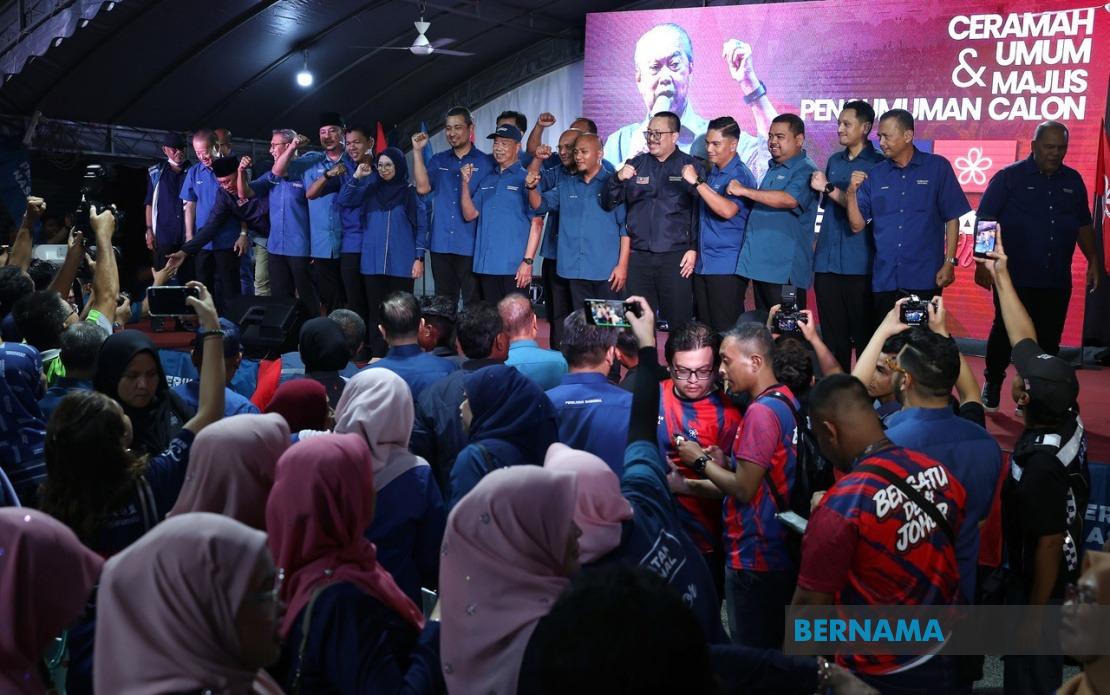
Tan Sri Muhyiddin Yassin, president of Parti Pribumi Bersatu Malaysia, formally unveiled the party's complete roster of 16 candidates contesting the Johor State Election at an event held in Muar on June 25. The announcement ceremony, held at the Pagoh Parliamentary Service Centre in Taman Pagoh Jaya, served as both a formal candidate presentation and a public ceramah session, allowing the party leadership to outline its electoral strategy and policy platform to supporters and media representatives.
The timing of the announcement reflects the compressed schedule now governing the electoral process. The Election Commission has designated June 27 as nomination day, providing candidates with just two days to complete formal registration procedures. This tight timeline places considerable administrative pressure on all contesting parties, requiring meticulous coordination of documentation, party endorsements, and candidate verification. The condensed calendar underscores the urgency surrounding the Johor election, which carries significant political implications both for the state and the broader national political landscape.
Polling will culminate on July 11, marking the conclusion of a campaign period spanning less than three weeks from nomination to voting. This relatively brief window for campaigning differs markedly from standard electoral timelines in Malaysia, compressing the period during which candidates can engage voters, conduct roadshows, and build grassroots momentum. For Bersatu specifically, the accelerated schedule necessitates rapid mobilisation of party machinery, volunteer networks, and media resources across all 16 contested seats.
The Johor State Assembly's dissolution on June 1 triggered the electoral countdown. That administrative act set in motion the machinery for what represents one of the most closely watched state elections in the nation. Johor's political complexion carries weight beyond its borders, given the state's size, economic significance, and the symbolic importance of its electoral outcomes for competing coalitions seeking to demonstrate electoral appeal and organisational capability.
Bersatu's decision to field candidates across all 16 seats reflects the party's confidence in its electoral viability and its assertion of political relevance in Johor politics. The party's participation in this election signals its determination to maintain or expand its footprint in state government, notwithstanding the fluid nature of Malaysian political coalitions and the shifting alliances that characterise contemporary governance. The composition of these 16 candidates represents months of internal party deliberation, considering factors ranging from constituency demographics to individual candidate profile and electability assessments.
Muhyiddin's personal involvement in the announcement ceremony underscores the strategic importance Bersatu assigns to the Johor contest. As party president, his direct participation lends legitimacy to the candidate selection process and conveys the party's commitment to a strong electoral showing. The public ceramah format integrated into the announcement allows the party leadership to articulate its vision for Johor's future development, economic management, and social policy priorities directly to voters during the candidate presentation.
For Malaysian political observers, the Johor State Election serves as a bellwether for broader political trends. The performance of Bersatu and its coalition partners will provide insights into voter sentiment regarding the current political alignments, governance effectiveness, and party competition dynamics. The state has historically served as a testing ground for new political configurations and electoral strategies, making its outcome disproportionately significant for national politics.
The electoral mechanics prescribed by the Election Commission require candidates to complete nomination procedures within the specified timeframe, submitting requisite documentation and party endorsements. The nomination day process typically involves verification of candidate eligibility, financial disclosures, and formal party authentication. Election officials will oversee this process to ensure compliance with electoral regulations and the integrity of candidate registration.
Bersatu's candidate slate composition across the 16 constituencies reflects the party's assessment of electoral prospects in different demographic and geographic contexts. The party must balance several considerations: the retention of sitting representatives where applicable, the introduction of new candidates to energise voter engagement, the demographic representation across constituencies, and the allocation of party resources to competitive battleground seats versus safer strongholds. These calculus exercises are fundamental to modern electoral strategy and resource allocation.
The intervening period between nomination day and polling day will witness intensive campaigning across all 16 constituencies. Candidates will conduct house-to-house visits, organise community engagement events, participate in public debates and forums, and leverage digital and traditional media platforms. The campaign intensity will vary by constituency, with marginal seats receiving disproportionate attention and resources from both Bersatu and competing parties seeking to capture undecided voters.
For Southeast Asian context, Malaysia's electoral system and the Johor State Election exemplify how subnational elections continue to shape broader political narratives. The state elections represent crucial stepping stones in the political careers of national figures and provide opportunities for parties to test electoral messaging and organisational capacity at scale. The results in Johor will ripple outward, influencing perceptions of party strength, coalition viability, and political momentum heading into potential future national electoral contests.
The Bersatu announcement completes part of the pre-election preparation phase, though other competing coalitions and independent candidates will continue their own candidate announcements and campaign preparations. The months ahead will determine whether Bersatu's candidate selection translates into electoral success, coalition leverage, and enhanced political positioning within Johor's governance structures. The election ultimately represents a democratic expression of voter preference and will determine the composition and direction of the Johor state government for the coming term.

