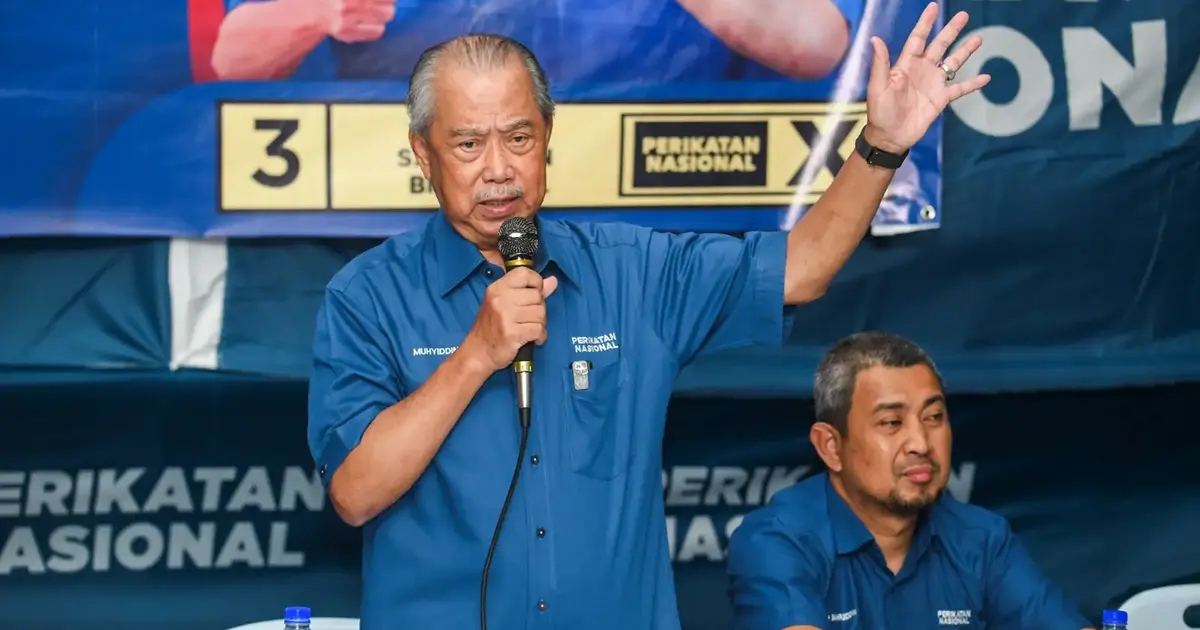
Bersatu president Muhyiddin Yassin has suggested that discussions surrounding the possible release of Najib Razak cannot be separated from the timing of the Johor state election, raising questions about the political calculations driving such decisions. Speaking on the matter, Muhyiddin emphasised a fundamental legal reality: Najib stands as a convicted individual whose sentence remains subject to review and potential clemency, but whose status within Malaysia's judicial system remains unchanged at its core.
The statement carries weight given Muhyiddin's position within Malaysia's fractious coalition politics and his own complicated history with Najib. As a senior figure within Pakatan Harapan's broader political sphere, though with independent Bersatu's particular interests, Muhyiddin's comments suggest growing scrutiny over how criminal justice decisions intersect with electoral considerations in Malaysian governance. The timing of any clemency or sentence reduction for Najib has long been a sensitive issue, with critics contending that political expediency rather than legal merit might influence such outcomes.
Najib's conviction and subsequent legal battles have dominated Malaysian political discourse since his 2020 conviction on charges related to the 1Malaysia Development Berhad (1MDB) scandal. While the former prime minister has maintained his innocence and pursued appeals through Malaysia's legal system, his case remains emblematic of post-2018 political upheaval when the Pakatan Harapan coalition first took power. The 1MDB affair, which implicated billions in misappropriated state funds, became a central campaign issue that propelled the then-opposition to electoral victory after 14 consecutive years of Barisan Nasional governance.
The invocation of the Johor election in relation to Najib's legal situation reveals the entangled nature of Malaysia's criminal justice and electoral systems. Johor has historically served as a political stronghold for the Umno-led Barisan Nasional coalition, though it has experienced competitive races in recent years. The state election's timing and its perceived connection to high-profile legal decisions raise broader concerns about whether considerations of party advantage might influence the judiciary or clemency processes that remain theoretically independent from political pressures.
Muhyiddin's framing emphasises that regardless of any future developments regarding Najib's sentence, the conviction itself represents a legal determination that cannot be erased by clemency procedures. This distinction—between a reduced sentence and an overturned conviction—carries symbolic importance for how Malaysia's legal system is perceived domestically and internationally. The 1MDB scandal attracted international attention from law enforcement agencies across multiple jurisdictions, and the conviction of a sitting prime minister was seen as a demonstration of judicial independence and accountability.
The broader context of Muhyiddin's comments involves the complex coalition mathematics that have characterised Malaysian politics since the 2022 general election. Bersatu, despite its relatively modest parliamentary representation, has wielded significant influence through its role in maintaining coalition stability. Muhyiddin's own tenure as prime minister between 2020 and 2021 was marked by similar tensions between principle and pragmatism, ultimately collapsing amid internal coalition disputes. His current positioning on Najib's situation therefore reflects both genuine policy concerns and tactical party interest.
Electoral considerations in Malaysian politics have occasionally intersected with criminal justice outcomes, though rarely acknowledged so directly by senior political figures. The Johor election, as a significant contest that could reshape state-level power dynamics, naturally attracts intense focus from major parties, particularly Umno and Barisan Nasional, which have experienced declining electoral dominance in recent state ballots. Any perception that Najib's legal circumstances might shift to coincide with campaign cycles would undermine confidence in Malaysia's institutions and reinforce narratives about politically motivated governance.
For Malaysian voters and regional observers, Muhyiddin's intervention underscores persistent uncertainties about how the country's legal, political, and executive systems interact in practice. While clemency and sentence review remain legitimate tools within any functioning democracy, the opacity surrounding decisions and the coincidental timing with electoral contests create legitimacy questions that extend beyond any single case. The 1MDB conviction represented a watershed moment for Malaysian governance, and subsequent developments remain subject to intense public scrutiny.
Looking ahead, the intersection of Najib's legal status, the Johor election schedule, and coalition political calculations will likely continue generating controversy. Muhyiddin's comments serve as a reminder that within Malaysia's current political configuration, criminal justice outcomes and electoral timing remain matters of active political contention rather than merely technical or procedural matters. Whether additional clarity emerges regarding the precise nature of any planned legal developments or election scheduling remains to be seen, though the political sensitivity surrounding both issues suggests continued public interest and debate.

