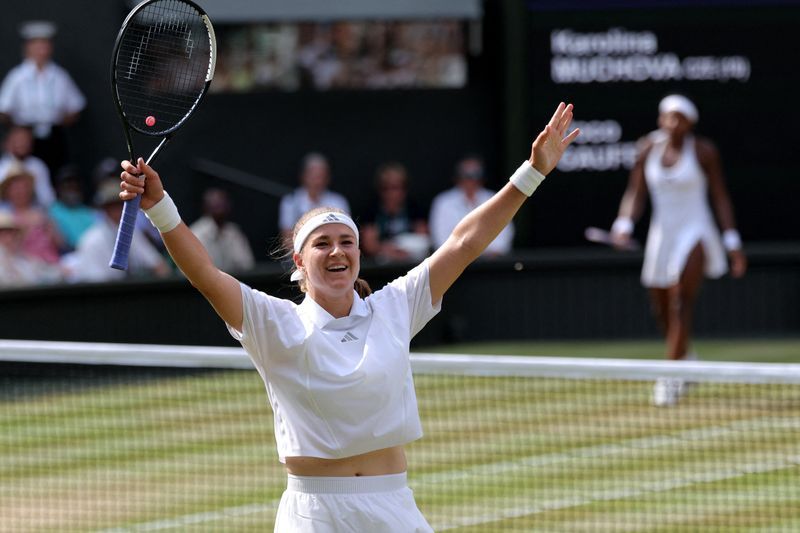
Karolina Muchova has reached a Grand Slam final for the first time after mounting an extraordinary comeback against Coco Gauff at Wimbledon, saving a match point in a dramatic semi-final encounter that extended nearly two hours and forty minutes. The Czech player prevailed 6-2 1-6 7-6 in a tiebreak thriller on Centre Court, denying the American teenager what appeared to be an inevitable breakthrough after Gauff had dominated much of their contest and held genuine opportunities to seal victory in straight sets.
Muchova's advancement sets the stage for a potentially historic all-Czech championship match. Should her compatriot Linda Noskova overcome Ukrainian rival Marta Kostyuk in Thursday's second semi-final, Saturday's final would represent the first time two players from the Czech Republic have contested a Grand Slam title. The achievement would cement a remarkable recent dominance by Czech women on tennis's grandest stages, following the Venus Rosewater Dish victories of Marketa Vondrousova in 2023 and Barbora Krejcikova in 2024, establishing a pattern of Czech excellence at Wimbledon within the span of just two years.
Perhaps the most remarkable aspect of Muchova's victory lies in the apparent incompatibility between her physical constitution and the surface on which she competes. The 28-year-old has long battled severe grass allergies that require aggressive medical intervention simply to function on the court, necessitating an extensive arsenal of pharmaceutical support including pills, sprays, and eyedrops merely to endure stepping onto the turf. Her triumph under such constraints underscores both her determination and the depth of her tactical understanding on grass, where technique often matters more than raw physical capacity.
The opening set belonged entirely to Muchova, who displayed the aggressive and varied attacking style for which she has become known on faster courts. Breaking Gauff's serve twice—first in the third game and again in the fifth—the Czech player established command with clinical efficiency. A devastating 111 mph ace punctuated her dominance and sealed the set decisively, suggesting the match might be heading toward a straightforward conclusion. The conditions on Centre Court that day were notably arduous, with the venue operating at high temperatures that tested the endurance and composure of both competitors throughout their encounter.
Gauff, however, has developed a reputation throughout this Wimbledon fortnight for thriving in moments of adversity and refusing to surrender even when circumstances appear dire. Her journey to the semi-finals had already required her to navigate four consecutive three-set matches, matches that revealed both her mental toughness and her willingness to extend contests when the alternative would be accepting defeat. She demonstrated this same resilience against Muchova by reclaiming control in the second set after a largely frustrating opening period in which she could not convert any of her first eight break point opportunities.
When Gauff finally secured the breakthrough on her ninth break point attempt, building a 3-1 lead, momentum shifted decidedly in her direction. A subsequent break for 5-1 elicited visible celebration from her mother in the player's box, and within games the American had leveled the match at one set apiece. Her renewed confidence suggested she would carry that momentum into the deciding set, and initially her superior groundstroke consistency and aggressive positioning appeared likely to prevail.
The third set evolved into a tense and closely contested battle where both competitors deployed their full technical arsenals. Extended rallies featured ferocious forehands and exquisite backhand constructions, with each player refusing to concede points without genuine effort. Gauff fashioned two genuine opportunities to break Muchova for a 5-4 lead, scenarios where she could have positioned herself within one game of victory. Yet Muchova's capacity for pressure defense and her willingness to risk spectacular shot-making proved decisive at these critical junctures.
When the set reached a deciding tiebreak, Muchova seized control through a combination of nervelessly executed strokes and occasional moments of inspired improvisational tennis. She produced an outrageous diving volley winner that momentarily shifted psychological momentum, followed by a precisely placed lob that earned her the first match point of the tiebreak. Though Gauff managed to extend the tiebreak when that initial opportunity disappeared, Muchova converted her second chance with clinical authority when her opponent misfired a forehand into the net to conclude the exhausting contest.
The victory represents a watershed moment for Muchova's career at the sport's highest level. While she has competed professionally for years, reaching a Grand Slam final demonstrates a consistency and capacity for performing under extreme pressure that had previously eluded her on the major stage. Her path to this achievement illuminates the unpredictable nature of major tennis tournaments, where accumulated fatigue, psychological factors, and momentary lapses in execution can determine outcomes as much as raw talent or ranking position.
For Gauff and her supporters, the loss will sting considerably given how closely she approached securing what would have been her first Grand Slam final appearance and the highest-profile stage of her career thus far. Yet her performance throughout the tournament and particularly her refusal to surrender even with match point against her suggests she possesses the mental and physical tools to return to this stage and convert such opportunities in future competitions. At just twenty years of age, Gauff's tennis career remains very much in its developmental phase, and the experience accumulated during runs such as this Wimbledon fortnight will prove invaluable.

