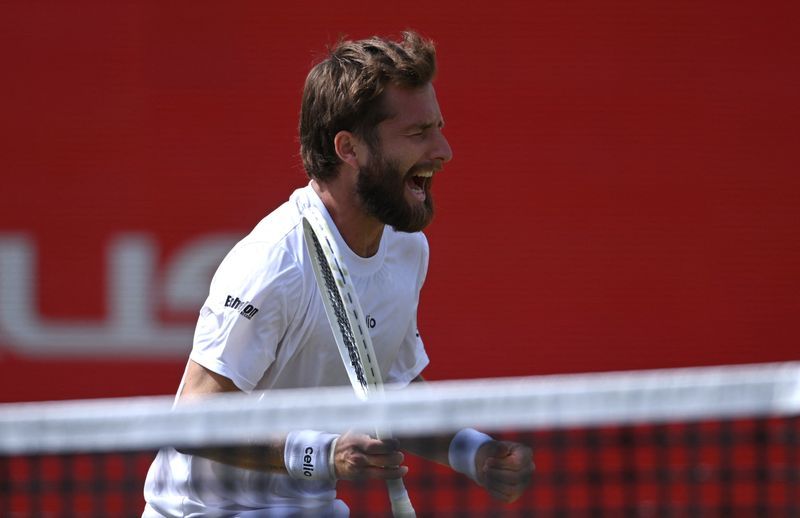
Corentin Moutet's run at the Queen's Club tournament has proven costly in more ways than one. The French tennis professional faces a significant financial penalty after the Association of Tennis Professionals imposed a $40,000 fine for unsportsmanlike conduct stemming from his on-court interview with the BBC. The penalty leaves the 27-year-old ranked player with virtually nothing from his second-round appearance at the prestigious London grass-court event, despite securing initial prize money of $43,000 for advancing past the opening round.
The incident unfolded immediately after Moutet's first-round victory over fellow Frenchman Giovanni Mpetshi Perricard, when he participated in a courtside interview with BBC broadcasters. During the exchange, the world number 36 player uttered profanities on seven separate occasions, with one particularly colourful outburst describing his reaction to being aced on match point by a 142 miles per hour second serve. Television protocols demand immediate intervention when such language is broadcast live, and the interviewer repeatedly asked Moutet to refrain from repeating the expletive.
Rather than heeding the request, Moutet continued swearing three additional times before the BBC production team terminated the interview prematurely. Formal apologies were subsequently issued to both the stadium crowd and television audiences watching across the United Kingdom. The on-court broadcast mishap generated considerable discussion among tennis commentators and administrators regarding player conduct and the evolving standards of professional decorum in the sport.
Following the incident, Moutet attempted to defuse the situation through social media, posting on Instagram that his remarks were intended purely as joking and should not be interpreted as genuine misconduct. However, the ATP's disciplinary committee evidently viewed the matter differently, determining that the behaviour violated established protocols governing professional conduct. The organisation formally classified the transgression as unsportsmanlike behaviour warranting substantial financial consequences.
Moutet's disciplinary troubles extend beyond this week's incident at Queen's Club. In 2022, the French player found himself defaulted from the Adelaide International following another swearing incident, this time directed at the umpire during a match against Serbia's Laslo Djere. That default represented one of tennis's harshest penalties, removing him entirely from competition and barring any prize money from that tournament. The recurrence of similar behavioural issues within such a relatively short timeframe suggests an ongoing pattern requiring professional intervention.
The French Tennis Federation took its own action in response to Moutet's 2022 conduct issues, formally suspending financial support and effectively cutting off federation backing during that calendar year. Such measures represent a significant loss for players, who often depend on national federation resources for training facilities, coaching support, and travel arrangements. The federation's willingness to distance itself from Moutet signalled institutional concern about his professional representation of French tennis.
Despite the financial ramifications, Moutet's Queen's Club campaign ended almost immediately, with his second-round loss to Spain's Alejandro Davidovich Fokina concluding his participation in the tournament. This quick exit meant he earned the $43,000 second-round prize only to have it almost entirely absorbed by the ATP fine, a scenario that underscores the severe financial consequences that disciplinary actions can impose on professional athletes. For context, the fine represents approximately 93 percent of his earned prize money from the event.
The timing of this incident comes at a sensitive juncture in professional tennis, where broadcasters and tournament organisers have become increasingly vigilant regarding language standards on live television. Major tournaments have invested substantially in broadcast rights, and any incident compromising the family-friendly nature of coverage represents a threat to those commercial agreements. Networks and sponsors expect a baseline standard of professionalism from competing athletes, particularly during high-profile interactions captured on camera.
Moutet has reportedly appealed the ATP's $40,000 sanction, though appeals involving on-camera conduct typically face an uphill battle given the documentary evidence of the transgression. The appeal process will determine whether the fine is upheld, reduced, or dismissed entirely, though complete reversal seems unlikely given the clear nature of the broadcast violation. The appeal will also be closely watched by other players and their representatives, as it may establish precedent regarding the severity of penalties for similar infractions going forward.
For Malaysian and Southeast Asian tennis followers, this incident highlights the increasingly stringent regulatory environment governing professional tennis conduct. Regional players competing on the international circuit must navigate not only the technical demands of elite competition but also evolving standards of professional behaviour. The Queen's Club incident serves as a cautionary example of how quickly a strong tournament performance can be overshadowed by off-court or courtside conduct, with serious financial implications extending well beyond the immediate disciplinary fine.