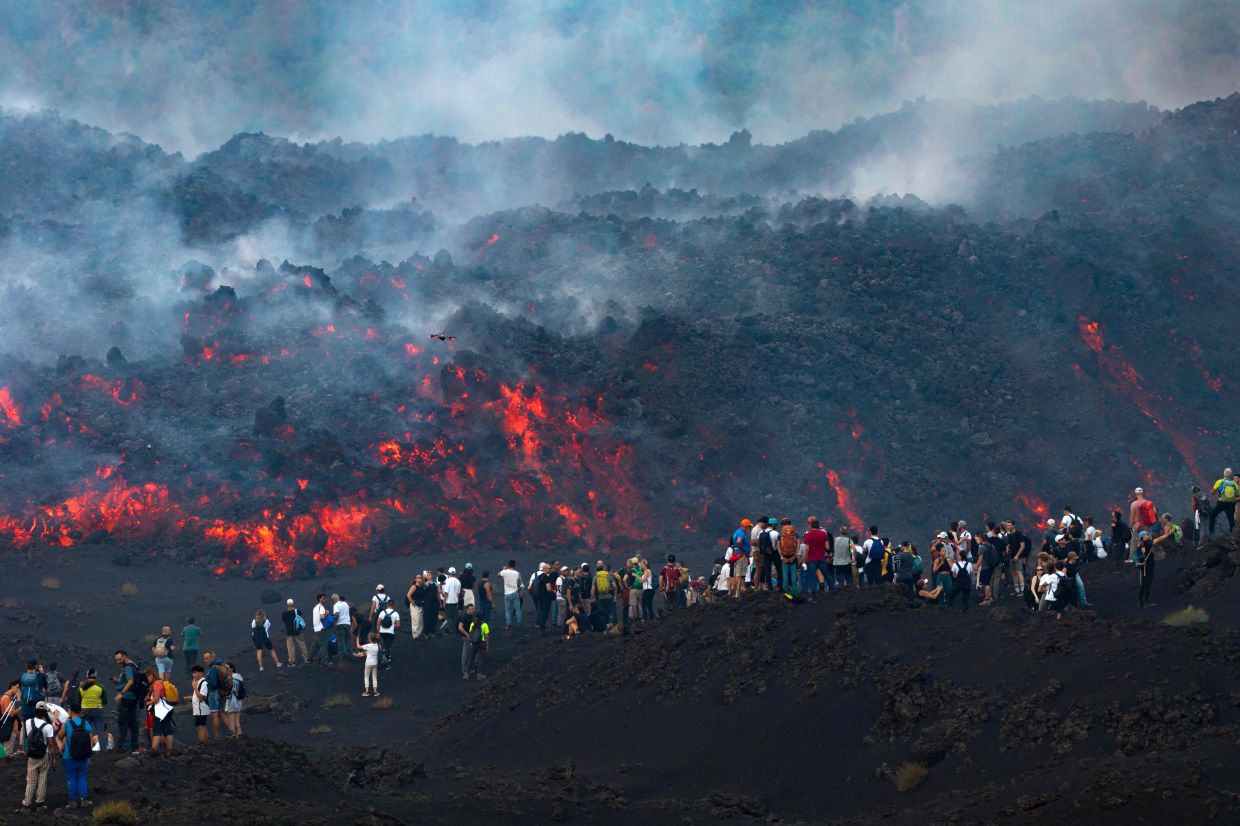
Europe's most active volcanic mountain is experiencing a period of intense activity that has captivated tourists worldwide, with images of glowing lava cascading down its slopes circulating on social media and prompting unprecedented visitor interest. Mount Etna, situated on the Italian island of Sicily, has been in continuous eruption for several days, transforming what might otherwise be routine geological activity into a major attraction drawing international attention and substantial tourist footfall.
The eruption's impact extends beyond the slopes themselves. Catania International Airport, which serves as the primary entry point for the eastern Sicilian region and one of Italy's premier tourist destinations, has experienced repeated disruptions due to ash cloud interference. Since Saturday alone, hundreds of flights have been cancelled or delayed, a significant operational challenge for an airport that processed approximately 12 million passengers during 2024. This infrastructure disruption underscores how volcanic activity, whilst attracting visitors, simultaneously creates logistical obstacles for the broader tourism ecosystem.
Guide Etna, a company specialising in escorted evening ascents that allow participants to observe the active lava flows at close range, exemplifies the surge in demand. Daniele Perricelli, the 41-year-old operation's founder, reports receiving approximately 300 daily enquiries—triple the volume typically experienced during peak summer tourism. He attributes this exceptional interest to the inherent appeal of witnessing such dramatic natural phenomena in what feels like a relatively contained and observable manner. The psychological draw of experiencing geological forces directly, combined with accessibility and the sense of relative safety offered by guided tours, creates a compelling proposition for adventure-oriented travellers.
Yet this surge presents substantial management challenges. Perricelli notes that Mount Etna's unstable terrain requires careful navigation and interpretive expertise. His guides are trained to read the mountain's conditions, anticipate hazard zones, and identify safe vantage points where cooled lava allows relatively proximate observation. However, the sheer volume of visitors—he estimates up to 2,000 climbers ascending each evening—has created overcrowding that complicates these safety protocols. Footpaths become congested, and the concentration of people in restricted zones elevates both accident risk and environmental impact.
A parallel concern involves visitors attempting independent ascents without professional guidance. Perricelli expresses particular alarm at the attire and preparedness of some unguided climbers, having observed individuals ascending in flip-flops—wholly inappropriate footwear for volcanic terrain characterised by sharp, unstable rock and unpredictable thermal conditions. This casual approach to a genuinely hazardous environment reflects a broader cultural attitude toward natural attractions, wherein the desire to acquire dramatic photographs or claim personal experience sometimes overshadows reasonable risk assessment.
Ernesto Maria Magri, a fellow guide, characterises the current phenomenon as a "touristic eruption"—an eruption that attracts substantial public interest precisely because it remains visually dramatic whilst maintaining perceived manageability. He notes that even local residents are ascending in significant numbers, sometimes without formal organisation or safety considerations. The eruption's repeated occurrence in historical records contributes to a perception of predictability that may lull visitors into underestimating actual dangers.
Social media has amplified both the attraction and controversy surrounding Mount Etna's activity. High-profile visitors, including Italian television personality Diletta Leotta, have documented their experiences through photographs taken apparently in close proximity to glowing lava flows. These images, whilst visually compelling, have generated critical commentary questioning whether such positioning represents reasonable risk-taking or irresponsible behaviour that might encourage others toward unsafe practices.
Under existing regulations, visitors may independently access elevations up to approximately 2,400 metres, whilst ascending to higher altitudes requires professional guide accompaniment. This regulatory framework creates zones of permitted autonomous exploration balanced against zones demanding expert supervision. Tour operators assert that safe observation of volcanic flows is achievable from lower-altitude areas where lava has cooled sufficiently to permit relatively close approach—potentially within metres of geological features that remain actively unstable.
Italy's civil protection authorities have assigned Mount Etna a yellow alert status, the second-highest classification on a four-tiered severity scale. This designation reflects expectations of frequent eruptions and potential explosions, justifying the airport closures and suggesting volcanic activity may persist. The alert system serves as an official acknowledgment of elevated geological risk, though such designations sometimes struggle to meaningfully modify visitor behaviour, particularly among tourists prioritising experiential acquisition over hazard avoidance.
For Malaysia and Southeast Asia, Mount Etna's eruption offers instructive parallels regarding volcanic tourism management. The region encompasses numerous active volcanic sites, including Mount Agung in Bali and Mount Merapi in Indonesia, which similarly attract adventure tourists despite genuine hazards. The governance challenges evident at Mount Etna—balancing economic benefits against safety obligations, managing unguided visitor access, contending with inadequate preparedness among participants—directly mirror issues confronting Southeast Asian destinations.
The Catania airport disruptions further illustrate how geological events disrupt regional tourism infrastructure and broader travel networks. For Southeast Asian tourism operators and policymakers, the Mount Etna situation underscores the necessity of contingency planning when natural attractions create both economic opportunity and infrastructure vulnerability. The convergence of unprecedented visitor demand with infrastructural strain and safety management difficulties presents a complex operational scenario with immediate commercial implications and longer-term governance considerations.

