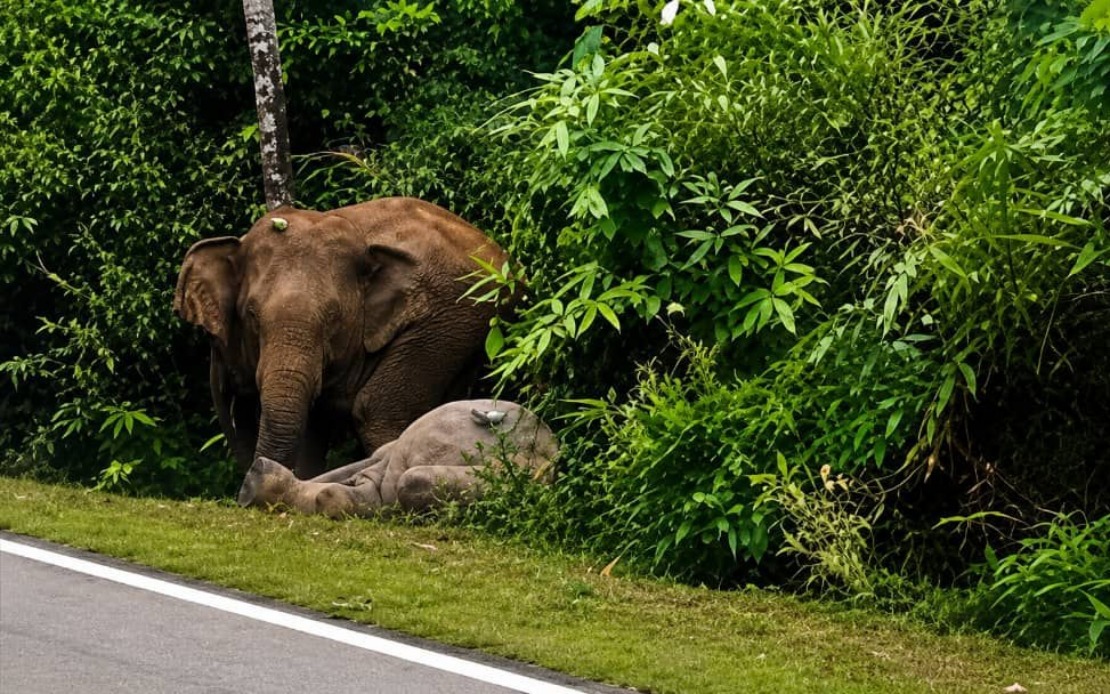
A distressing scene unfolded along Jalan Felda Nitar in Mersing this morning when a young elephant was fatally struck by a Perodua Bezza, with its mother steadfastly remaining at the site for seven hours afterwards. The incident, captured in viral social media footage, evoked painful memories of the Gerik tragedy that captivated the nation on Mother's Day the previous year, reigniting concerns about the escalating human-wildlife clashes across Malaysian territory.
The collision occurred at approximately 2.28 am, with the Johor Department of Wildlife and National Parks receiving notification roughly six hours later. Four personnel were dispatched to investigate what would become a harrowing display of maternal instinct and loss. Upon their arrival, officers confirmed that a female elephant calf, approximately five years old and measuring roughly 150 centimetres in body length, had succumbed to injuries sustained in the vehicle impact. The calf, identified through her distinctive physical characteristics including her front footprint width of 11 inches and rear footprint width of 14 centimetres, showed no tusks.
The bereaved mother, presumed to be the calf's dam, remained steadfastly at the scene throughout the extended morning hours, unwilling to depart from her offspring's lifeless form. This behaviour underscores the profound emotional bonds that exist within elephant family units, a phenomenon that has become increasingly visible to the Malaysian public through incidents such as this. Wildlife officials determined that both elephants belonged to the Jamaluang-Mersing identification group, part of the broader elephant populations that traverse the peninsula's forested regions and increasingly encounter human infrastructure.
Beyond the loss of the young elephant, the incident claimed another victim in the form of human suffering. A 31-year-old driver operating the vehicle was trapped in his vehicle after the collision sent his car plunging into a five-metre-deep ravine. Emergency responders from the Fire and Rescue Department extricated him from the wreckage, though he sustained significant leg injuries during the ordeal. The incident thus exemplifies the mutual vulnerability of both species when their territories intersect without adequate safeguards.
Response from wildlife authorities involved specialized personnel from the Johor Elephant Sanctuary's Capture Unit, who worked methodically to guide the grieving mother elephant back towards the forest. Once they had successfully encouraged her to depart, wildlife staff buried the young elephant's remains in close proximity to the accident site. This approach balances practical considerations with respect for the animals and their environmental context.
The aftermath extended well beyond the immediate rescue operation. Johor Perhilitan announced intentions to conduct intensive patrols throughout the following night and subsequent day to monitor the mother elephant's condition and forestall any potential return to the dangerous roadway. Such follow-up surveillance reflects accumulated knowledge from past incidents, where grieving elephants have sometimes ventured back to accident locations, placing themselves in further peril from traffic.
The tragedy gains particular resonance when contextualised against the Gerik incident of May 11 the preceding year, which similarly involved a young elephant fatally struck by heavy commercial traffic. In that instance, a container lorry proved the lethal vehicle, and footage distributed across social networks showed an adult elephant attempting to manipulate the overturned truck, apparently endeavouring to extract her trapped offspring. That incident garnered substantial public attention and substantially elevated national awareness regarding human-elephant conflict dynamics.
Warning signage had been positioned along the Mersing section to alert drivers to potential elephant crossings in the area, though the darkness and road conditions at 2.28 am likely limited visibility and reaction time. Wildlife authorities reiterated public advisories cautioning motorists traversing this region to maintain heightened vigilance, particularly during nocturnal hours when elephant movement increases and visibility diminishes. The location's designation as an elephant crossing corridor indicates known patterns of animal migration through this zone.
These recurring incidents illuminate the precarious equilibrium between territorial expansion, infrastructure development, and wildlife preservation in peninsular Malaysia. As human settlements and transportation networks progressively encroach upon elephant corridors, collisions have become depressingly routine. Unlike the singular drama of the Gerik case, which achieved exceptional media penetration, similar tragedies occur with troubling regularity across Malaysian jurisdictions, often without equivalent public acknowledgment.
The elephant's seven-hour vigil beside her dead calf resonates deeply within Malaysian consciousness precisely because it transcends the clinical language of wildlife management. It embodies the raw reality of ecological conflict, where modern economies and surviving megafauna navigate incompatible spatial requirements. The Johor incident demonstrates that solutions requiring genuine commitment—wildlife corridor protection, infrastructure redesign, driver education, and enforcement mechanisms—remain inadequately implemented despite accumulated tragedy.
For Malaysia's wildlife conservation community, these events underscore the urgency of implementing more comprehensive preventative frameworks. Current responses remain largely reactive, addressing incidents after they occur rather than substantially reducing their frequency through landscape planning and road engineering modifications. The mother elephant's refusal to abandon her dead calf serves as a poignant reminder of what Malaysians continue to sacrifice in the pursuit of development and convenience.

