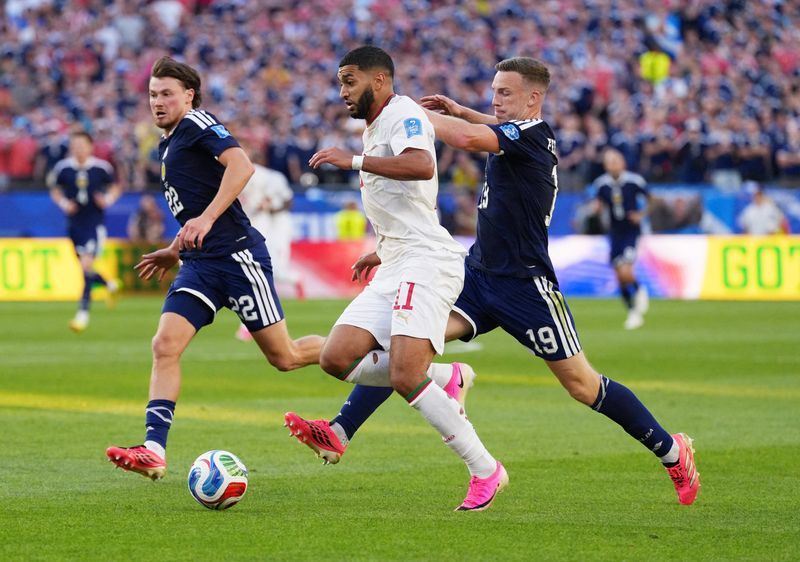
Morocco asserted their credentials as a serious tournament contender by dismantling Scotland with a commanding 1-0 victory at Foxborough, Massachusetts, on Friday. The decisive moment came with remarkable speed—Ismael Saibari struck after just 71 seconds, delivering what would become the fastest goal of this World Cup. That early breakthrough set the tone for a one-sided affair that saw the North Africans methodically break down their opponents and establish themselves as the group's frontrunners with one round of matches still to play.
The Moroccan side, who reached the semi-finals in Qatar four years ago, demonstrated why they merit consideration among the tournament's elite by displaying superior technical ability, tactical discipline, and physical intensity. From the opening whistle, they pressed aggressively, controlled possession, and created space with incisive passing movements that Scotland struggled to counter. The Scottish defence proved particularly vulnerable to Morocco's fluid attacking play, with central defender Grant Hanley's premature positioning allowing Brahim Diaz to deliver a cross that Saibari finished with clinical precision. For supporters accustomed to seeing Scottish football at international level, the disparity in quality on display must have made for uncomfortable viewing.
Saibari's early strike represented more than just an important goal; it underscored his emergence as a player of genuine significance at the world stage. The midfielder, who had previously scored in Morocco's opening draw against Brazil, became only the second African player ever to find the net in each of his first two World Cup appearances, joining Egypt's Mohamed Salah in that exclusive club. His impressive performances have apparently attracted the attention of Bayern Munich, with reports suggesting he has already passed a medical to join the German champions, a move that would represent a significant step up in his career trajectory.
Scotland, who had arrived at this match with considerable optimism following their maiden World Cup victory in 36 years against Haiti, found themselves completely outmatched by a Moroccan side bent on demonstrating their superiority. The Scottish attack never troubled Morocco's defence with any real conviction, failing to register a single shot on target until late in the first half, a damning statistic that illustrated their inability to create meaningful opportunities. Instead, they were forced into a reactive stance throughout, constantly chasing the game while Morocco dictated tempo and direction with consummate ease.
Morocco's dominance extended well beyond the opening goal. In the second half, Saibari came close to a second strike when his deflected effort struck the post, while Bilal El Khannouss tested goalkeeper Angus Gunn with a glancing header shortly after the restart. The Moroccan attacks flowed with such regularity that Scotland appeared perpetually on the backfoot, unable to string together sustained periods of possession or constructive play. One particularly telling moment saw Azzedine Ounahi surge down the left flank before cutting the ball back to waiting teammates, only for both players to narrowly fail to convert what should have been straightforward chances—a reminder that even dominant performances can see clear opportunities go begging.
The presence of Morocco's captain Achraf Hakimi provoked considerable controversy, with the player subjected to booing from Scottish supporters. Hakimi currently faces a rape trial, an issue that has generated significant debate about athlete conduct and accountability in international football. Despite the hostile reception, he remained focused on his team's objectives, contributing to Morocco's commanding display without being drawn into emotional responses that might have disrupted their performance.
Ounahi had already made headlines before kick-off by suggesting that Morocco aimed to reach the final, a statement that might have seemed audacious at the time. However, the manner in which his team dominated Scotland provided considerable credibility to that ambition. The performance showcased a squad with genuine tactical intelligence, technical quality, and the mental toughness required to sustain pressure and impose their game plan on established opponents. For Malaysian and Southeast Asian observers, the match provided a valuable demonstration of how well-organised African football has become on the world stage.
The victory repositioned Morocco at the summit of Group C with four points from two matches, a commanding position that puts them firmly on track for qualification. Their next assignment sees them face Haiti on Wednesday, a match that should present a considerably less stern examination than the challenge posed by Scotland. Scotland, meanwhile, must regroup from this disappointment and prepare for a daunting final group-stage encounter against five-time champions Brazil, a fixture that will likely determine whether they advance or exit the tournament. Haiti and Brazil's Friday evening meeting would also influence the complex mathematics of qualification possibilities.
For strategic observers analysing World Cup dynamics, Morocco's comprehensive performance raises important questions about which teams possess the depth and consistency to maintain excellence through multiple matches. The semi-finalists from four years ago appear to have evolved further rather than retreated, suggesting they could prove uncomfortable opponents for any of the tournament's traditional powerhouses. Scotland's difficulty in mounting any sustained challenge indicates that the gap between elite and upper-tier nations remains substantial, a lesson that will resonate through the remainder of the competition as teams discover whether they possess the calibre to succeed at this demanding level.

