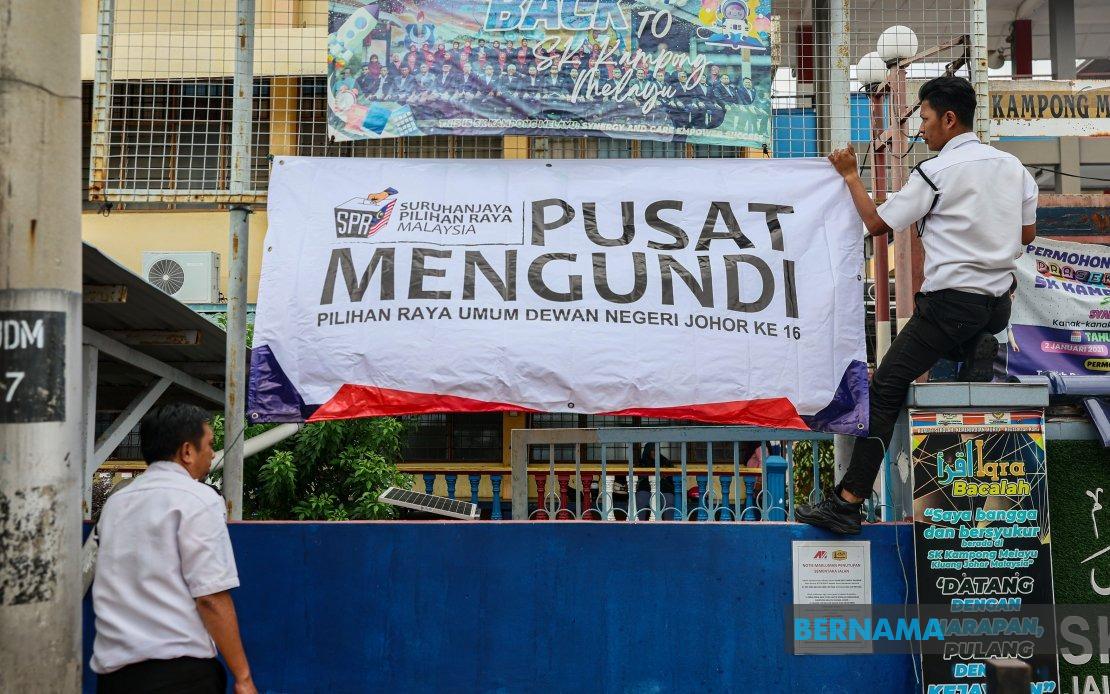
The southern state of Johor entered a critical political juncture as voting commenced in its 16th state election, with more than 2.7 million eligible citizens exercising their democratic franchise to determine the composition of the State Legislative Assembly. The exercise represented a significant democratic moment for Malaysia's second-largest state, with implications extending beyond Johor's borders given its strategic importance to the broader political landscape of the nation.
Election preparations reflected the scale of the undertaking, with the Election Commission establishing 1,076 polling centres equipped with 4,889 separate voting streams to accommodate the massive electorate. These facilities opened uniformly at 8 am across the state, allowing voters to proceed simultaneously from peninsula to island locations. The staggered closure schedule, beginning as early as 11 am at remote polling stations on Pulau Besar and extending to 6 pm for mainland centres, was designed to accommodate geographical variations while maintaining ballot security. The commission deployed 43,036 election workers to manage operations, underscoring the logistical complexity of running a democratic exercise across such a large territory.
The polling exercise concluded a fortnight-long campaign period that formally ended at midnight the previous day. During this window, political parties mounted competing campaigns to secure voter support across the state's diverse constituencies, each seeking to articulate their vision for Johor's governance and development. The campaign intensity reflected the competitive nature of contemporary Malaysian politics, with multiple coalitions and independent contenders vying for voter attention.
Participation patterns offered insights into voter engagement levels. Early voting had already captured 20,607 ballots cast by military personnel, police officers, and their spouses on the preceding Tuesday, indicating significant mobilisation among sectors traditionally offering early voting facilities. The Election Commission targeted overall voter turnout of approximately 70 per cent, a noticeable improvement target over the 2022 state election, when participation stood at 54.92 per cent. This aspiration reflected broader efforts to enhance democratic engagement and ensure electoral results reflected broader populace preferences rather than minority participation decisions.
The candidate field demonstrated substantial political competition, with 172 individuals contesting for the 56 available seats. Pakatan Harapan and Barisan Nasional fielded the maximum allowable candidates, each presenting 56 nominees, effectively positioning themselves as the primary contenders for state control. Perikatan Nasional mounted a significant campaign with 33 candidates, while Parti Bersama Malaysia, a relatively newer political entity, presented 15 contenders. Smaller parties and independent candidates rounded out the field, with MUDA offering four candidates, Parti Orang Asli Malaysia one, Parti Sosialis Malaysia one, and six independent candidates seeking mandate without party affiliation. This configuration demonstrated the increasingly fragmented nature of Malaysian electoral politics, with voters facing expanded choice sets compared to earlier periods.
The preceding legislative term had witnessed shifting political fortunes. Before dissolution on June 1, the previous assembly had been dominated by Barisan Nasional, which held 40 of 56 seats, demonstrating substantial control. Pakatan Harapan occupied 12 seats, Perikatan Nasional held three, and MUDA possessed one. These numbers suggested a fractured opposition and dominant ruling coalition, though the election campaign outcome remained uncertain until actual balloting concluded.
Weather considerations played practical roles in voting execution. The Malaysian Meteorological Department forecast morning rainfall in several constituencies including Johor Bahru, Batu Pahat, Kulai, Muar, Pontian and Tangkak, with afternoon improvements anticipated. Afternoon and evening thunderstorms were predicted for Kluang, Kota Tinggi, Segamat and Mersing. These weather patterns necessitated logistical adjustments to ensure polling station accessibility and voter convenience throughout the day, demonstrating the environmental variables affecting democratic exercises in tropical climates.
Postal ballot management represented an important administrative dimension often overlooked in election coverage. A total of 24,677 postal ballots had been issued to eligible voters unable to participate at physical polling centres, with all such ballots required to arrive at designated collection points by 6 pm. This mechanism extended franchise accessibility to those working beyond state boundaries or facing mobility constraints, ensuring inclusive democratic participation. The vote-counting process was scheduled to commence following polling station closures, with results anticipated by 10 pm, allowing relatively swift determination of electoral outcomes while maintaining ballot security protocols.
Employer cooperation formed an essential prerequisite for successful voting participation, particularly given Malaysia's commercial and industrial activity concentration in Johor. Labour authorities had reminded business operators to grant workers reasonable time away from employment responsibilities to fulfil voting obligations. This coordination between state apparatus and private sector actors reflected recognition that democratic participation requires structural accommodation across institutional domains.
Johor's election held broader significance for Malaysian federalism and political dynamics. As the nation's second-largest state by population and a traditional electoral battleground, outcomes would signal shifting voter preferences and potentially influence national political calculations. The state's economic importance to regional stability and development meant that election outcomes carried implications extending beyond parochial state interests to encompass national economic performance and interstate relations. Political analysts would scrutinise results carefully to discern emerging electoral patterns, coalition viability, and shifting demographic voting behaviours that might foreshadow future national-level political shifts.
The election also tested institutional capacity under contemporary pressures. Election commission operations demonstrated the technical sophistication required to administer democratic exercises across geographically challenging terrain while maintaining security, transparency, and fairness standards. The deployment of advanced polling infrastructure, substantial personnel resources, and coordinated logistics reflected decades of institutional development in Malaysian electoral administration. Voter experience at the ballot would likely determine public confidence in democratic institutions, particularly given heightened scrutiny of electoral processes across Southeast Asia.
As voting progressed throughout the day, attention focussed on whether the Election Commission would achieve its 70 per cent turnout target and how quickly accurate results could be tabulated and announced. The Johor state election represented a moment when abstract constitutional principles became concrete reality through millions of individual voting decisions, each contributing to the collective determination of political governance and policy direction for Malaysia's important southern state over the coming legislative term.

