The Bharatiya Janata Party, anchored by Prime Minister Narendra Modi, has launched a pointed attack on the Cockroach Janta Party, questioning why the activist organisation that spearheaded disruptive student demonstrations in the national capital last month has largely absented itself from parallel agitations now convulsing Jharkhand in India's eastern hinterland. The accusation, levelled by BJP spokesperson Keya Ghosh on Tuesday, strikes at what the ruling party sees as a fundamental contradiction in the pressure group's stated commitment to educational and employment fairness.
According to Ghosh, the Cockroach Janta Party has functioned as a "mute spectator" to the Jharkhand unrest despite the ideological similarities between the two protest movements. The implication is deliberate and cutting: that the organisation's earlier mobilisation efforts in New Delhi were less about genuine reform and more about unseating the Modi administration. By this logic, once their primary objective—the resignation of Education Minister Dharmendra Pradhan—was achieved, the group lost its appetite for sustained activism. Ghosh directly challenged Cockroach Janta Party founder Abhijeet Dipke to demonstrate commitment to the cause by visiting Jharkhand and standing alongside those students.
The Cockroach Janta Party emerged as a satirical movement before evolving into a substantive pressure group capable of marshalling thousands to New Delhi's Jantar Mantar protest ground. Their August agitation targeted alleged irregularities in national examination administration, grievances that resonated deeply with aspirants across India's competitive academic and employment landscape. The movement's success in precipitating Pradhan's resignation represented a rare instance of grassroots activism directly impacting ministerial accountability in Modi's tenure. Yet the group's decision to suspend protests immediately after achieving this goal provided ammunition for critics who questioned whether the movement possessed a coherent political agenda beyond the singular objective of government embarrassment.
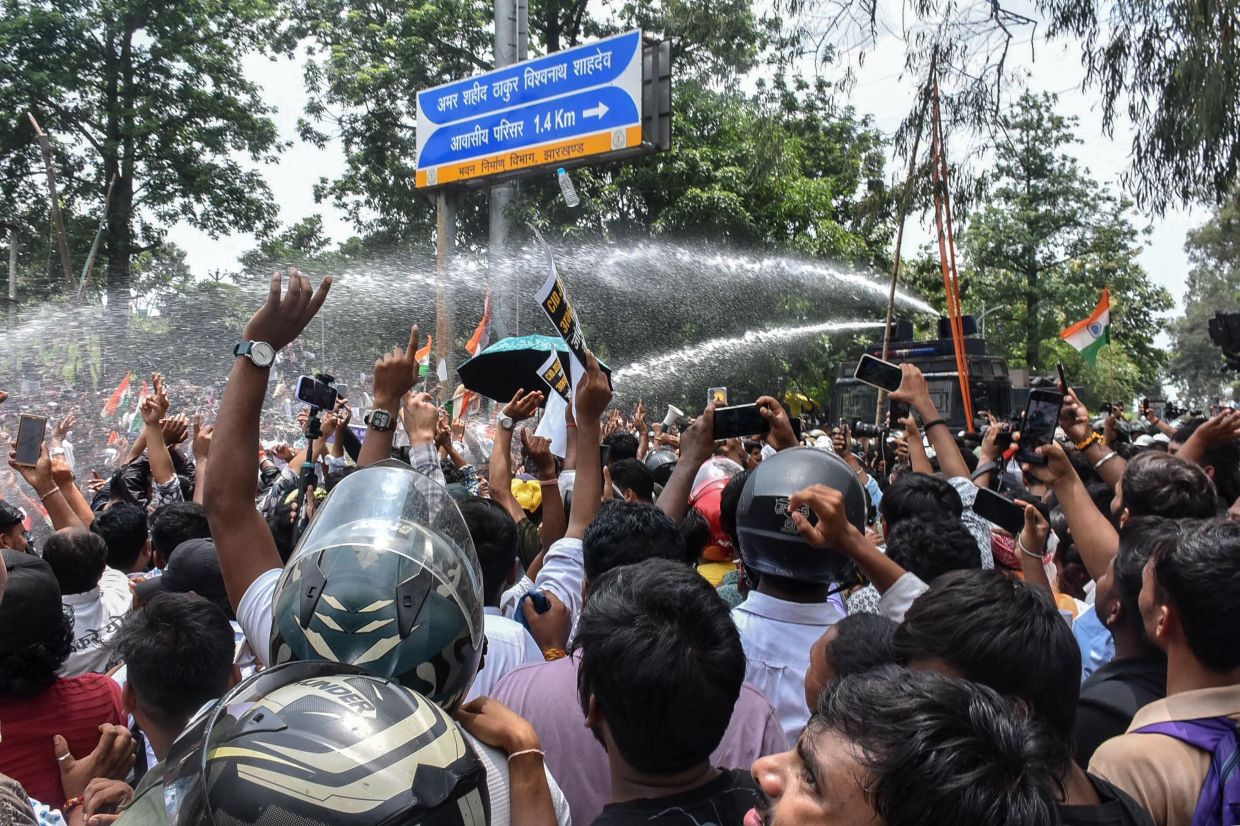
Jharkhand's situation presents a strikingly analogous scenario. Students and job seekers in this mineral-rich eastern state have taken to the streets demanding a federal investigation into suspected malpractice within the state civil service examination system. The protests carry genuine undertones of youth frustration with employment prospects and institutional credibility—concerns that should logically command the Cockroach Janta Party's sustained attention if its commitment to educational reform is principled rather than opportunistic. Yet the movement has remained largely localised, driven organically by Jharkhand's own student bodies and job aspirants rather than amplified by the national organisation.
That said, the Cockroach Janta Party's actual position is more nuanced than the BJP's framing suggests. The organisation has publicly endorsed the substantive demands emerging from Jharkhand, and founder Dipke has vocally condemned police deployment of water cannons and baton charges against demonstrators—actions he characterised as "cruel and inhuman" through a post on social media. Several activists who participated in the New Delhi movement have travelled to Jharkhand to contribute their organising experience and solidarity, according to local reporting. Akshay Shinde, identified as the national coordinator, stated categorically that movement members intend to persist at protest sites until all student demands are addressed. This suggests at minimum a measured involvement rather than the complete abandonment that the BJP narrative implies.
The BJP's aggressive posturing reflects deeper frustrations rooted in Jharkhand's political composition. The state operates under a coalition government led by the Jharkhand Mukti Morcha, which includes the Indian National Congress as a coalition partner. The BJP itself occupies the principal opposition benches in the state assembly, a position that historically provides far less leverage over policy implementation or administrative accountability than direct governmental authority. In this context, the Jharkhand protests present a political liability for the ruling coalition while simultaneously offering the opposition limited direct mechanisms through which to extract concessions. The BJP's attacks on the Cockroach Janta Party partly constitute a proxy assault on the Congress, attempting to highlight what the ruling party perceives as selective indignation from opposition quarters.
Keya Ghosh's pointed interrogation on Bloomberg Television—demanding to know why Congress leader Rahul Gandhi had not visited Jharkhand protest sites—epitomises this strategy. Gandhi, who leads the principal opposition party at the national level, has refrained from physically appearing at either the New Delhi or Jharkhand demonstrations, though he has issued statements condemning police force and asserting students' rights to peaceful assembly. His measured distance from active protest participation may reflect calculated political positioning; too visible an embrace of agitations against a state government where his own party holds coalition power could create awkward optics, yet complete disengagement invites accusations of partisan hypocrisy. Gandhi's assertion that "only dialogue can yield solutions" represents an attempt to stake out centrist ground, but it plainly frustrates both the BJP, seeking to expose opposition inconsistency, and activist networks demanding more forceful advocacy.
For Malaysian observers, the Jharkhand-New Delhi comparison illuminates dynamics increasingly visible across South Asia regarding the relationship between civil society pressure, party politics, and state accountability. The Cockroach Janta Party phenomenon—where a satirical initiative transforms into consequential activism capable of toppling government personnel—suggests that organised youth mobilisation remains a formidable political force in India despite decades of institutional decay and bureaucratic entrenchment. Yet the group's apparent difficulty in sustaining momentum across geographically dispersed struggles raises serious questions about the reproducibility of such movements. Without institutional infrastructure, financial resources, or established leadership hierarchies, activist networks risk becoming episodic phenomena that flare dramatically around specific catalysts before dissipating.
The BJP's accusations also reveal the calculus through which Indian ruling parties evaluate opposition movements. By framing the Cockroach Janta Party as hypocritical or politically motivated, the government attempts to delegitimise grassroots activism as merely instrumental to party political advantage rather than principled advocacy. This rhetorical strategy has proven effective in neutralising movements by introducing doubt regarding their authenticity and independence. Whether the characterisation proves persuasive depends substantially on whether the Cockroach Janta Party can demonstrate sustained, principled engagement with educational reform issues across multiple contexts, or whether its activism will be remembered as a momentary rupture in the Modi administration's otherwise assured political dominance.

