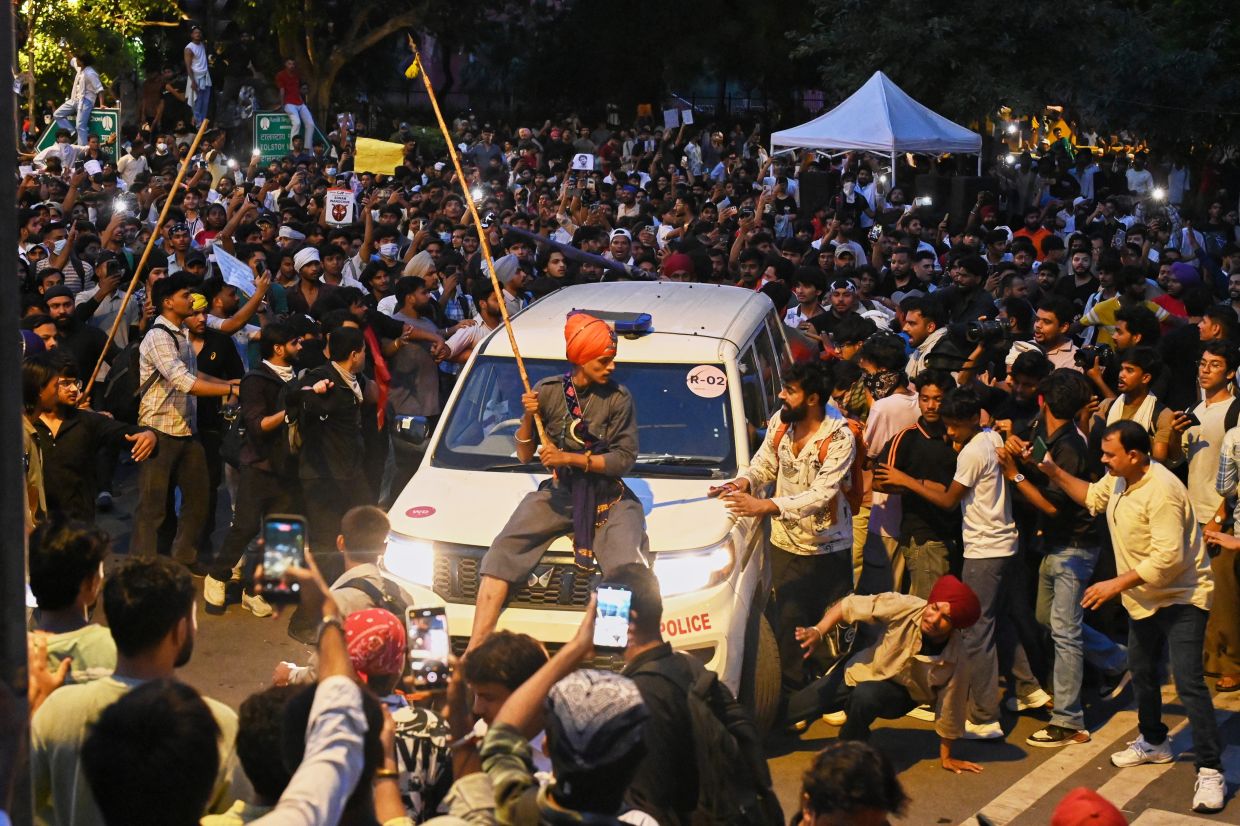
Prime Minister Narendra Modi has moved to contain escalating public anger over examination irregularities, pledging on Thursday to impose "stringent punishment" on those implicated in question paper leaks and related fraud. The assurance marks his first substantive engagement with the grievances driving the largest street demonstrations against his government since his re-election to a third consecutive term in 2024. Speaking through social media, Modi emphasised that "nothing is more important than the welfare and future of our youth," while announcing plans to establish fast-track courts dedicated to prosecuting those responsible for undermining the integrity of India's examination system.
The protests, which have drawn considerable momentum from the Cockroach Janta Party (CJP), a social media-driven movement that mobilised thousands on Wednesday in New Delhi, represent a significant political challenge for the Modi administration. The CJP emerged initially in May as a satirical response to remarks attributed to Chief Justice Surya Kant, who reportedly described young people as "cockroaches" and "parasites" during court proceedings. What began as a pointed criticism of judicial insensitivity has evolved into a broader youth movement encompassing concerns about joblessness, limited opportunities, and what supporters characterise as increasingly authoritarian governance under Modi.
Violent confrontations between demonstrators and security forces have raised the stakes considerably. Police deployed tear gas and conducted baton charges on Monday as tens of thousands attempted to march toward parliament on the opening day of the monsoon session, triggering a counteroffensive in which protesters hurled stones and other projectiles. The clashes escalated further on Wednesday evening outside Jantar Mantar, a traditional protest site in the capital, where late-night confrontations left at least 178 people wounded, including police and security personnel. Internet services were suspended in parts of Delhi during the crackdown, and CJP spokesman Ashutosh Ranka alleged that police action was disproportionately harsh, describing demonstrators as having been "brutally" beaten. Delhi Police countered by claiming that protesters had assaulted officers with stones and plastic bottles, inflicting serious injuries.
The examination system failures that sparked the uprising have accumulated over months, eroding public confidence in India's educational institutions and testing mechanisms. A particularly damaging incident involved the leak of a medical entrance examination question paper, forcing over two million candidates to retake the test at considerable cost and disruption. Compounding this crisis, irregularities in the online marking of examinations administered to nearly two million secondary school students have further inflamed grievances. These successive failures have created a perception that institutional safeguards have collapsed, affecting millions of young Indians whose futures depend on fair and transparent assessment.
Opposition political parties have seized upon the tumult to intensify pressure on Modi's government, using parliamentary procedures to disrupt proceedings and demanding an official apology for Monday's police response. Rahul Gandhi of the Congress Party explicitly blamed Modi for presiding over the "total capture and destruction" of India's education system, accusing him of protecting those responsible for systemic failures. The opposition's alignment with student concerns, while partly opportunistic, reflects genuine anxiety across India's political spectrum about the legitimacy of institutions and the government's handling of youth grievances.
The unrest has transcended Delhi's boundaries, with demonstrations erupting in major metropolitan centres including Mumbai, Bengaluru, and Patna on Wednesday. This geographic diffusion suggests that underlying discontent resonates widely among India's young population, extending beyond the capital's student corridors. The breadth of participation and the mobilisation capacity demonstrated by the CJP through social media platforms indicate that traditional constraints on political organising have weakened, enabling rapid coordination among geographically dispersed groups.
International dimensions add further complexity to the crisis. In neighbouring Bangladesh, student activists called for a "torch rally" on Thursday evening to express solidarity with Delhi protesters, drawing explicit parallels to the youth-led movements that toppled Sheikh Hasina's government in 2024. This cross-border expression of sympathy highlights how student movements in South Asia increasingly operate within transnational networks, drawing inspiration and strategic lessons from one another. For Indian policymakers, the Bangladesh precedent carries cautionary weight, demonstrating that student agitation, once mobilised, can precipitate dramatic political upheaval.
Modi's public commitment to establishing fast-track courts and pursuing prosecutions represents a tactical acknowledgment that the government cannot simply suppress the movement through security force deployment. The rhetorical shift toward addressing substantive grievances, however, may prove insufficient if systemic problems in India's examination infrastructure remain unresolved. The promise of punishment focuses on individual wrongdoing rather than addressing institutional weaknesses, structural inequities, or the larger questions of educational quality and equity that animate youth discontent.
The movement's growth also reflects deeper anxieties among India's young population about employment prospects, social mobility, and political voice. Unemployment and underemployment have persistently troubled India's post-pandemic economy, leaving millions of educated young people frustrated about prospects despite considerable educational investments. When combined with concerns about examination integrity, these economic anxieties create a volatile mix that transcends conventional party politics and mobilises youth across regional and linguistic boundaries.
For Malaysia and other Southeast Asian nations, the Indian protests offer instructive lessons about youth political engagement in the digital age. The capacity of social media movements to achieve rapid mobilisation, bypass traditional institutional channels, and sustain momentum despite official pressure presents both opportunities and challenges for regional stability. The CJP model demonstrates how satirical or cultural critiques can catalyse broader political consciousness among younger populations less invested in conventional political parties or ideologies.

