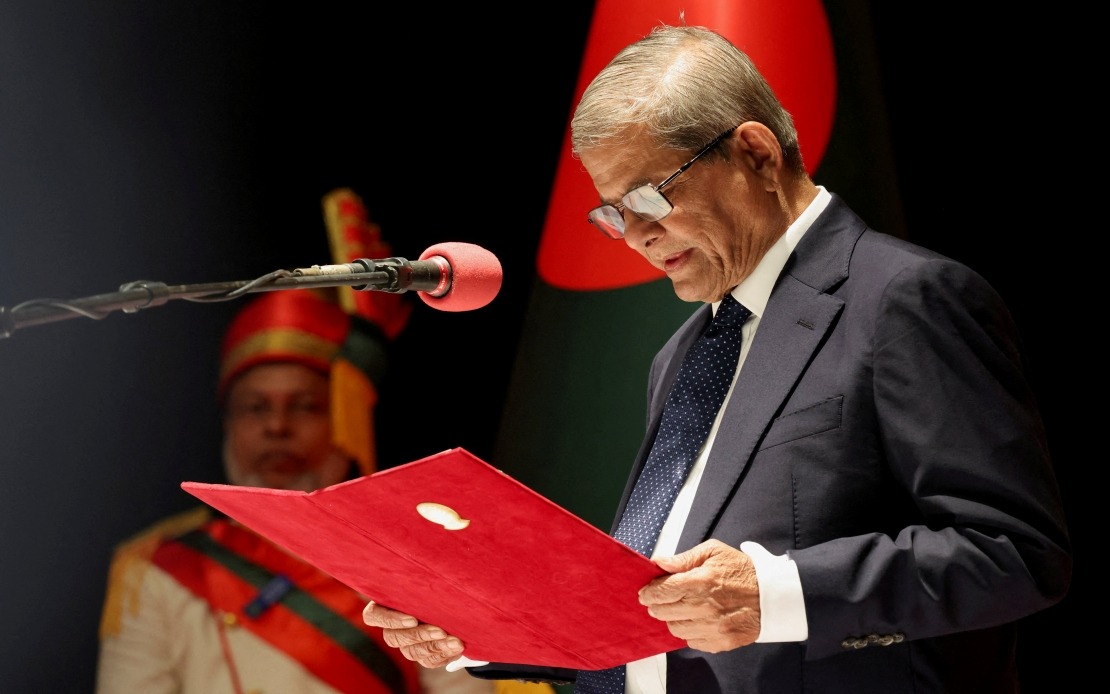
Mirza Fakhrul Islam Alamgir formally assumed the presidency of Bangladesh on Friday evening, marking a significant transition in the nation's political leadership. The inauguration took place at the Darbar Hall within Bangabhaban, the official residence and workplace of the Bangladeshi head of state, with the ceremony commencing at 7.30 pm local time. Acting Speaker Barrister Kayser Kamal administered the constitutional oath, overseeing a formal proceeding that included all major state dignitaries and representatives from Bangladesh's political establishment.
The ceremony itself represented far more than a routine transfer of power. When Fakhrul arrived at Bangabhaban, protocol officials extended a formal welcome before he was received by Acting President Hafiz Uddin Ahmad Bir Bikram, whose interim tenure had concluded with this transition. The presence of Prime Minister Tarique Rahman, the nation's chief justice, members of the Cabinet, accredited foreign diplomats, members of parliament, and senior officials from both civilian and military branches underscored the constitutional importance attached to this moment in Bangladesh's political timeline.
The symbolic dimensions of the ceremony held particular significance. Following the administration of the oath, the incoming and outgoing presidents exchanged their seating positions, a ritual gesture that visually represented the formal handover of executive authority. Fakhrul subsequently signed both the oath of office and the oath of secrecy before the proceedings concluded with the playing of Bangladesh's national anthem, a standard protocol that marks the completion of presidential inaugurations.
Fakhrul's election to this position came through a parliamentary vote conducted in accordance with Bangladesh's constitutional framework. He represents one of the nation's most experienced political figures, having held senior positions within the Bangladesh Nationalist Party (BNP), one of the country's two dominant political organisations. His tenure as secretary-general of the BNP established him as a key institutional figure within the party's leadership structure, demonstrating both longevity and organisational influence within Bangladesh's political system.
The appointment carries implications for Bangladesh's broader political trajectory, particularly regarding the balance between parliamentary and presidential authority. As Bangladesh's system vests substantial executive powers in the prime minister while reserving important ceremonial and constitutional functions for the president, Fakhrul's background as a party stalwart suggests continuity in the relationship between the executive government under Tarique Rahman and the presidential office. His elevation reflects the BNP's consolidated position within the current political arrangement.
For Malaysia and other Southeast Asian observers, Bangladesh's presidential transition illustrates the region's ongoing constitutional evolution. While Malaysia's own parliamentary system differs in its distribution of presidential or monarchical authority, neighbouring nations frequently study each other's governance mechanisms and democratic procedures. Bangladesh's institutional practices, particularly the manner in which it conducts high-level transfers of power, contribute to broader regional discussions about constitutional propriety and democratic legitimacy in South and Southeast Asia.
Mirza Fakhrul's path to the presidency reflects Bangladesh's political party structures, where senior roles frequently serve as stepping stones toward state positions. His career trajectory—from party secretary-general to the nation's ceremonial and constitutional head of state—demonstrates how Bangladesh integrates party leadership with formal governmental authority. This intertwining of partisan and constitutional functions characterises much of South Asian governance, distinguishing it from some Western models that emphasise greater separation between party affiliation and executive role.
The timing of this transition occurs within a broader context of Bangladesh's contemporary political development. The nation has experienced significant institutional challenges and constitutional discussions in recent years, making the orderly conduct of such ceremonies particularly noteworthy. The peaceful transfer of the presidency, witnessed by the country's most senior officials and international representatives, reinforces the functioning of Bangladesh's constitutional mechanisms despite previous periods of considerable political turbulence.
Looking forward, Fakhrul's tenure as president will likely be characterised by his role as chief custodian of constitutional authority and as a representative of national unity, roles that traditionally transcend day-to-day partisan considerations despite the president's party affiliations. The president's constitutional responsibilities include signing legislation, receiving foreign diplomats, and serving as supreme commander of the armed forces in a ceremonial capacity, functions that require engagement across political divides and maintenance of institutional traditions.
The formal nature of Friday's ceremony, with its meticulous attention to constitutional protocol and its attendance by representatives from all branches of government, demonstrates Bangladesh's commitment to orderly constitutional succession. For a nation that has experienced multiple constitutional crises and periods of extraconstitutional governance in its relatively brief history since independence in 1971, the smooth functioning of such procedures represents an important affirmation of institutional resilience and democratic continuity within South Asia's complex political landscape.

