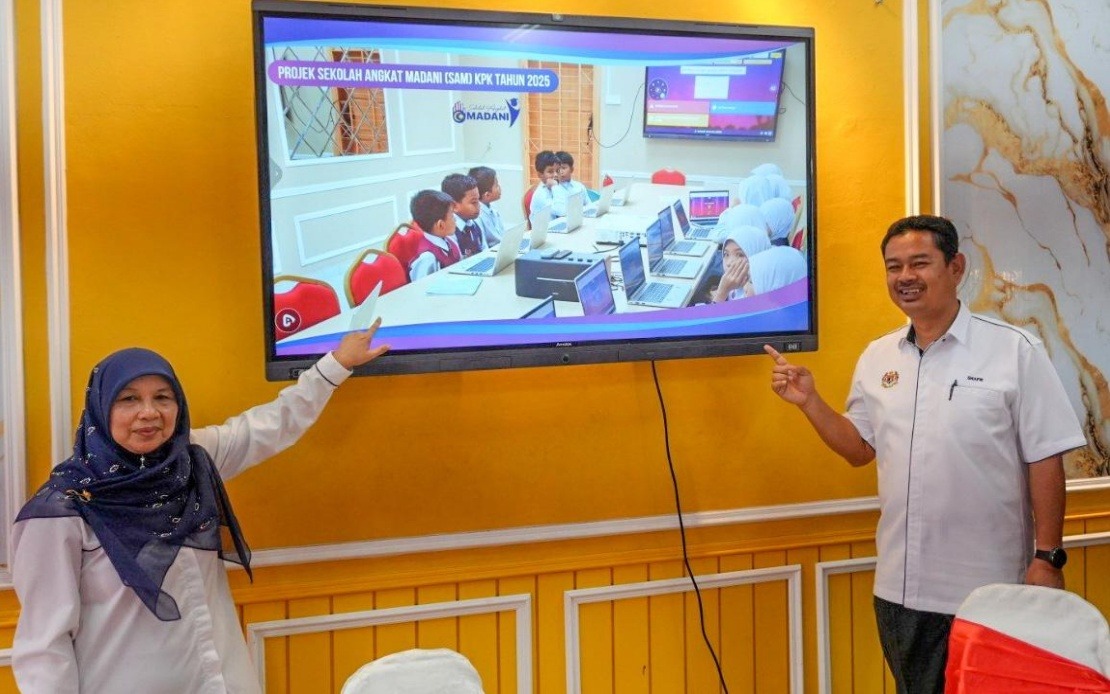
The Ministry of Plantation and Commodities (KPK) has committed RM100,000 towards comprehensive improvements at SK Bendang Kering in Kuala Kangsar as part of its institutional adoption initiative. The funds, officially handed over during a ceremony at the school on June 19, represent the government's widening push to elevate educational standards in rural communities where resource gaps remain persistent across Malaysia.
Deputy Secretary-General (Strategic Planning and Management) Shafie Taib presided over the handover, underscoring the ministry's strategic pivot towards complementing its sectoral remit with direct educational investment. The Malaysian Rubber Board (LGM) has been designated as the implementing agency, working in tandem with KPK to execute the upgrade and ongoing support mechanisms. This arrangement reflects a broader administrative trend in which commodity-focused agencies leverage their institutional networks and budgets to support national development priorities beyond their traditional mandates.
The immediate physical improvements funded through this allocation target core learning infrastructure. The school's assembly area and main hall have been renovated to accommodate larger gatherings and events, while dedicated reading corners have been established to foster literacy engagement among younger cohorts. Preschool classrooms received particular attention, recognising the formative importance of early childhood learning environments. These tangible upgrades address a documented disparity in facility quality between urban and rural schools, where budgetary constraints often leave basic infrastructure inadequate.
Technology integration forms a central pillar of the enhancement strategy. Interactive smartboards have been installed across teaching spaces, enabling educators to employ multimedia-rich instructional methods that research consistently shows improve comprehension and retention, particularly in STEM subjects. The inclusion of air conditioning units responds to Malaysia's tropical climate, where heat-related discomfort can impair concentration and academic performance during extended classroom sessions. Complementary investments in educational signage and new furniture create cohesive, psychologically supportive learning environments that signal institutional investment to students and families alike.
Beyond physical infrastructure, KPK has embedded academic acceleration measures within the adoption framework. A structured improvement scheme targeting Malay, English, Science, and Mathematics establishes performance benchmarks while offering targeted incentives for students demonstrating exceptional progress. This component acknowledges that facility upgrades alone do not guarantee learning outcomes; systematic academic support, teacher development, and student motivation mechanisms are equally critical. The approach mirrors international evidence suggesting that school adoption programmes yield greatest impact when combining infrastructure enhancement with pedagogical intervention.
Character and leadership development occupy equal priority within the programme's design. The Student Leadership Motivation Camp and Student Talent Development Camp create extracurricular pathways through which students identify and cultivate personal capabilities beyond conventional academic metrics. Such initiatives prove particularly valuable in rural contexts where exposure to diverse career trajectories and role models may be limited. By embedding these experiences within the adoption programme, KPK signals recognition that competitive human capital development requires holistic nurturing of intellectual, interpersonal, and creative dimensions.
The selection of SK Bendang Kering exemplifies government strategy to deliberately extend quality educational access to communities historically marginalised in resource allocation. Rural schools in Perak, though administratively integral to national systems, frequently operate with older infrastructure and smaller budgets than their urban counterparts. This adoption scheme directly targets that disparity, ensuring students in Kuala Kangsar have comparable facilities and support mechanisms to peers in metropolitan areas. The optics matter equally—public investment in rural education signals commitment to equitable development and counters perceptions of urban bias in resource distribution.
For Malaysia's broader educational ecosystem, such initiatives carry systemic implications. When ministries across government portfolios adopt schools, coordination becomes essential to prevent duplication and maximise complementary coverage. The KPK's focus on SK Bendang Kering creates potential templates for other commodity agencies—palm, timber, rubber, and mining sectors—to identify similar opportunities. However, sustainability emerges as a critical consideration; initial capital investment must be accompanied by recurrent funding for maintenance, staff training, and programme continuation once initial enthusiasm wanes.
The programme also reflects evolving thinking about how government agencies fulfil corporate social responsibility obligations. Rather than ad-hoc sponsorships or donations, structured adoption schemes embed accountability, measurable outcomes, and longitudinal engagement. KPK's designation of LGM as implementing agency establishes institutional responsibility rather than diffusing accountability across multiple departments. This clarity should theoretically improve programme execution and enable better tracking of outcomes over time.
Regional implications warrant consideration as well. Within Southeast Asia, rural-urban educational disparities persist across Malaysia, Indonesia, Thailand, and Philippines. Malaysian initiatives like the KPK scheme generate policy learning that neighbouring countries monitor closely. Should SK Bendang Kering demonstrate measurable improvements in student outcomes, infrastructure quality, and institutional capacity over coming years, the model gains replicability appeal regionally, positioning Malaysia as a development exemplar in targeted educational investment.
For stakeholders in Kuala Kangsar specifically, the RM100,000 allocation signals institutional recognition of the school's potential and community importance. Teacher morale typically improves when schools receive targeted investment, directly influencing instructional quality. Parents perceive enhanced facilities as validation of their locality's development trajectory, potentially strengthening community engagement with educational processes. Students benefit most directly, inheriting learning spaces and support systems that substantially exceed what their predecessors experienced.
The adoption programme ultimately tests whether sustained institutional partnership can narrow educational gaps that infrastructure investment and policy directives alone have struggled to address. Success requires consistent follow-through: timely repair of facilities, ongoing staff development, sufficient incentive funding for academic schemes, and genuine commitment to capacity-building beyond the initial ceremonial handover. KPK's declaration that this initiative represents ongoing commitment rather than one-time intervention sets expectations for measurement and accountability that will become critical as the programme matures.

