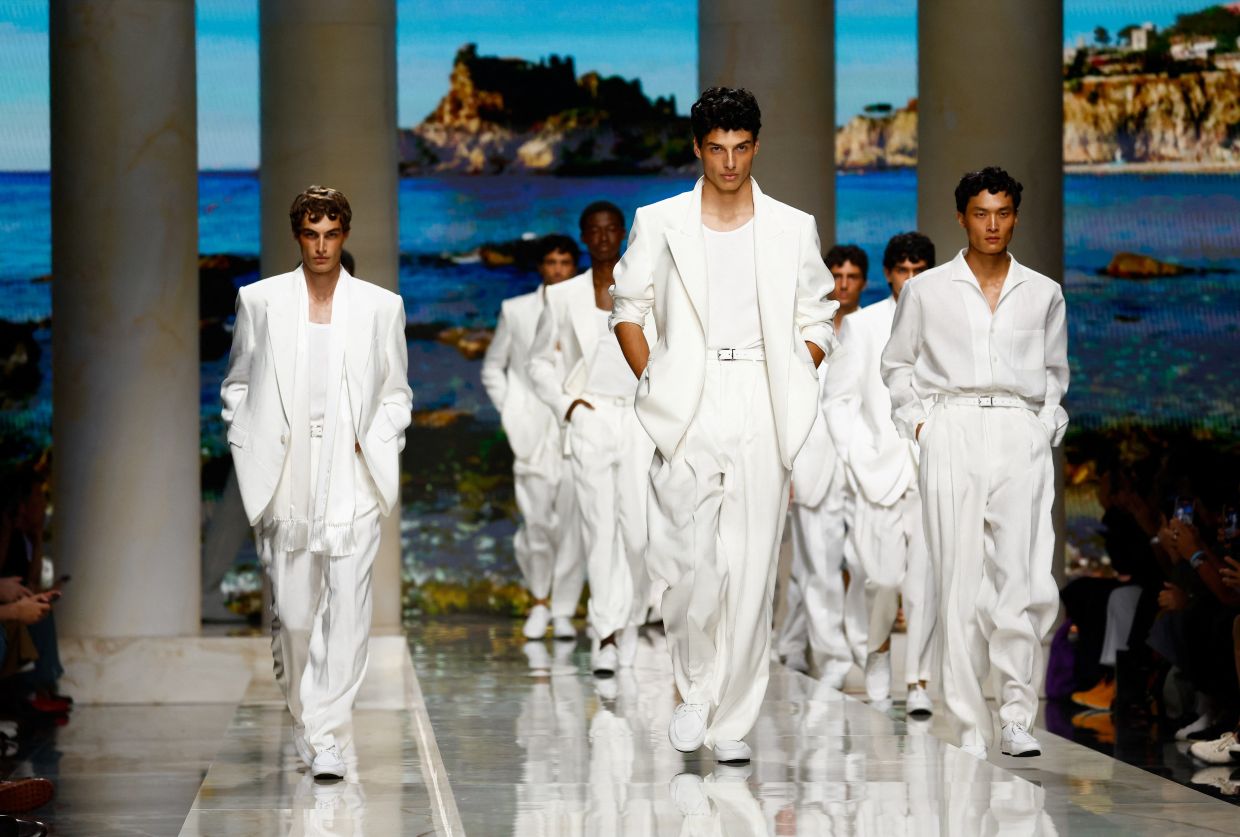
The designers who descended on Milan for menswear Fashion Week last week confronted a peculiar challenge: how to dress for optimism when the world itself feels unsettled. Amid economic headwinds, geopolitical tensions, and a city gripped by oppressive heat, the collective response was surprisingly unified. Rather than retreat into excess or architectural exuberance, Milan's creative voices largely chose to pare back, finding liberation in simplicity and proportion. The message emerging from the runway on Monday, June 22, suggested that in uncertain times, the most radical statement a designer can make is one of clarity and ease—even if that ease remains largely theoretical given the materials chosen.
Prada set the philosophical tone for the season through the collaborative lens of Miuccia Prada and Raf Simons. Their vision centred on the democratic ideals of familiar silhouettes reconsidered through proportion and fabric innovation. This wasn't about inventing new forms but about finding fresh meaning in the clothes already embedded in the male wardrobe. The five-pocket jean became a conceptual starting point, with its universal appeal and democratic associations informing everything from cut to construction. It was a distinctly intellectual approach to menswear, one that acknowledged fashion's current moment: when everything feels fragile, there is comfort in returning to what works.
Yet Milan's embrace of restraint existed in constant tension with its material choices. The runways were saturated with leather—material that, in its traditional forms, offers neither breathability nor comfort in extreme heat. This presented an obvious paradox. If designers truly intended their collections for summer wear, why saturate the calendar with such thermally challenging fabrics? The answer lay in technique. Prada demonstrated how leather could be reimagined through engineering: perforated surfaces, woven structures, and unconventional cuts all conspired to allow air movement while maintaining leather's luxurious associations. Other designers followed suit, suggesting that Milan's elite clientele may need to relocate to alpine elevations, fortified air-conditioning systems, or northern latitudes to authentically wear these pieces.
The relationship between luxury and practicality became the season's defining tension. For years, menswear has indulged in oversized, voluminous silhouettes that provided distance between fabric and body. Milan signalled a decisive shift back toward fitted clothing that acknowledges and celebrates the male form. This wasn't about vanity alone—closer tailoring also reduces the volume of fabric, theoretically offering relief in warm conditions. The challenge was achieving this fitted aesthetic without sacrificing formality or the tailored heritage that defines Milan menswear.
The solution, across multiple designers, was ventilation as an aesthetic principle. Dress shirts remained present but were increasingly left unbuttoned, sometimes rendered partially transparent, or occasionally discarded altogether. Necklines opened dramatically. Construction softened while structure persisted. The result was a new vocabulary of formal menswear—one that acknowledged body temperature without abandoning refinement. Thom Browne's return to Milan after a 15-year absence, now under Zegna ownership, exemplified this direction. His layered suiting drew on seersucker, a fabric historically associated with summer informality, and incorporated pleated skirts for men—a signature Browne element that challenged gender conventions while addressing heat through volume and movement in strategic places.
Dolce & Gabbana pushed beyond mere ventilation into deliberate exposure. Microshorts that highlighted muscular legs represented a willingness to abandon leg coverage entirely, while exposed torsos challenged the fundamental assumption that formal menswear requires maximum coverage. These moments suggested that the definition of appropriate formal dressing is itself being renegotiated, particularly as younger generations inherit the menswear conversation. The suit remains central—nearly every significant designer acknowledged this—but its construction, proportions, and degree of coverage are now subject to experimentation.
While much of Milan operated within a philosophy of reduction, dissenting voices offered pointed counterarguments through decoration and embellishment. Philipp Plein presented crystal-encrusted denim that required days of handwork to complete, a deliberate assertion of craft and value through labor-intensive ornamentation. Dolce & Gabbana similarly leaned into beaded accents and coral-inspired embellishment, creating a distinct maximalist lane within the season. These collections acknowledged that not all clients value restraint or have the same relationship to fashion. Some prefer spectacle, narrative, and unmistakable luxury signalling. That both approaches coexisted on Milan's calendar suggests a market sophisticated enough to accommodate multiple philosophies simultaneously.
Milan's lighter fashion calendar this year created space for emerging talent to gain visibility alongside established houses. Martin Quad made his Milan debut with tailoring innovations that had earlier attracted attention in Copenhagen, while Domenico Orefice explored leather and textiles in a co-ed collection that blurred traditional menswear boundaries. Japanese designer Shinya Kozuka's label also made its Milan introduction, presenting perhaps the season's most poetic articulation of summer informality: a shirtless model draped in a billowing sheer coat in teal, paired with oversized white trousers. This image captured something essential about the season's prevailing sensibility—a comfort with lightness, transparency, and unconventional proportions that suggested menswear is gradually liberating itself from rigid historical constraints.
For Southeast Asian markets, Milan's direction carries particular significance. The region's climate mirrors the heating conditions Milan temporarily endured, meaning that the technical innovations driving these collections—breathable leather, ventilated tailoring, strategic exposure—address real concerns for local consumers. As luxury menswear filters into markets across Malaysia, Singapore, and Thailand, these designs will necessarily be adapted to permanent tropical conditions rather than temporary summer seasons. Additionally, Milan's experimental approach to silhouette and coverage may resonate differently in markets where traditional formality carries different cultural weight. The conversation emerging from Milan suggests that global menswear is finally acknowledging climate as a design constraint rather than an afterthought, a shift with immediate relevance for Southeast Asian consumers and designers.