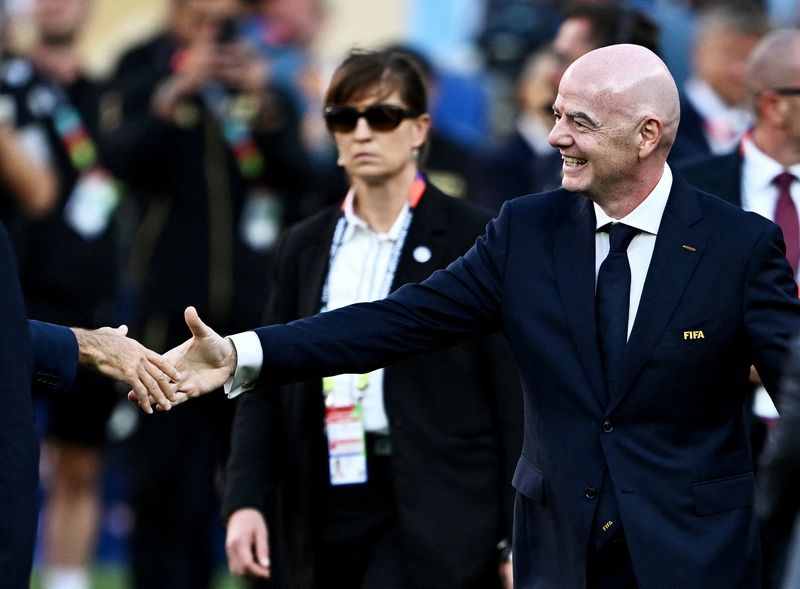
FIFA President Gianni Infantino's grip on power remains contested as rival football confederations split over their backing for his continued leadership. Mexico's football federation and Argentina's football association have publicly endorsed Infantino this week, positioning themselves against growing calls for his removal that have emanated from other major continental bodies. The declarations of support arrive as fallout intensifies from a now-scrapped proposal that would have permitted FIFA to sell portions of the World Cup's commercial rights, a scheme that triggered exceptional resistance across the global football community.
The Mexican Football Federation's decision to publicly stand by Infantino marks a significant departure from CONCACAF's official position. CONCACAF, the continental confederation overseeing North American, Central American, and Caribbean football, had previously demanded what it termed a "comprehensive reckoning" with Infantino's presidential tenure. Mexico's move splits the regional body's united front and suggests that national-level associations may diverge from their confederation's diplomatic stances when individual interests align differently. The FMF emphasised in its statement that it would neither acknowledge nor validate any process to remove Infantino that fell outside FIFA's formal institutional procedures, insisting that only a vote involving all 211 member associations could legitimately determine such a question.
Argentina's football association reinforced this position through a separate letter expressing confidence in Infantino's decade-long stewardship of FIFA. The AFA acknowledged that the controversial World Cup commercial proposal had generated substantial uncertainty and that procedural errors had occurred, yet argued that progress required continuing to work within FIFA's current leadership framework. By aligning itself with Infantino ahead of next March's FIFA Congress in Morocco, Argentina—the reigning World Cup champion—lent considerable prestige to the embattled administrator's reelection campaign.
The continental divisions reflect deeper disagreements about FIFA's governance trajectory and the legitimacy of Infantino's methods. On Thursday, Africa's confederation voted unanimously to support Infantino, providing him with backing from the continent whose nations comprise roughly a quarter of FIFA's membership. Simultaneously, South America's CONMEBOL federation issued a statement opposing any removal process that circumvented a full membership vote, effectively defending the institutional status quo that favours Infantino's continuation. Yet UEFA, the European confederation representing the world's wealthiest and most influential football nations, has committed to boycotting FIFA tournaments in protest. Asia's confederation publicly declared solidarity with UEFA and CONCACAF's critical positions, further fragmenting the global football establishment.
Individual national associations have begun breaking ranks with Infantino as well, complicating his path to an uncontested fourth-term reelection. Croatia's football federation withdrew its support, citing concerns about FIFA's unilateral decision-making on the World Cup commercial matter. England and Albania preceded Croatia in withdrawing their endorsements, signalling that European nations in particular view Infantino's presidency as problematic. The Croatian federation's statement specifically referenced failures in dialogue and institutional process, pointing to what it saw as governance lapses that demanded reassessment.
FIFA's official response to the controversy has emphasised that all actions complied with regulatory frameworks, attributing difficulties to process and communication rather than fundamental governance breaches. Following a meeting in Rabat, FIFA issued an apology to member associations for mistakes surrounding the commercial rights proposal and pledged to review the processes that generated the conflict. This defensive posture, however, has not satisfied critics who view the affair as symptomatic of deeper problems with presidential authority and transparency within world football's governing body.
The scale of institutional opposition to the World Cup commercial proposal suggests that Infantino misjudged the football world's tolerance for centralised decision-making on matters affecting all nations. The proposed commercialisation scheme would have permitted FIFA to monetise future World Cup broadcasting and sponsorship revenues in ways that national associations and confederations believed should require their explicit consent. That Infantino proceeded without building consensus beforehand exposed what FIFPRO, the international players' union, characterised as a "profound abuse of presidential power." The union's condemnation extended beyond procedural criticism to question the fundamental legitimacy of unilateral executive action on such consequential matters.
Infantino's reelection bid, which appeared virtually inevitable two months ago, now faces genuine uncertainty despite the backing from major confederations and leading national associations. No clear alternative candidate has emerged to challenge him at next March's Congress, meaning that even divided support may suffice for his victory. The absence of a credible opposition candidate reflects both Infantino's entrenched institutional position and the fragmentation within world football that makes coordinating a unified challenge extraordinarily difficult. Continental confederations disagree so fundamentally on his fitness to govern that no single opposing figure could plausibly unite the required voting blocs.
For Malaysian and Southeast Asian readers, the FIFA governance crisis carries implications for how regional football develops and where resources flow. AFC, Asia's continental confederation, has aligned with UEFA's critical position, meaning the region's football bodies officially oppose Infantino's leadership. Should Infantino secure reelection despite this opposition, it would signal that presidential incumbency and support from Africa and South America outweighs European and Asian objections. Conversely, a Infantino defeat would represent an extraordinary rebuke of a sitting FIFA president and could trigger substantial reforms to executive authority. Either outcome will shape how FIFA structures future commercial opportunities and distributes World Cup hosting rights—questions directly affecting Asian nations' prospects for major tournament hosting.
The timeline toward the March FIFA Congress will test whether momentum builds against Infantino or whether his institutional advantages prove decisive. The divisions evident among Mexico, Argentina, UEFA, and CONCACAF suggest that world football remains fractured along geographical and economic lines that transcend traditional confederation boundaries. Infantino's survival or departure will therefore reflect not merely individual judgement about his competence but fundamental questions about how global football should distribute power and commercial benefits among its constituent parts.

