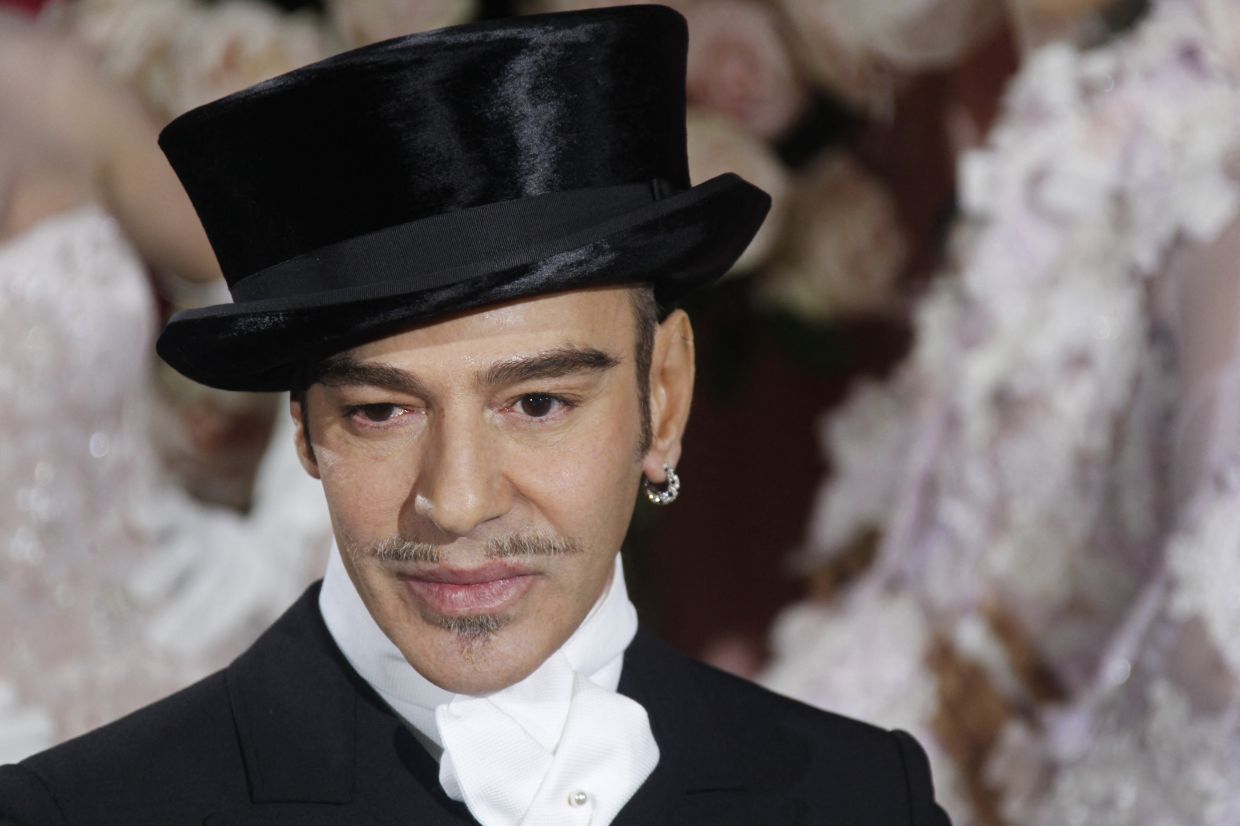
The Metropolitan Museum of Art's Costume Institute has announced that next May's Met Gala will centre on John Galliano, the British designer whose extraordinary creative vision became inseparable from one of fashion's most prominent falls from grace. This marks only the third time the museum has devoted its flagship spring exhibition to a living designer, underscoring both Galliano's undeniable influence on contemporary couture and the institution's determination to grapple honestly with the moral complexities his career now represents.
Galliano's trajectory encapsulates a particular kind of reckoning that has become increasingly difficult to ignore in the fashion world. For nearly fifteen years, he occupied one of the industry's most coveted positions as creative director at Christian Dior, shaping the aesthetic language of one of fashion's most prestigious houses. His work during this period established him as a master of historical referencing, theatrical presentation, and technical virtuosity—qualities that positioned him at the absolute apex of haute couture. Yet between 2010 and 2011, he made a series of public statements containing antisemitic, racist, and anti-Asian remarks that fundamentally altered his professional standing and public reputation. The emergence of a video showing him expressing admiration for Hitler catalysed swift industry action: Dior terminated his contract, his own label dissolved, and a French court convicted him of public insults based on race, religion, ethnicity, and origin.
What distinguishes this retrospective from typical designer celebrations is the museum's explicit commitment to avoiding sanitised commemoration. In a Friday statement, the Costume Institute emphasised that the exhibition will confront rather than minimise Galliano's misconduct, framing the show as an exploration of how artistic achievement must be understood alongside ethical accountability. This represents a notable shift in how major cultural institutions approach complicated legacies—rather than compartmentalising genius from transgression, the Met has chosen to present them as intertwined aspects of a single historical moment requiring serious examination.
The path to this exhibition involved consultations between museum leadership, including curator Andrew Bolton and Vogue's Anna Wintour, and Jewish community leaders in New York. These conversations reflected the institution's awareness that mounting such a show required not simply curatorial sophistication but genuine engagement with communities directly affected by Galliano's statements. The consultation process itself signals a recalibration in how museums approach retrospectives involving figures whose conduct raises questions about complicity and commemoration.
Galliano's personal response to his career rupture included both private rehabilitation and public accountability work. Following his dismissal, he undertook treatment for substance addiction and gradually undertook efforts to acknowledge and learn from his actions. In 2014, Paris-based fashion house Maison Margiela offered him an opportunity for professional resurrection, employing him as creative director for a decade-long tenure that allowed him to rebuild credibility within the industry through his design work rather than through public relations management. This period demonstrated that rehabilitation within fashion was possible, though not automatic or assured.
The exhibition's three-part structure reflects an intentional pedagogical approach. The first section, titled "Bearings," will directly address the 2010-2011 conduct that precipitated his dismissal and legal conviction, his subsequent treatment for substance abuse, and his public acknowledgment of these events. Rather than burying this material in contextual asides, the curators have positioned it as the necessary foundation for understanding everything that follows. The second section, "Horizons," will examine Galliano's creative inspirations drawn from history, geography, art, storytelling, and performance—the intellectual and aesthetic sources that have animated his design philosophy across different eras of his career.
The final section, "Atlas Of Transformation," will concentrate on Galliano's technical mastery, experimentation with materials, and innovative approaches to garment construction. This tripartite organisation allows visitors to move from confrontation with ethical failure, through exploration of artistic inspiration, toward appreciation of technical achievement—a progression that neither excuses nor erases earlier material but contextualises it within a broader historical and creative narrative.
For Malaysian and Southeast Asian fashion observers, this retrospective offers important lessons about how the global luxury industry reckons with its figures. Galliano's work has long influenced fashion consciousness in the region, and his designs appear regularly at prestigious events across Asia. The Met's approach—neither cancellation nor uncritical celebration, but rather sustained critical engagement—reflects evolving standards about how institutions navigate the relationship between artistic contribution and personal conduct. The exhibition suggests that serious museums now see their role as requiring them to educate audiences about complexity rather than offering simple narratives of triumph or condemnation.
Curator Andrew Bolton's framing emphasises how the show will examine simultaneously Galliano's remapping of the fashion world through his creative vision and how his conduct, its consequences, and shifting cultural values have fundamentally altered our understanding of his work. This dual focus acknowledges that we cannot separate the designer's innovations from the historical moment in which they occurred, nor can we appreciate his technical contributions while ignoring their connection to his personal failings and subsequent attempts at repair.
The 2025 Met Gala itself will inevitably become one of the year's most scrutinised fashion events, with attendees navigating the complex symbolism of celebrating a designer whose presence on the red carpet carries multiple meanings. The exhibition represents an institutional commitment to complexity in an industry often built on simplified narratives of beauty and aspiration. Whether this approach succeeds in educating audiences while maintaining necessary accountability remains to be seen, but it signals a meaningful shift in how major cultural institutions are beginning to address the careers of complicated historical figures.

