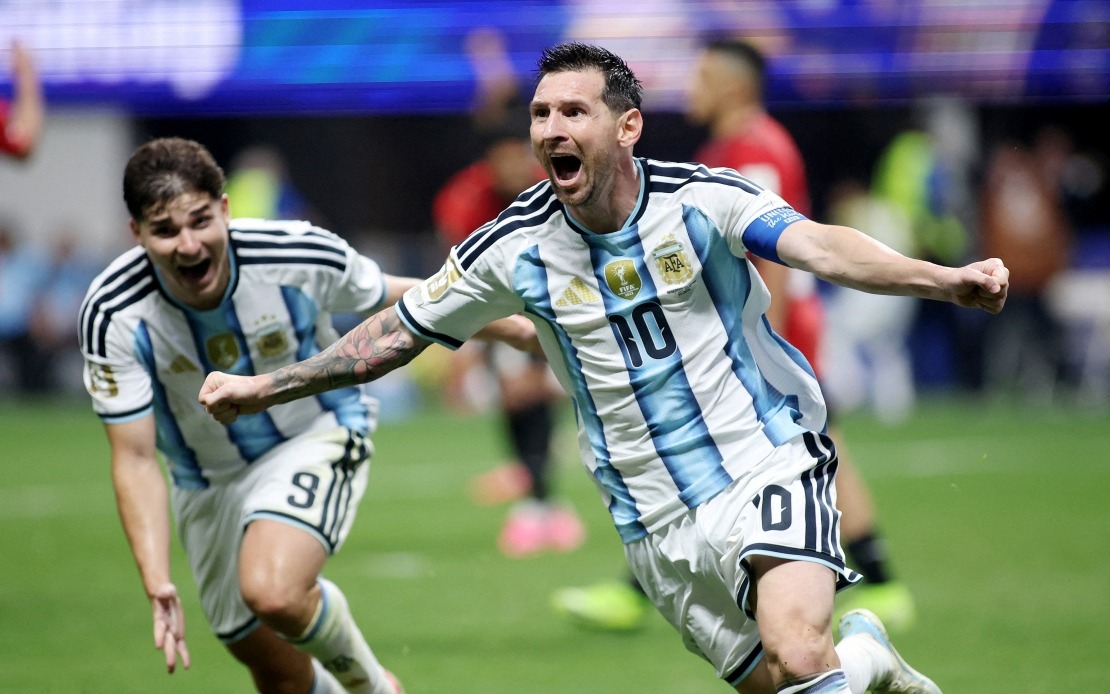
As Argentina prepares to face England in Atlanta this week, Lionel Messi stands poised to add yet another remarkable chapter to a World Cup legacy that few could have predicted would extend this far into his career. The 39-year-old's presence in this tournament defies conventional wisdom about athletic longevity, yet his performance metrics suggest he remains as dangerous a force as ever when international football's greatest prize is at stake.
Messi's 2022 World Cup triumph in Qatar fundamentally altered the narrative surrounding his career and Argentina's footballing identity. At 35 years old, many believed he had finally achieved his life's ambition when he guided his nation to victory, scoring seven goals in the process and securing Argentina's third global title. That triumph, which came after two decades of near-misses and disappointments on the international stage, seemed destined to be the crowning moment of a legendary career. The prevailing sentiment was that the entire nation had rallied around one final push to deliver Messi a World Cup before he inevitably retired.
Yet nearly four years later, Messi has confounded expectations once again by competing at the highest level. His presence in North America has injected Argentina's campaign with an undeniable quality that sets them apart from competing nations. Through the tournament's knockout stages, he has accumulated eight goals, an achievement that places him level with France's Kylian Mbappé as the competition's leading scorer. For Malaysian observers, Messi's sustained excellence offers a masterclass in how professional athletes can maintain peak performance well into their fourth decade through rigorous discipline and an almost obsessive dedication to the sport.
The statistics reveal a fascinating sub-narrative within the broader competition. While Messi and Mbappé currently share the top goalscoring honour, the French forward maintains a marginal advantage when considering secondary metrics. Mbappé's greater number of assists and his efficiency in terms of minutes played give him the edge in the formal rankings, yet both players have transcended traditional scoring records this summer. England's Harry Kane and Jude Bellingham, who have each netted six goals, represent the next tier of attacking prowess, though the elimination of Norway's Erling Haaland has shifted the conversation about who might ultimately claim the Golden Boot.
Beyond this tournament's immediate competition lies a deeper historical context that demonstrates how dramatically the World Cup's scoring landscape has transformed. Messi and Mbappé have together shattered Miroslav Klose's long-standing record of 16 career World Cup goals, with each player now operating well beyond that threshold. Messi currently holds 21 such goals, though Mbappé's trajectory suggests he will inevitably surpass this mark in future tournaments. Kane's rapid ascent up the all-time list, now standing at 14 goals, indicates that the modern era of international football has produced strikers of unprecedented finishing ability and consistency at this level.
An even more striking achievement involves the historical records that Messi and Cristiano Ronaldo have jointly rewritten this summer. Both players have now competed in six separate World Cup tournaments, making them the first men ever to reach this milestone. Their combined presence across a quarter-century of global football underscores the exceptional nature of their longevity and competitive drive. Previously, Lothar Matthäus held the record for most World Cup appearances, a mark that stood at 25 matches for nearly three decades. Messi will surpass this when he takes the pitch against England, set to record his 33rd World Cup appearance and moving six matches clear of Ronaldo's tally.
Messi's trajectory through World Cup competitions reveals an intriguing evolution in his tournament performances. His debut in 2006, when he appeared as an unused substitute during Argentina's penalty shootout loss to Germany, seemed to presage a supporting role. He failed to score during the 2010 edition, raising questions about whether he could deliver on football's biggest stage. The 2014 tournament, held in Brazil, marked a turning point when he netted four crucial goals and led Argentina to the final, though ultimately they fell short against Germany. His 2018 contribution was modest by comparison, yielding just a single goal, before his remarkable resurgence in 2022 when he produced more goals in that single tournament than across his previous four World Cups combined.
The 2022 statistics, however, warrant deeper examination beyond their headline figures. Four of Messi's seven goals came from penalty kicks, a factor that contextualises his impact while simultaneously demonstrating his value in high-pressure situations. Yet his penalty record across all World Cup competitions presents a more complicated picture. He has successfully converted only four of eight penalty attempts during open play, excluding shootouts entirely, a success rate that falls short of elite standards. Two notable failures punctuate his current campaign: a miss against Austria in the group stage and a saved attempt against Egypt's Mostafa Shobeir in the round of 16. This weakness contrasts sharply with his impeccable record in penalty shootouts, where he has succeeded in all three occasions, including decisive moments against the Netherlands and France.
The philosophical dimensions of Messi's continued excellence at this advanced stage of his career offer valuable lessons for Malaysian sports enthusiasts and athletes. His refusal to accept that career decline is inevitable, coupled with his demonstrated ability to adapt his game and maintain physical conditioning, illustrates how mental resilience and professional commitment can extend athletic careers beyond traditional expectations. For a region where football passion runs extraordinarily deep, Messi's example serves as inspiration that excellence transcends age when coupled with unwavering dedication.
The Golden Ball award, given to the tournament's outstanding player, represents one of the few individual honours that has eluded Messi despite his dominance across multiple World Cups. He has claimed this award twice previously, yet recent tournaments have seen it distributed among other players. Similarly, the Golden Boot has proven frustratingly elusive, with Mbappé claiming it four years ago despite finishing on the losing side in the final. Should Messi secure either award this summer, it would represent a completion of his World Cup legacy, though the passage of time and the emergence of younger players suggest that such individual honours may increasingly gravitate toward other contenders.
As Argentina progresses deeper into this tournament, the narrative of a 39-year-old player pursuing a second world championship while simultaneously rewriting the sport's historical record books captures the imagination of football supporters across Southeast Asia and beyond. Whether Messi can guide Argentina to another title remains uncertain, as does whether he will claim the Golden Boot that has eluded him. What seems certain is that his presence at this World Cup has elevated the competition and reminded the world why, for so many years, he has been considered among the sport's greatest ever competitors.

