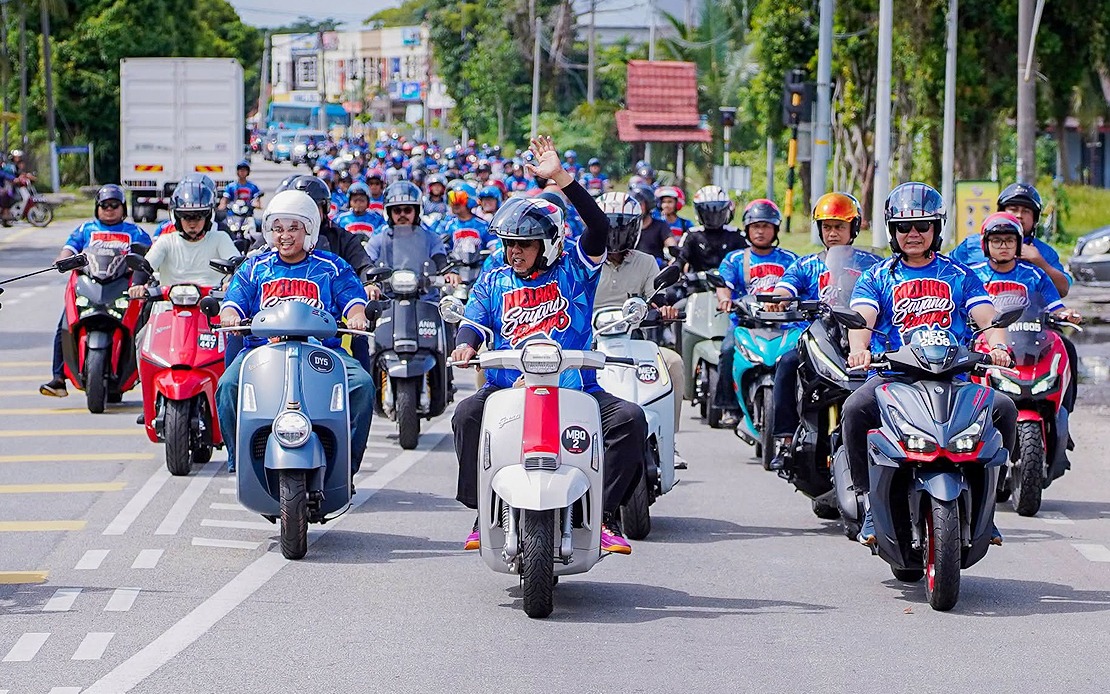
Melaka Chief Minister Datuk Seri Ab Rauf Yusoh has widened his government's community engagement strategy by launching the Tangga Batu parliamentary WRUR programme, signalling a commitment to systematic grassroots outreach that extends beyond traditional political cycles. The two-phase initiative will encompass the Pantai Kundor and Paya Rumput state constituencies, representing a deliberate expansion of an approach that the chief minister frames as persistent rather than episodic.
The WRUR programme, which encompasses initiatives spanning welfare assistance, community infrastructure, educational support, youth engagement and small business development, aims to deploy more than 200 discrete programmes across the affected constituencies. This volume suggests a comprehensive rather than token engagement, with the ambition to touch multiple facets of constituent life simultaneously. The breadth indicates an administration attempting to address the holistic needs of communities rather than concentrating resources narrowly.
According to Ab Rauf, this is not a novelty but rather an institutionalised component of governance. Through 23 previous implementation cycles, the initiative has accumulated more than 4,000 recorded complaints from residents, with nearly 70 per cent achieving resolution. This resolution rate, while not perfect, demonstrates a mechanism for converting grievances into tangible action, a capacity that distinguishes responsive administration from purely symbolic engagement.
Within the Tangga Batu parliamentary constituency specifically, earlier iterations of WRUR in the Sungai Udang and Kelebang state constituencies received 359 complaints, of which 328 were resolved with 31 remaining under active follow-up. The persistence in tracking unresolved matters suggests an attempt to avoid the common pitfall whereby complaints disappear into bureaucratic limbo once initial publicity subsides. Maintaining visibility on outstanding issues indicates a process designed for accountability.
The sixth phase distribution alone demonstrates material commitment, with RM150,000 in aid dispersed across diverse groups. Fishermen, among whom 220 received RM22,000 in collective support, represent a constituency often marginalised in urban-focused policy agendas. Boat owners affected by sinking incidents received targeted relief totalling RM1,500, indicating responsiveness to specific community traumas. Small and medium enterprise operators benefited from RM14,000 in business equipment, targeting the economically productive segments of society. Educational institutions, places of worship, students and vulnerable homeowners rounded out the recipients, suggesting an attempt to balance economic stimulus with social safety nets.
Crisis management constitutes another dimension of the initiative's response capacity. Recent flash flooding in Pantai Kundor inundated 73 houses, triggering emergency infrastructure intervention. The Department of Irrigation and Drainage mobilised RM50,000 for cleaning and maintenance of Sungai Seberang Gajah, with completion expected imminently. This reactive capacity, while necessary, also reveals underlying vulnerability in local drainage infrastructure that proactive planning should have addressed earlier.
Beyond immediate crisis response, the administration has initiated improvement works, with RM100,000 allocated for upgrading Sungai Lereh. More ambitiously, the Public Works Department has sought federal approval for an RM16 million project to reconstruct the crossing culvert on Jalan Tangga Batu-Tanjung Minyak. This escalation from local maintenance to major infrastructure reconstruction suggests recognition that short-term drainage fixes cannot substitute for systemic capacity enhancement. The reliance on federal approval, however, injects uncertainty into implementation timelines and raises questions about the adequacy of state-level budgetary allocation to address infrastructure deficiencies.
The programme's scope and iteration frequency raise important questions about implementation quality and community perception. With more than 200 programmes running simultaneously across two constituencies, questions arise regarding whether coverage translates into depth or whether programmes risk becoming superficial. The accumulated resolution of 4,000 complaints across 23 cycles averages approximately 174 complaints per cycle, a manageable volume that suggests systematic rather than overwhelming processing capacity.
For Malaysian readers, particularly those in smaller parliamentary constituencies, the Tangga Batu model offers lessons in structured community governance. The separation of complaint tracking from political rhetoric, the quantifiable resolution metrics and the persistence across electoral cycles suggest an approach distinct from crisis-driven or campaign-season engagement. The model also illuminates chronic weaknesses in Malaysian infrastructure planning, whereby drainage systems require RM16 million reconstructions rather than preventive maintenance, and emergency relief must substitute for proactive flood mitigation.
The programme's emphasis on multiple constituencies simultaneously reflects a broader strategic choice to distribute political capital across a wider geographic footprint rather than concentrating resources in politically marginal areas. Whether this represents genuine commitment to inclusive governance or strategic political calculation remains an assessment for observers to make. What remains quantifiable is the institutional mechanism created: a visible complaint-resolution process with public accountability metrics, a system many Malaysian constituencies lack entirely.
As the Tangga Batu phase progresses, monitoring will reveal whether the programme sustains momentum beyond the initial launch enthusiasm and whether the 70 per cent resolution rate in previous cycles proves replicable. For stakeholders in Pantai Kundor and Paya Rumput, the initiative represents both a tangible engagement mechanism and an implicit acknowledgment that communities require structured channels to surface and resolve grievances. Whether such channels ultimately improve governance quality or merely formalise complaint management awaits assessment through subsequent cycles.

