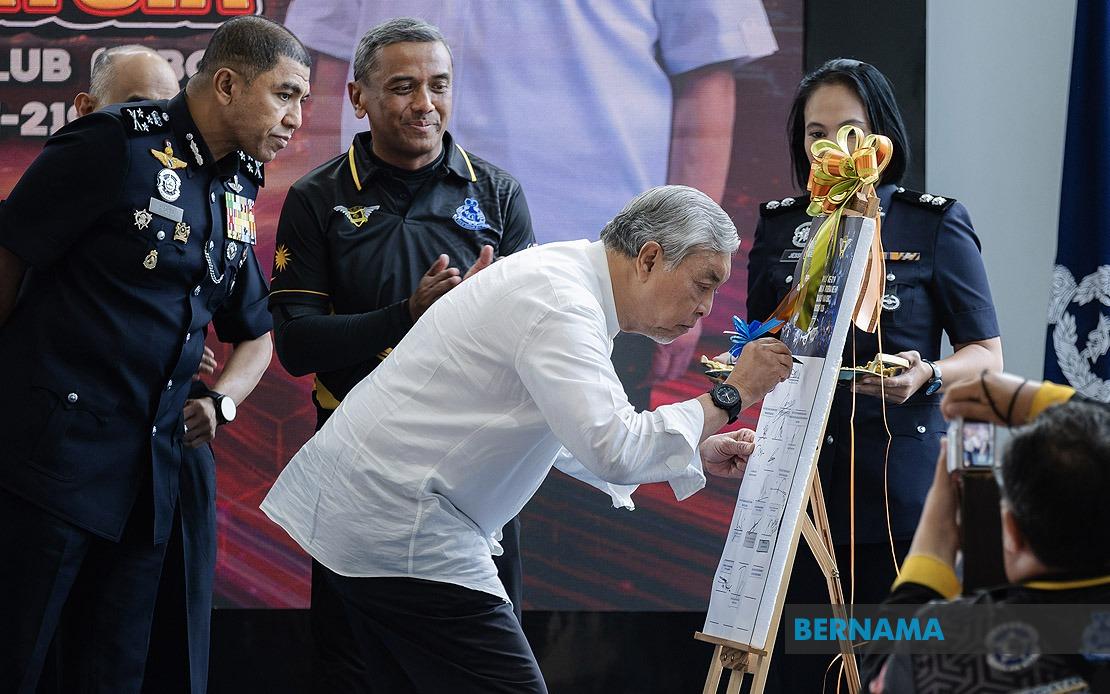
Deputy Prime Minister Datuk Seri Dr Ahmad Zahid Hamidi has signalled that Barisan Nasional will tailor its political strategy for the Melaka state election rather than replicate the coalition-building approaches that delivered decisive victories in Johor and Negeri Sembilan. Speaking at a ceremonial event in Kuala Lumpur, the BN chairman emphasised that any electoral formula must account for Melaka's distinct political environment and the specific dynamics that shape competition in the state.
The upcoming election in Melaka carries particular strategic weight for BN's broader national positioning. The state mandate expires on Dec 31, necessitating either a new election or negotiated continuation of current governing arrangements. BN commands a substantial assembly majority, having secured 21 of 28 seats in the 15th state election, while Pakatan Harapan holds five seats and Perikatan Nasional two. This configuration mirrors the federal-level Unity Government arrangement, where both BN and PH govern collectively despite competing in elections.
Ahmad Zahid's remarks suggest BN leadership recognises that a mechanistic application of winning strategies from neighbouring states could prove counterproductive in Melaka's context. The coalition's recent triumphs in Johor and Negeri Sembilan involved specific political arrangements and partnership structures that reflected those states' particular circumstances. Melaka presents different political terrain, with its own configuration of party strengths, local power networks, and community interests that demand distinct consideration.
The framework Ahmad Zahid outlined emphasises rigorous cost-benefit analysis in any pre-election negotiations with potential coalition partners. He stressed the necessity of weighing tangible gains against potential liabilities, suggesting BN will not pursue electoral partnerships simply for aggregate seat-gathering purposes. This calculus implies serious internal deliberation about whether alignment with additional parties or maintaining current governing partnerships serves BN's fundamental interests in Melaka.
Integrity in political commitments emerges as a secondary but critical theme in Ahmad Zahid's statement. He explicitly warned against agreements reached in negotiation that parties subsequently abandon or reinterpret following election outcomes. This language suggests institutional memory of previous arrangements where post-election political behaviour diverged significantly from pre-election understandings. By publicly emphasising honesty and promise-keeping, BN's chairman attempts to establish reputational stakes around whatever formula the coalition ultimately adopts.
The delegation of negotiating authority to Melaka Chief Minister Datuk Seri Ab Rauf Yusoh reflects organisational structure where state-level political actors conduct preliminary discussions before elevating outcomes to national scrutiny. This approach allows state leaders familiar with local conditions to propose arrangements that subsequently undergo evaluation by BN's federal leadership. The two-tiered process suggests BN's recognition that successful electoral strategies require both local political expertise and national party coordination.
Ahmad Zahid positioned state-level political cooperation within broader national stability considerations. He articulated a perspective wherein Melaka's electoral arrangement should strengthen rather than undermine the Unity Government framework operating at federal level. This framing acknowledges that voters increasingly view state and federal politics as interconnected systems, where inconsistencies between state-level partnerships and federal-level cooperation arrangements generate confusion and potentially erode public confidence in both tiers of governance.
The emphasis on whole-of-government coordination and inter-ministerial alignment as expressions of political cooperation indicates BN's conviction that electoral success requires institutional performance beyond campaign messaging. From this perspective, voters in Melaka assess political coalitions partly through observable governmental effectiveness, service delivery coordination, and the absence of institutional friction between ostensible coalition partners. This shifts competitive strategy away from purely electoral tactics toward the harder challenge of maintaining cohesive administrative functioning across multiple parties and interests.
Melaka's significance within Malaysia's broader political economy deserves recognition. The state occupies crucial geographic and commercial positioning along the western seaboard, with substantial port infrastructure, manufacturing sectors, and tourism industries. Control of Melaka's state government carries implications for BN's ability to demonstrate effective stewardship and competitive advantage relative to opposition coalitions. The state therefore functions as both a symbolic and substantive test of BN's capacity to govern in Malaysia's contemporary multi-party environment.
The decision to avoid simply replicating Johor and Negeri Sembilan models implicitly acknowledges that electoral success in those states depended partly on circumstances unique to those polities. Johor's electoral outcome reflected particular local dynamics and Negeri Sembilan's reflected its specific political sociology. Melaka's different electoral history, composition of political parties at state level, and local power structures necessitate independent strategic assessment rather than mechanical application of neighbouring states' approaches.
The timeline leading toward the Dec 31 mandate expiration creates pressure for clarity around Melaka's post-election governance arrangements. Whether BN pursues fresh elections or negotiates continuation of current executive council composition will shape the state's political trajectory and signal important messages about BN's strategic confidence and coalition-building philosophy. Ahmad Zahid's remarks suggest senior party leadership remains genuinely deliberative about the available options rather than having predetermined outcomes.
Looking forward, the Melaka situation tests whether BN can successfully navigate the complexity of competing in elections while simultaneously maintaining power-sharing arrangements with rival coalitions. The outcome will inform assessments of whether Malaysia's Unity Government framework represents a durable new model for national governance or a temporary accommodation vulnerable to dissolution when electoral cycles create conflicting incentives among coalition partners.

