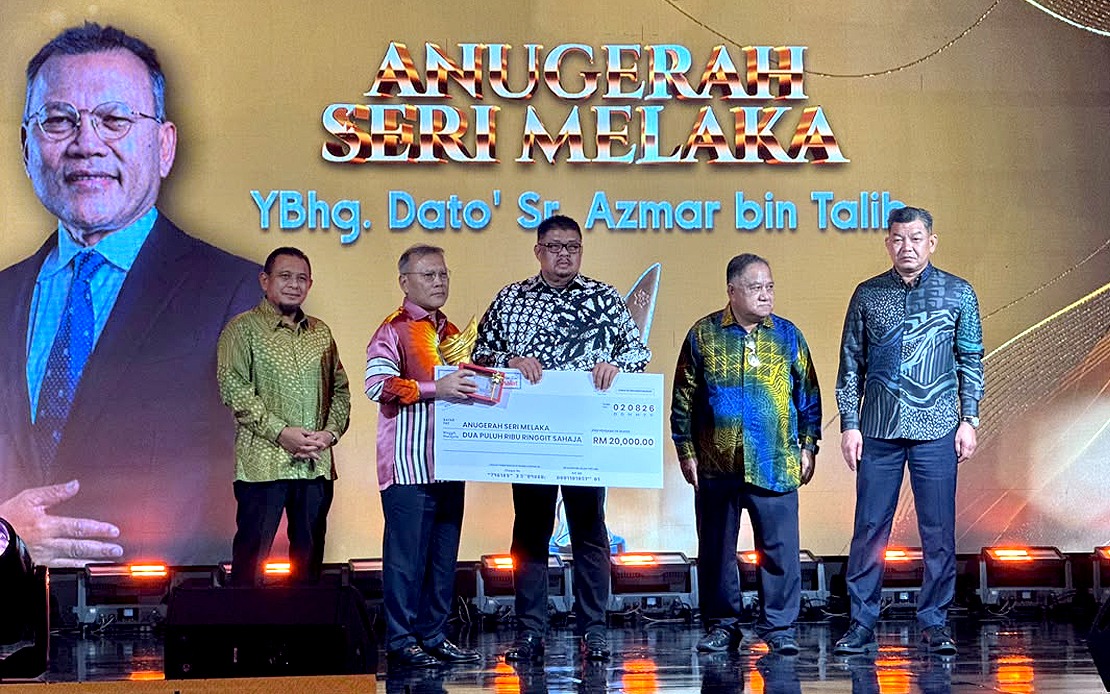
Melaka's Chief Minister Datuk Seri Ab Rauf Yusoh has extended an invitation to the state's accomplished professionals and entrepreneurs to forge meaningful partnerships with the state administration, positioning themselves as catalysts for broader economic and social development. Speaking at the Anugerah Seri Melaka (ASM) Gala Night ceremony held at the Melaka International Trade Centre in Ayer Keroh, Ab Rauf articulated a vision where individual achievement transcends personal recognition to become a springboard for collective progress, particularly benefiting the state's younger demographics seeking pathways to success.
The Chief Minister's appeal represents a strategic reorientation of how Melaka intends to harness human capital beyond traditional employment frameworks. Rather than allowing expertise accumulated by successful individuals to remain confined to private enterprise or personal endeavour, the government seeks to create structured mechanisms through which these resources become accessible to the broader population. This approach recognizes that mentorship, professional networks, and accumulated institutional knowledge often constitute the most valuable assets for emerging talent, yet remain largely unavailable to many citizens unless deliberately channelled through formal initiatives.
Central to this strategy is the Melaka Sayang Rakyat (MeSRa) programme, which functions as an umbrella initiative designed to document, celebrate, and systematically disseminate the experiences of high-achieving Melakans across diverse sectors. Rather than treating success stories as isolated incidents, the government intends to convert them into educational resources and inspiration for populations seeking similar trajectories. This methodology reflects contemporary understanding that aspirational narratives carry particular potency, especially when rooted in local context and demonstrable outcomes achieved by individuals from similar socioeconomic or geographical backgrounds.
The Anugerah Seri Melaka award itself operates across four distinct categories, each recognizing excellence in Public Service, Corporate enterprise, Sports, and Arts and Culture. The breadth of these categories underscores a deliberate attempt to validate achievement across the entire spectrum of human endeavour rather than narrowly privileging commercial success or bureaucratic advancement. By receiving over 200 nominations, the programme has generated substantial participation, indicating receptiveness among Melaka's professional and accomplished cohorts to formal recognition frameworks that emphasize their contributions to state identity.
The inaugural recipients represent exemplars within their respective domains. Datuk Azmar Talib, chief executive of TRX City Sdn Bhd, claimed the Corporate category award, embodying success within Malaysia's competitive real estate and urban development landscape. Aaron Chia's recognition in the Sports category reflects the state's production of international-calibre talent, specifically in badminton—a discipline where Malaysia maintains significant regional prominence. Performing arts director Lokman Abd Ghani's recognition in Arts and Culture acknowledges Melaka's cultural heritage and contemporary creative industries, while Datuk Zamri Misman's Public Service award validates administrative excellence and national-level contribution by a Melaka-born official.
Dr Saiful Anuar Singar's Special Category award as an international medical science researcher demonstrates the government's recognition that Melakan achievement extends beyond domestic boundaries into the global knowledge economy. His selection signals that the state views its talented diaspora not merely as brain drain but as representatives of Melakan capability on international platforms. This nuancing suggests maturity in state-level thinking regarding how to benefit from citizens who have achieved prominence outside traditional geographic boundaries, recognizing that such individuals often retain psychological and professional connections to their origins.
The financial rewards accompanying these honours—RM20,000 plus trophies for the overall award recipient, with RM10,000 and trophies for category winners—represent more than symbolic gestures. These sums constitute meaningful recognition that incentivizes participation while signalling government commitment to valuing achievement materially. For a regional audience, particularly within Southeast Asia where state-sponsored awards often carry substantial prestige, such recognition can meaningfully enhance professional standing and facilitate networking opportunities that transcend the immediate cash component.
Ab Rauf's emphasis on leveraging "experience, expertise and networks" reflects sophisticated understanding of how competitive advantage accrues in contemporary economies. Individual credentials matter, certainly, but access to professional networks and institutional knowledge often determines whether talented individuals can translate potential into realized opportunity. By explicitly requesting successful individuals to become "strategic partners," the government acknowledges that its role extends beyond provision of educational infrastructure or regulatory frameworks into active facilitation of intangenerational knowledge transfer and network access.
The Chief Minister's framing of individual achievement as potential "source of strength for the state and future generations" indicates aspirational thinking about how Melaka might position itself competitively within Malaysia's complex federal structure. Penang and Selangor have historically leveraged intellectual capital and entrepreneurial networks to maintain developmental advantages; Melaka's initiative suggests recognition that competing effectively requires similar cultivation of human capital ecosystems. This regional competitive dynamic carries implications for the broader Southeast Asian context, where city-states and municipalities increasingly recognize that attracting and retaining talent depends upon creating environments where achievement receives recognition and where successful individuals perceive meaningful opportunities for impact and legacy-building.
The requirement that candidates' nominations "reflect the life journey of the candidates, built through hard work, sacrifice and perseverance" emphasizes narrative authenticity rather than mere credentials accumulation. This approach aligns with emerging regional trends toward recognizing the messy, non-linear pathways through which most individuals achieve success. For Malaysian audiences particularly, such emphasis resonates with values embedded in national narratives around self-improvement and meritocratic advancement, even as it acknowledges the structural advantages that certain backgrounds provide.
Looking forward, the initiative's effectiveness will likely depend upon translating recognition into actionable mechanisms for partnership. Establishing platforms where award recipients can meaningfully engage with younger talent, whether through formal mentorship programmes, internship placements, or structured knowledge-sharing, will determine whether MeSRa and ASM function as inspirational programmes or as primarily ceremonial exercises. The success of this approach will carry implications for how other Malaysian states think about cultivating and retaining human capital in increasingly competitive regional and global environments.

