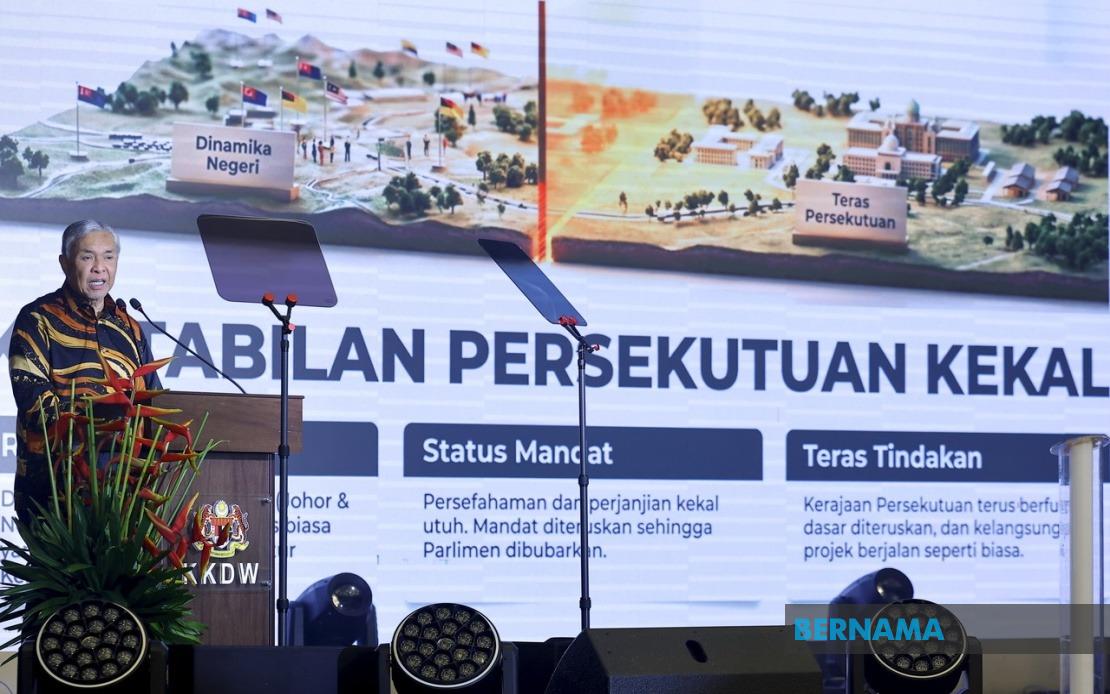
Barisan Nasional's Melaka chapter is preparing an ambitious defence of its full slate of 21 state assembly seats as the coalition gears up for the 16th Melaka state election. BN chairman Datuk Seri Dr Ahmad Zahid Hamidi revealed that Chief Minister Datuk Seri Ab Rauf Yusoh, who also leads the state's BN machinery, has communicated the coalition's determination to safeguard every single constituency it presently controls.
The announcement signals confidence within the Melaka BN machinery, which has maintained considerable dominance in the state's political landscape. Ahmad Zahid's public declaration of this defensive posture underscores the importance Putrajaya places on retaining Melaka as a reliable BN stronghold, particularly given the state's geographical proximity to the capital and its symbolic value within the party's broader electoral strategy across the peninsula.
Yet beneath this unified front lies a more nuanced political calculus. While BN has committed to defending all 21 seats with full candidacy, the coalition leadership has simultaneously signalled flexibility regarding potential arrangements with other political entities. This balancing act reflects the complex dynamics within Malaysia's contemporary electoral environment, where coalitions must simultaneously project strength and demonstrate willingness to forge consensus across the political spectrum.
Ahmad Zahid emphasised that the central BN leadership would retain final authority over any electoral pacts or power-sharing arrangements that might emerge. This hierarchical decision-making structure ensures that decisions made at the state level in Melaka do not contradict broader national coalition strategies or create precedents that could complicate negotiations elsewhere. The BN chairman's comments effectively placed gatekeeping authority at the party centre, preventing overly ambitious local leaders from committing the coalition to arrangements that senior leadership might later find disadvantageous.
Melaka's political significance within the Malaysian federation cannot be overstated. As a coastal state with a diverse economic base spanning tourism, manufacturing, and agriculture, it represents a microcosm of peninsular Malaysian constituencies. The state's electoral performance often foreshadows broader trends in national politics, making its outcomes closely watched by political strategists across the spectrum. Losing ground in Melaka would carry symbolic weight beyond the numerical loss of seats.
The state's recent political history reveals considerable volatility. Having weathered internal governance challenges and shifting voter preferences, Melaka's political establishment recognises the necessity of robust grassroots organisation and responsive governance. The BN's commitment to defend all 21 seats reflects not merely confidence but also an acknowledgement that complacency could prove costly. Chief Minister Ab Rauf Yusoh's demonstrated determination, as conveyed through Ahmad Zahid, suggests a leadership genuinely invested in consolidating support across diverse voter demographics within the state.
From a broader Southeast Asian perspective, Malaysia's electoral dynamics carry relevance for regional observers. The BN's continued influence in several states, coupled with its national governing coalition responsibilities, makes its electoral fortunes important markers of political stability within the region. A decisive BN performance in Melaka could reinforce confidence in Malaysia's political continuity, while setbacks might prompt speculation about shifting voter sentiments across other constituencies.
The coalition's openness to understanding with other parties warrants careful interpretation. Rather than suggesting weakness, this pragmatism reflects maturity in Malaysia's evolving political culture, where rigid ideological positioning has gradually given way to transactional coalitional politics. Previous state elections have demonstrated that voters increasingly reward parties capable of forming stable, functional governments over those pursuing zero-sum electoral competition. BN's willingness to negotiate from a position of strength in Melaka aligns with this emerging preference.
For Malaysian voters in Melaka, the significance lies in what this electoral contest implies for governance. A BN government with solid electoral endorsement typically commands resources and attention for state-level development. Conversely, a closely contested or unexpected outcome could precipitate political instability that disrupts administrative continuity. The coalition's ambitious target of retaining all 21 seats reflects its assessment that current governance satisfaction levels support such an outcome, though no electoral prediction proves entirely reliable until ballots are counted.
The timing of Ahmad Zahid's announcement carries strategic importance as well. By publicly committing to defending all seats while simultaneously acknowledging flexibility on coalitional matters, BN leadership maintains maximum optionality. If circumstances favour a purely BN government, the party possesses clear mandate language. Should electoral conditions demand coalition partners, the leadership has already primed the public for such arrangements, potentially smoothing potential friction that might otherwise arise from unexpected alliances.
Looking forward, Melaka's state election will serve as a crucial test of BN's contemporary electoral appeal and organisational capacity. The party's performance here will directly influence its confidence and approach to subsequent state elections and the eventual general election cycle. Should BN succeed in its ambitious defence of all 21 seats, the victory would substantially strengthen the coalition's narrative about its continued relevance and voter support. Conversely, any significant losses could trigger recalibrations in strategy and questions about whether BN's traditional dominance in certain states remains assured or whether demographic shifts and voter preferences are reshaping electoral terrain more fundamentally than recent polling might suggest.

