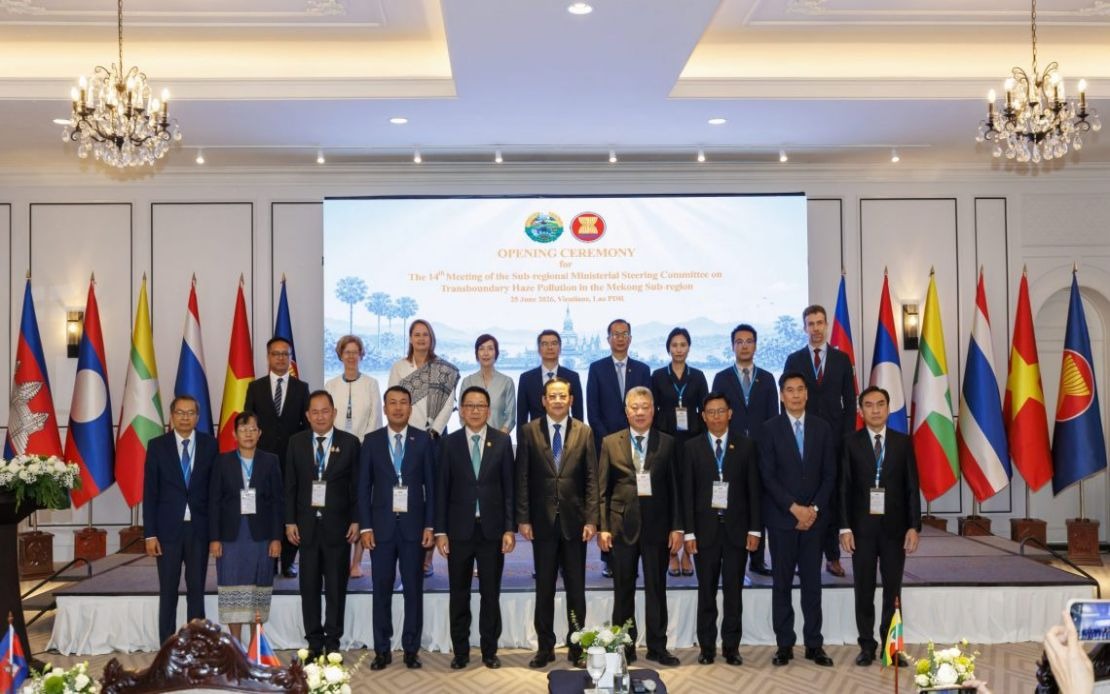
Policymakers throughout the Mekong subregion are racing to contain an emerging environmental crisis as climate patterns shift and fire risks escalate across national borders. Meeting in Vientiane on June 25, regional ministers gathered to address transboundary haze pollution at the 14th session of the Sub-Regional Ministerial Steering Committee, signalling growing alarm over the intersection of rising temperatures, El Niño conditions, and forest fire dangers that threaten to engulf communities from Laos to Vietnam and Thailand.
The context for this urgency is unmistakable. Temperature records are breaking across major urban centres. Bangkok faces unprecedented heat stress despite seasonal expectations, while Ho Chi Minh City battles intense thermal conditions even as monsoon rains should be providing relief. These anomalies underscore how climate change and El Niño patterns are fundamentally altering weather behaviour across Southeast Asia, creating conditions where traditional seasonal safeguards no longer function predictably. The arrival of the rainy season has failed to deliver expected cooling, leaving populations and agricultural zones vulnerable to drought-like conditions that mirror the environmental precarity already familiar to Malaysians.
Lao Prime Minister Sonexay Siphandone articulated the stakes bluntly at the Vientiane meeting, emphasising that forest fires and transboundary air pollution represent existential threats to the Greater Mekong Subregion. The damage catalogue he outlined extends beyond visible air quality problems: biodiversity loss, public health impacts spanning respiratory illness to heat-related mortality, and cascading economic losses ripple through agriculture, tourism, and regional supply chains. For Malaysia and other ASEAN economies integrated into regional trade networks, the economic implications extend beyond border regions, potentially disrupting commodity prices and investment stability.
The numerical evidence confirms deteriorating conditions. Hotspot counts—a key metric for monitoring potential fire activity—rose approximately eight per cent between December 2025 and May 2026 compared to the previous year's equivalent period. While seemingly modest, this figure compounds over time and reflects expanding areas where ignition and fuel conditions align dangerously. The Lao Ministry of Agriculture and Environment has warned that El Niño could drive temperatures in vulnerable zones to 35-38 degrees Celsius, accompanied by erratic rainfall patterns, prolonged dry spells, and declining water levels. Such conditions create perfect tinder for wildfires while simultaneously draining water resources needed for irrigation and drinking supplies.
El Niño's particular threat lies in its historical correlation with Southeast Asian drought and fire seasons. Weather scientists are now cautioning that conditions could intensify into a Super El Niño event this year—a possibility that carries profound implications for the region's environmental stability. The last major El Niño events saw Indonesia and Malaysia shrouded in haze for months, choking neighbouring countries and inflicting health emergencies that overwhelmed healthcare systems. Understanding this risk context reveals why governments are treating cross-border coordination as urgent rather than routine.
The ministerial pledges emerging from Vientiane represent a recognition that unilateral approaches cannot solve problems that literally cross borders on prevailing winds. ASEAN member states committed to reducing fire hotspots and controlling transboundary haze pollution specifically during vulnerable dry seasons—the very period when agricultural burning, accidental ignition, and natural lightning strikes converge most dangerously. For these commitments to translate into meaningful outcomes, nations must dedicate resources to forest management, fire suppression infrastructure, and real-time monitoring systems capable of detecting emerging hotspots before they metastasise into regional catastrophes.
The challenge facing policymakers extends beyond firefighting logistics. Agricultural pressures drive much deliberate burning across the region, particularly in Indonesia and parts of Thailand, where land preparation and pest control traditionally rely on fire. Shifting these practices requires alternative technologies, farmer education, and economic incentives—investments that compete for limited government budgets already strained by climate adaptation demands. Malaysia's experience with transboundary haze has demonstrated how difficult such transitions prove politically and practically, even when air quality reaches hazardous levels affecting millions.
Public health dimensions add moral urgency to the haze question. Particulate matter from peat and forest fires penetrates deep into respiratory systems, triggering asthma, bronchitis, and cardiovascular complications. Children and elderly populations face elevated mortality risks during severe haze episodes. Hospital admissions spike across affected regions, straining healthcare infrastructure precisely when resources are most needed. The 2015 Southeast Asian haze event produced documented health impacts persisting months after air quality normalised, including long-term lung function decline in exposed populations.
Regional economic interconnection means agricultural disruption in one country ripples across ASEAN markets. Crop failures, livestock losses, and fishing disruptions triggered by drought and haze create price shocks affecting food security and inflation rates regionally. Tourism sectors already recovering from pandemic impacts face additional setbacks when international visitors encounter hazardous air quality advisories. Manufacturing zones dependent on cross-border supply chains experience production interruptions when haze forces facility closures or transportation disruptions. For Malaysia's position as a regional economic hub, these cascading effects pose real GDP implications.
The effectiveness of the Vientiane commitments will ultimately depend on implementation rigour and sustained political will beyond the immediate crisis period. Regional monitoring systems must be funded and maintained. Fire prevention budgets cannot be raided to address other emergencies. International technical assistance and financial support from developed nations with vested interests in regional stability becomes critical. ASEAN's track record on transboundary haze coordination shows mixed results—past agreements have produced varying compliance levels, and enforcement mechanisms remain weak.
Looking forward, the convergence of multiple stressors—climate change, population growth, agricultural expansion, and now potentially a Super El Niño—creates an exceptionally demanding environment for regional stability. The Mekong nations' recognition of transboundary haze as a collective crisis requiring collective action represents important diplomatic progress. Whether this recognition translates into the sustained, funded, coordinated action required to prevent another debilitating haze season will largely determine the region's environmental and economic trajectory through 2026.

