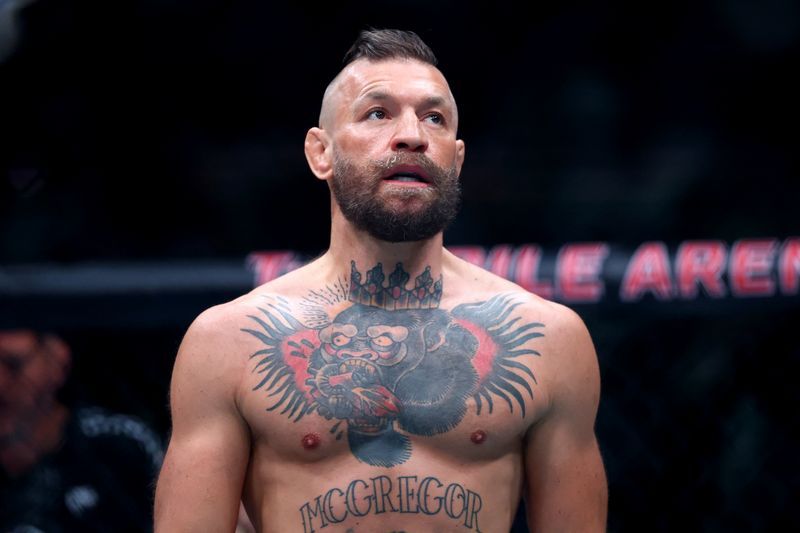
The mixed martial arts world witnessed another setback for Conor McGregor on Saturday at UFC 329 in Las Vegas, as the former two-division champion's much-anticipated comeback fight against Max Holloway unravelled in dramatic fashion within the opening minute. McGregor, attempting to make his competitive return after nearly four years away from the octagon, attempted an aggressive flying kick early in the first round but landed awkwardly, immediately compromising his mobility. What should have been a marquee showdown between two of the sport's finest competitors instead became a cautionary tale about the unpredictability of combat sports and the physical toll demanded by the professional fighting circuit.
The Irishman's injury was evident immediately to observers and to McGregor himself, who signalled to the referee within seconds of the misstep that he was unable to continue. Despite battling through several more seconds of the opening exchanges, the extent of the knee damage became apparent as he withdrew from the bout. The premature conclusion denied fans and the broader MMA community the competitive spectacle they had anticipated, coming as it did after McGregor's extended hiatus from professional fighting. The brevity of the encounter—lasting just over sixty seconds—underscores how quickly fortunes can shift in the unpredictable environment of mixed martial arts competition, where a single miscalculation or moment of misfortune can derail months of preparation and strategy.
McGregor's road back to the octagon has been fraught with obstacles extending well beyond the physical demands of training. His last competitive outing came against Dustin Poirier in July 2021, when he sustained a severe leg fracture that sidelined him for an extended period. When plans materialised for a return bout against fellow fighter Michael Chandler in June 2024, those aspirations were again thwarted when McGregor injured his toe during training camp, forcing cancellation of the eagerly awaited clash. The accumulation of these setbacks demonstrates how the sport's demands create layered vulnerabilities for returning competitors, particularly those attempting comebacks after significant absences from active competition.
Beyond the sporting arena, McGregor's career trajectory has been complicated by matters unrelated to fighting. In 2023, a jury in an Irish civil court determined that McGregor bore liability in connection with allegations dating to 2018. Additionally, the fighter faced penalties from anti-doping authorities in October 2025 after missing three separate collection attempts by Combat Sports Anti-Doping during 2024, resulting in an eighteen-month suspension that was backdated and subsequently expired in March. These extracurricular complications have inevitably affected McGregor's standing, training opportunities, and overall career momentum during a critical period when maintaining competitive edge becomes increasingly challenging with age.
Saturday's opponent Max Holloway, the former featherweight champion, demonstrated magnanimity following the injury, suggesting that a rematch would be worthwhile once McGregor recovers from his setback. Holloway's measured response reflected the mutual respect that often characterises encounters between elite combat athletes, even as the former champion recognised the commercial and sporting appeal of another contest. The pair had previously met in 2013, when McGregor secured victory through unanimous decision in what was the Irishman's earlier career stage. Holloway's willingness to revisit the matchup indicates confidence in his own abilities while simultaneously acknowledging the drawing power that McGregor continues to command within professional fighting circles.
The broader implications of McGregor's injury extend beyond his individual career trajectory, affecting the sport's promotional landscape and fan expectations. McGregor remains one of mixed martial arts' most marketable personalities, with fights featuring his participation generating substantial viewership and commercial interest. His repeated inability to complete fights owing to injury raises questions about whether the demanding nature of competitive mixed martial arts at the highest level is compatible with his current physical condition and readiness. For Southeast Asian followers of the sport, McGregor's struggles highlight the importance of adequate preparation and the inherent risks present in combat athletics, regardless of an athlete's past accomplishments or marketability.
On the same card, British lightweight Paddy Pimblett demonstrated the kind of decisive performance McGregor could not achieve, securing victory over France's Benoit Saint-Denis with remarkable efficiency. Pimblett required less than a minute to execute a chokehold that forced Saint-Denis to submit, showcasing the technical proficiency and explosive capabilities that distinguish elite competitors in the sport. The contrast between Pimblett's decisive success and McGregor's early injury creates a stark illustration of how individual performances can vary dramatically even within the same competitive event, influenced by factors ranging from physical readiness to tactical decision-making in the heat of competition.
Looking ahead, McGregor faces a prolonged rehabilitation process for his knee injury, one that will demand both medical expertise and psychological resilience. The recovery period will test whether he can overcome not only the physical damage but also the mental burden of repeated setbacks. His age—at thirty-seven—introduces additional complexity to the rehabilitation timeline, as recovery for combat athletes becomes more protracted and complications more likely as they advance through their career. The question remains whether McGregor will be able to return to competitive fighting with the sharpness and mobility required to succeed at the elite level, or whether Saturday's injury represents another chapter in an increasingly difficult journey back to the octagon.
For the UFC and its promoters, McGregor's repeated inability to complete scheduled bouts presents ongoing challenges in building reliable event cards and managing fan expectations. The organisation must balance the marketability that McGregor provides with the practical realities of his ongoing injury troubles and legal complications. For Malaysian and Southeast Asian combat sports enthusiasts, McGregor's situation serves as a reminder that even sport's biggest personalities face genuine physical vulnerabilities and that consistent success requires not merely talent and charisma but also good fortune with injury avoidance—an element no athlete can fully control regardless of their investment in training and preparation.

