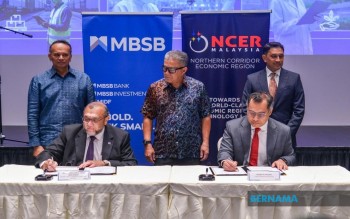
MBSB Bank Bhd and the Northern Corridor Implementation Authority (NCIA) have forged a strategic financing partnership aimed at catalysing business expansion across Malaysia's Northern Corridor Economic Region. The collaboration, formalised through a memorandum of understanding signed in Petaling Jaya on July 17, will make available up to RM1 billion in financing facilities specifically tailored to support small and medium enterprises operating within the region comprising Perlis, Kedah, Penang and Perak.
The initiative signals a concerted effort to deepen financial access for businesses that form the backbone of the Northern Corridor's economy. Speaking at the signing ceremony, MBSB Bank chairman Datuk Wan Kamaruzaman Wan Ahmad emphasised that the partnership creates a catalyst for business growth by removing financial barriers that often constrain SME expansion. The RM1 billion fund will enable qualifying enterprises to enhance operational capacity, forge connections with major supply chains, and ultimately contribute meaningfully to the region's trajectory under the 13th Malaysia Plan.
For SMEs in the Northern region, this partnership addresses a persistent challenge: access to flexible, growth-oriented financing at scale. Many smaller enterprises struggle to bridge the gap between their ambitions and the capital required to realise them. By channelling RM1 billion through MBSB Bank's lending infrastructure, the MoU creates a tangible pathway for businesses to invest in upgrading production capabilities, purchasing equipment, and funding operational improvements that can propel them into larger supply chains.
The agreement carries particular resonance for export-oriented businesses, which form a critical segment of the Northern Corridor's strategic vision. MBSB Bank group chief executive officer Rafe Haneef highlighted the bank's partnership with Europe's Santander Group, a collaboration that extends beyond domestic financing to provide a platform for companies to penetrate international markets. This layered approach—combining local financing with global export support—positions participating SMEs to compete beyond Malaysian shores and capture opportunities in high-value export markets.
The Northern Corridor Economic Region has established itself as one of Malaysia's most dynamic growth zones, consistently attracting domestic and foreign capital into high-tech sectors. The region has developed particular strength in electrical and electronics manufacturing, advanced production facilities, logistics infrastructure, and emerging domains like the digital economy and green technology. By securing dedicated financing for SMEs within this ecosystem, the MBSB-NCIA partnership amplifies the region's capacity to nurture companies at the growth stage, enabling them to scale from small operations into significant economic contributors.
NCIA chief executive Datuk Mohamad Haris Kader Sultan positioned the financing initiative as foundational to the region's medium-term development under Malaysia's broader economic planning. He noted that partnerships of this nature become essential as the country advances under the 13th Malaysia Plan, particularly in building the institutional and financial infrastructure needed to attract investment, accelerate project rollout, and sustain economic momentum. The focus on six strategic sectors—electrical and electronics, advanced manufacturing, agri-food, logistics, digital economy and green technology—reflects deliberate policy choices about where the region's competitive advantages lie.
From a policy perspective, the arrangement exemplifies how development authorities and financial institutions can align their mandates to achieve shared objectives. NCIA, as a statutory body charged with driving economic transformation across the Northern Corridor, requires banking partners capable of deploying capital at scale while maintaining rigorous lending standards. MBSB Bank, meanwhile, gains access to a pipeline of vetted opportunities within high-growth sectors, reducing transaction costs while building market presence in a region poised for accelerated development.
The agri-food sector represents a particularly promising avenue within this partnership. The Northern Corridor encompasses fertile agricultural areas with existing clusters of food processing and export-oriented agribusiness. Access to dedicated financing can help farmers and agribusinesses invest in modern equipment, cold-chain infrastructure, and quality certification needed to supply international markets or large domestic retailers. Similarly, the region's emerging digital economy—comprising software developers, e-commerce enablers, and tech startups—stands to benefit from financing that supports research, talent acquisition, and market expansion.
For Malaysian SME owners and entrepreneurs contemplating expansion into the Northern region, the availability of RM1 billion in dedicated financing materially changes the calculus. Rather than navigating fragmented lending markets or approaching multiple institutions, eligible businesses can access a streamlined application process through MBSB Bank, with support from NCIA's sector expertise. This integration of finance and economic development advice creates value beyond mere capital provision.
The partnership also reflects growing recognition that regional development cannot rest solely on large multinational investments. While foreign direct investment remains important, sustainable economic growth requires building capability within local and medium-sized enterprises. By enabling SMEs to upgrade, expand, and integrate into supply chains, the MBSB-NCIA initiative addresses a critical gap in Malaysia's development architecture—the need to cultivate indigenous competitive capacity across regions.
Looking forward, the success of this financing facility will likely influence how other development corridors structure banking relationships. The NCER's track record of attracting investment, combined with MBSB Bank's commitment to commercial expansion, creates conditions for the RM1 billion to catalyse meaningful business activity. If the facility performs well, it may prompt similar initiatives across other regional development zones, establishing a replicable model for combining targeted finance with sectoral development strategies across Malaysia's regional economy.

