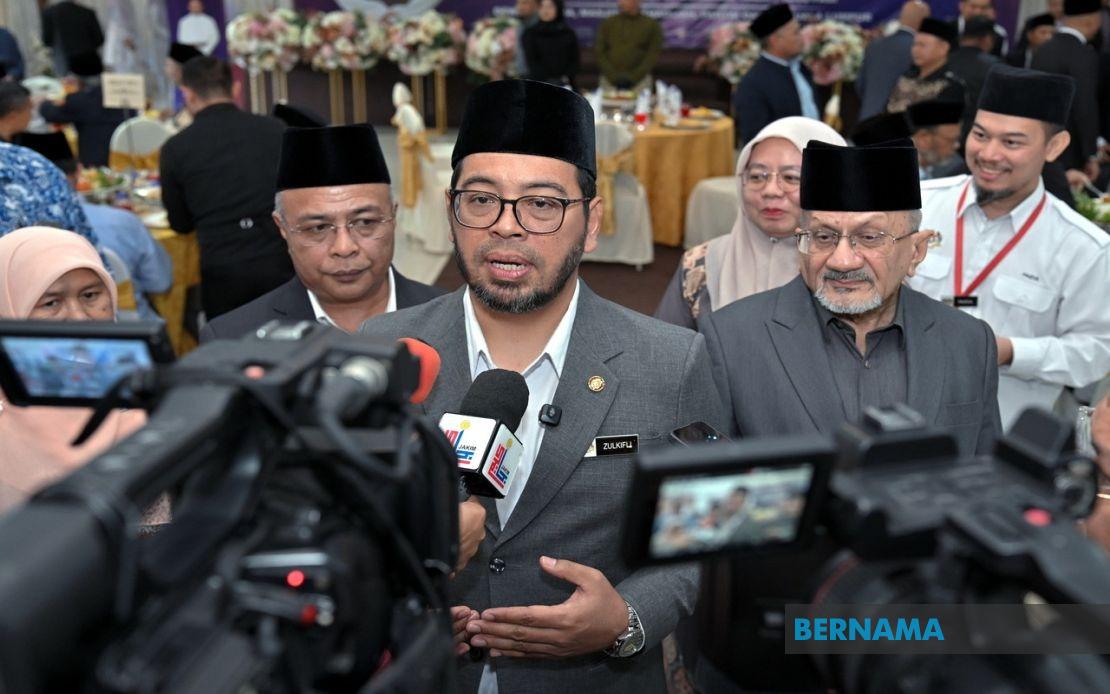
The government has reaffirmed its commitment to constructing Masjid Warisan in front of the Tun Razak Exchange (TRX) tower, with Minister in the Prime Minister's Department (Religious Affairs) Dr Zulkifli Hasan dismissing calls for the project's abandonment. Speaking in Kuala Lumpur on June 23, Dr Zulkifli indicated that the mosque's construction represents a long-established initiative aimed at strengthening the role of religious institutions as focal points for community cohesion and social stability.
The announcement comes amid a period of heightened scrutiny over the project, with some groups having publicly urged the government to suspend work, citing concerns that the mosque could trigger social disharmony and generate public backlash. Rather than retreating from the plan, Dr Zulkifli chose to reframe the debate, positioning the Masjid Warisan as part of an intentional strategy to embed Islamic institutions within Kuala Lumpur's modern urban landscape. His statement reflects a government determination to proceed with infrastructure that underscores Malaysia's identity as a Muslim-majority nation while maintaining its position as a multifaith society.
The minister's defence of the project draws upon international precedent, noting that major cities worldwide accommodate mosques and the Islamic call to prayer as integrated elements of their urban fabric. This comparative approach suggests that rather than being anomalous or destabilizing, the Masjid Warisan follows established global patterns in which religious architecture coexists with commercial and financial hubs. The proximity of the mosque to TRX, one of Malaysia's most ambitious financial and mixed-use development projects, represents a deliberate choice to situate spirituality alongside economic activity—a positioning that carries symbolic weight in how Malaysia conceptualizes modernization.
For those harbouring reservations about the mosque's construction, Dr Zulkifli directed inquiries toward the Federal Territories Islamic Religious Council (MAIWP), suggesting that dialogue rather than obstruction remains the appropriate mechanism for addressing concerns. This approach implies that the government views opposition as stemming partly from information gaps, and that clarification through established Islamic administrative channels can mitigate misgivings. The minister's invitation for dialogue also signals confidence that the project's merits can withstand public scrutiny when properly explained.
The Masjid Warisan initiative must be understood within the broader context of Malaysia's religious governance infrastructure. On the same occasion, Dr Zulkifli formally appointed committee members for Federal Territories mosques and Friday prayer suraus for the 2026-2029 term. The appointment process itself underscores the rigour applied to Islamic institutional management—3,010 nominations across 91 mosques and 124 suraus were subjected to integrity vetting involving the Royal Malaysia Police, the Malaysian Anti-Corruption Commission, and the Insolvency Department. Only 2,914 candidates survived this screening, demonstrating that the government applies stringent standards to those overseeing religious institutions.
This comprehensive vetting mechanism is relevant to understanding the government's broader approach to mosque development and management. If such scrutiny is applied to those administering existing mosques, it suggests similar or equivalent standards would be applied to projects like Masjid Warisan. The procedural rigour signals an intent to ensure that religious infrastructure operates transparently and within accepted governance frameworks, potentially addressing concerns that the project lacks adequate oversight or accountability.
For Malaysian readers and regional observers, the Masjid Warisan decision illuminates ongoing tensions between rapid urban modernization and religious identity preservation in Southeast Asia. Kuala Lumpur, like Singapore, Bangkok, and Jakarta, continuously navigates the integration of religious and secular spaces as cities densify and financial districts expand. The TRX project itself represents Malaysia's ambition to establish a world-class financial centre; the adjacent Masjid Warisan reflects an insistence that economic development need not marginalize Islamic practice or visibility.
The project also carries implications for how Malaysia markets itself internationally. Many investors and businesses view religious and social stability as prerequisites for sustained economic activity. By demonstrating that modern financial infrastructure and prominent mosques can coexist harmoniously, Malaysia potentially strengthens its appeal to both domestic and international stakeholders who value pluralistic yet faith-sensitive governance. The Masjid Warisan thus becomes a statement about Malaysia's capacity to balance development with cultural and religious authenticity.
The government's firm stance is unlikely to end all debate, yet the decision to proceed signals that policy has been set and will not be reversed by public pressure alone. This positions the Masjid Warisan as a test case for Malaysia's ability to execute symbolic religious projects within predominantly Muslim-led governance while maintaining social cohesion in an increasingly diverse metropolitan context.

