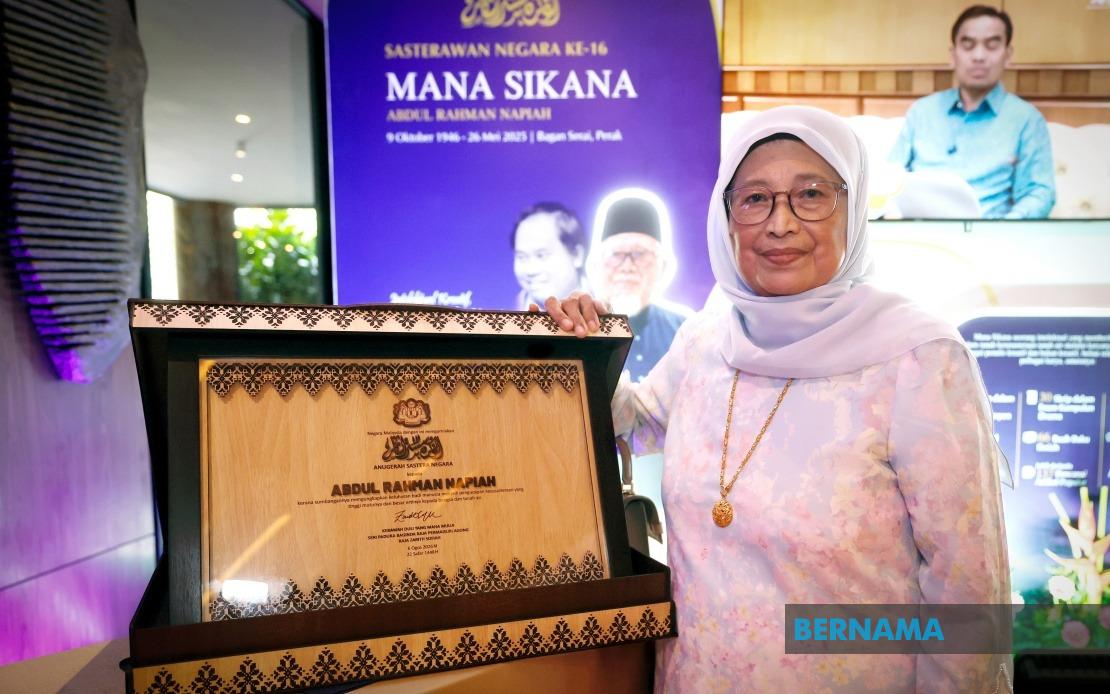
Malaysia's literary establishment has bestowed its highest honour upon a towering figure in the nation's cultural landscape—albeit one no longer present to witness the moment. Mana Sikana, the pen name of Dr Abdul Rahman Napiah, has been designated the 16th National Laureate, an accolade that recognises his transformative role in shaping Malaysian literature across seven decades of prolific creative and scholarly endeavour. The award was presented today by Her Majesty Raja Zarith Sofia, Queen of Malaysia, at a ceremony in Kuala Lumpur, with Salmah Ali, the recipient's widow, accepting on his behalf amid visible emotion.
The conferment carries particular poignancy given that Sikana passed away last May at the age of 80 from heart complications, having already received advance notice of the honour's likelihood. According to Salmah Ali, who is 82, her husband had long anticipated this recognition as the capstone to a career distinguished by relentless innovation and mentorship. She recounted that on the very day he suffered the fatal illness, he had been engaged in professional work for Dewan Bahasa dan Pustaka, the government's premier language and literary institution, underscoring his commitment to furthering Malaysian letters until his final hours.
Sikana's trajectory through Malaysian academia and creative life represents a distinctive model of intellectual engagement. Born in Bagan Serai, Perak, on October 9, 1946, he began his professional journey as a schoolteacher before ascending into university-level scholarship and creative direction. His career arc carried him through multiple prestigious institutions, including Universiti Kebangsaan Malaysia, Universiti Pendidikan Sultan Idris, and latterly Nanyang Technological University in Singapore, where he maintained influence across the broader Southeast Asian intellectual sphere. This regional reach extended to Indonesia as well, where he held visiting lectureships, positioning him as a transnational figure in contemporary Asian letters rather than a writer confined to national borders.
Sikana's creative output ranged far beyond the traditional novel or short story. His wife emphasised that his prolific television and radio drama production, particularly during his years in Johor Bahru, where he created content for Singaporean broadcasters alongside Malaysian networks, demonstrated a conviction that serious literature could and should reach mass audiences through emerging media. This boundary-crossing sensibility—treating drama, criticism, theory, and teaching as interconnected dimensions of literary work—shaped how he influenced successive generations of Malaysian writers and thinkers.
Education Minister Fadhlina Sidek, speaking at the ceremony, framed the National Laureate selection as formal recognition of Sikana's foundational contributions to strengthening Malaysian literature through multiple channels: creative writing itself, the development of literary theory, critical analysis, and scholarly discourse. Her remarks crystallised the consensus among Malaysia's cultural custodians that Sikana's achievement transcended entertainment or commercial success; he had systematically advanced the conceptual and artistic infrastructure through which Malaysian letters could be understood and further developed. This institutional dimension of his work—building frameworks, mentoring talent, importing theoretical innovations—often receives less public attention than individual creative masterworks, yet proves essential to sustaining a national literary culture across generations.
Salmah Ali spoke movingly of her husband's deep satisfaction in transmitting knowledge across his own family line. Their four children and twelve grandchildren benefited from his ongoing engagement with literature and writing until his death, suggesting that his pedagogical impulse extended into the domestic sphere. This family transmission of intellectual values reflects a pre-digital era conception of literary culture, in which household conversations and direct mentorship sustained aesthetic and intellectual traditions alongside formal institutional channels.
The recognition arrives as part of a broader Malaysian pattern of honouring cultural figures through national honours systems. The National Laureate designation represents the pinnacle of literary recognition available in the Malaysian context, reflecting state acknowledgment of literature's significance to national identity and social cohesion. By conferring the honour posthumously, the government affirms that Sikana's contributions have already entered the permanent record of Malaysian cultural achievement, requiring no further validation through his continued living presence.
For Southeast Asian readers and policymakers, Sikana's trajectory offers instructive lessons about the institutional conditions sustaining serious literary culture. His successful navigation of multiple universities, media platforms, and national contexts depended partly on individual talent but also on relatively stable funding for higher education, pluralistic broadcasting systems, and cultural institutions willing to experiment with serious drama. The infrastructure supporting such careers has altered substantially in subsequent decades, posing questions about how future literary figures might emerge and sustain themselves.
Salmah Ali's emotional acceptance of the award crystallised the bittersweet nature of posthumous recognition. She articulated pride in her late husband's achievement whilst simultaneously mourning his absence from the ceremony honouring his life's work. This poignancy underscores a perpetual tension in cultural history: the gap between deserved recognition and the moment of its conferment, between a figure's awareness of approaching esteem and the actual experience of its public acknowledgment.

