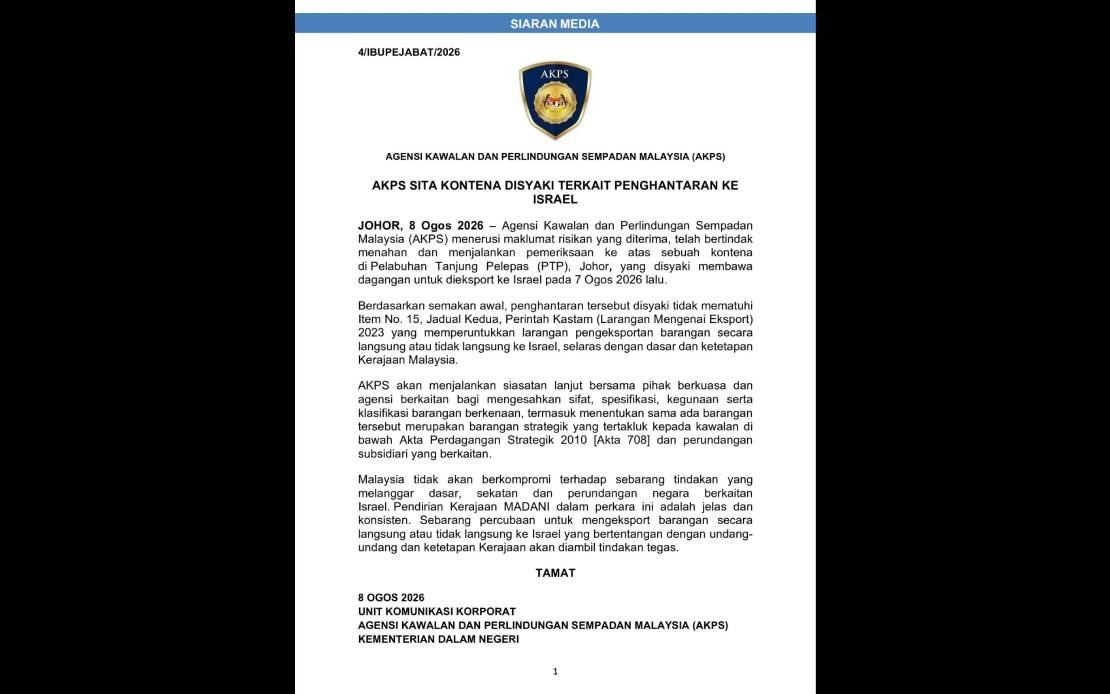
Prime Minister Datuk Seri Anwar Ibrahim has publicly commended the Malaysian Border Control and Protection Agency (AKPS) for intercepting a shipment at the Port of Tanjung Pelepas yesterday, reinforcing Malaysia's resolute position on trade restrictions related to Israel. The seizure represents a tangible enforcement action that demonstrates how Malaysian authorities are implementing the government's stated commitment to prevent the country from becoming a conduit for commercial activities that could benefit the Israeli government.
In remarks posted to Facebook, Anwar framed the container detention within the broader context of Malaysia's foreign policy stance on the Israeli-Palestinian conflict. He emphasised that the operation reflected the nation's determination to ensure its ports and logistics infrastructure do not inadvertently facilitate trade flows that would support what the government characterises as Israeli actions against Palestinians. This positioning aligns Malaysia's trade enforcement with its diplomatic commitments and public statements on Middle Eastern affairs, creating consistency between policy declarations and practical implementation.
The Prime Minister further contextualised the seizure within Malaysia's adherence to The Hague Group's framework, an international coalition focused on addressing various geopolitical issues. Anwar referenced the existing prohibition on Israeli-registered vessels and cargo ships carrying Israeli goods from utilising Malaysian ports, a ban that has been in force since December 2023. This regulatory architecture demonstrates that the AKPS action represents not an isolated incident but rather part of a comprehensive system designed to enforce these trade restrictions systematically across Malaysia's maritime facilities.
According to the AKPS statement, the inspected container was suspected of violating Item No. 15 of the Second Schedule of the Customs (Prohibition of Exports) Order 2023. This specific reference indicates that Malaysian customs authorities possess detailed regulatory mechanisms to identify prohibited shipments, with the legal framework explicitly prohibiting direct or indirect export of goods to Israel in line with government policy directives. The invocation of this particular customs order demonstrates that Malaysia has translated its political position on Israel into enforceable legal instruments that border control officers can apply uniformly.
The indirect export clause within the customs order is particularly significant, as it closes potential loopholes where goods might be shipped to third countries with the intention of eventual transfer to Israel. This legal sophistication reflects an understanding that modern supply chains frequently involve transshipment through intermediary ports, and that effective enforcement requires authorities to scrutinise not merely the stated final destination but also the apparent intent behind the shipment. The AKPS interception suggests that officers identified indicators suggesting the container's true destination differed from its official documentation.
From a regional trade perspective, Malaysia's enforcement of these restrictions carries implications for logistics operators and exporters throughout Southeast Asia. Businesses utilising Malaysian ports must ensure their shipments comply with the export prohibition order, or risk detention and potential legal consequences. This creates a compliance burden on regional trading networks and may incentivise some shippers to utilise alternative routing through countries without similar restrictions, potentially affecting Malaysia's port throughput and maritime services revenue.
Anwar's public endorsement of the AKPS action serves an important political function within Malaysia's domestic context. The Prime Minister has consistently positioned himself as a leader deeply concerned with Palestinian rights and Islamic solidarity, and publicly celebrating enforcement of Israel-related trade restrictions reinforces this political identity to domestic constituents, particularly within Malaysia's Muslim-majority population. The Facebook post transforms a routine customs enforcement matter into a broader statement about national values and international principles.
The government's articulation of defending Palestinian dignity through trade restrictions reflects a particular interpretation of international law and humanitarian principles. Malaysian officials argue that maintaining these trade barriers represents support for justice and adherence to international legal norms regarding occupied territories. This framing positions Malaysia as a principled nation willing to bear certain economic costs to uphold what its leadership considers moral imperatives, even when other trading partners maintain normal commercial relations with Israel.
The timing of the AKPS seizure and the Prime Minister's public response suggest coordinated messaging around Malaysia's Middle East policy. By highlighting successful enforcement, the government demonstrates to domestic audiences that its stated commitments translate into concrete actions. This approach also serves to preempt criticism that Malaysia's pro-Palestinian rhetoric lacks substance, by providing evidence of enforcement mechanisms actively working to prevent prohibited trade flows.
For Malaysian businesses and port operators, the seizure underscores the need for robust due diligence procedures when processing containerised cargo. Export companies must verify their customer base and understand where their goods ultimately end up, rather than relying solely on stated destinations in shipping documentation. Freight forwarders and logistics companies operating through Malaysian ports should implement enhanced screening procedures to avoid inadvertent involvement in prohibited trade chains.
The enforcement action also reflects broader regional dynamics, as several Southeast Asian nations navigate balancing commercial interests with political pressure regarding Israeli relations. While some regional countries maintain robust trade ties with Israel despite Palestinian concerns, Malaysia has chosen to enforce explicit restrictions. This differentiated approach highlights how individual Southeast Asian governments are pursuing distinct policies toward Israel based on their own domestic political considerations and values frameworks.
Looking forward, the visibility accorded to this seizure may encourage greater scrutiny of Israel-related shipments passing through Malaysian maritime infrastructure. Exporters and importers should anticipate that Malaysian customs authorities will continue applying the Customs (Prohibition of Exports) Order 2023 with vigilance. The political capital the Prime Minister has invested in celebrating this enforcement action suggests the government intends to maintain high-profile implementation of these trade restrictions as part of its broader foreign policy narrative.

