Malaysia faces a silent but deadly health crisis: sudden cardiac arrest kills without warning, yet the nation's survival rates remain among the bleakest globally, hovering between just 0.5 and 8.5 per cent. The disparity between these figures and those in developed nations points to a systemic gap in emergency infrastructure and public preparedness. Sunway Medical Centre Velocity has recognised this gap and launched an ambitious initiative to transform how Kuala Lumpur responds to cardiac emergencies, placing life-saving Automated External Defibrillators at strategically chosen public locations while simultaneously equipping ordinary Malaysians with the knowledge to act decisively when seconds determine survival.
The urgency of this initiative cannot be overstated. When sudden cardiac arrest strikes, the body's tolerance for oxygen deprivation is brutally unforgiving. Within eight to ten minutes, the window for meaningful intervention closes dramatically, and each passing moment without Cardiopulmonary Resuscitation significantly reduces chances of recovery. For context, in countries with robust public access defibrillation programmes, survival rates can exceed 50 per cent—a sobering reminder of what Malaysia could achieve with adequate infrastructure and training. The current Malaysian figures suggest that delays in response and the physical unavailability of life-saving equipment are claiming preventable deaths daily. Dr Wee Tong Ming, Medical Director and Consultant Emergency Physician at Sunway Medical Centre Velocity, articulates this reality clearly: emergencies often prove fatal not because help is unavailable, but because help arrives too slowly or equipped inadequately.
The hospital's intervention strategy demonstrates sophisticated urban planning applied to emergency medicine. Rather than scattering defibrillators randomly, Sunway Medical Centre has identified high-traffic nexuses where cardiac emergencies are statistically most likely to occur or where crowds gather regularly. The selection spans transportation infrastructure, including Tun Razak Exchange, Bukit Bintang, Ampang Park and Muzium Negara MRT stations, recognising that public transit hubs concentrate vulnerable populations and time-sensitive environments. Commercial landmarks including Aquaria KLCC, Menara Public Bank, and Menara Public Bank 2 represent another critical tier, where office workers and visitors represent a demographic prone to stress-related cardiac events. This geographic approach acknowledges that accessibility matters little if a device sits in an obscure location during an actual emergency.
Beyond mere placement, Sunway Medical Centre has designed each installation for maximum usability during chaos. Every AED unit is accompanied by clearly marked standees that facilitate rapid discovery and deployment. Most innovatively, QR code stickers link bystanders directly to the hospital's "Save A Number, Save A Life" campaign webpage, providing immediate guidance through a smartphone interface—acknowledging that many people facing cardiac emergencies have never used a defibrillator and will seek reassurance through digital instruction. Linking to General Practitioner clinics through the same QR codes creates a support ecosystem where medical professionals can reinforce training and where public awareness becomes embedded within existing healthcare touchpoints.
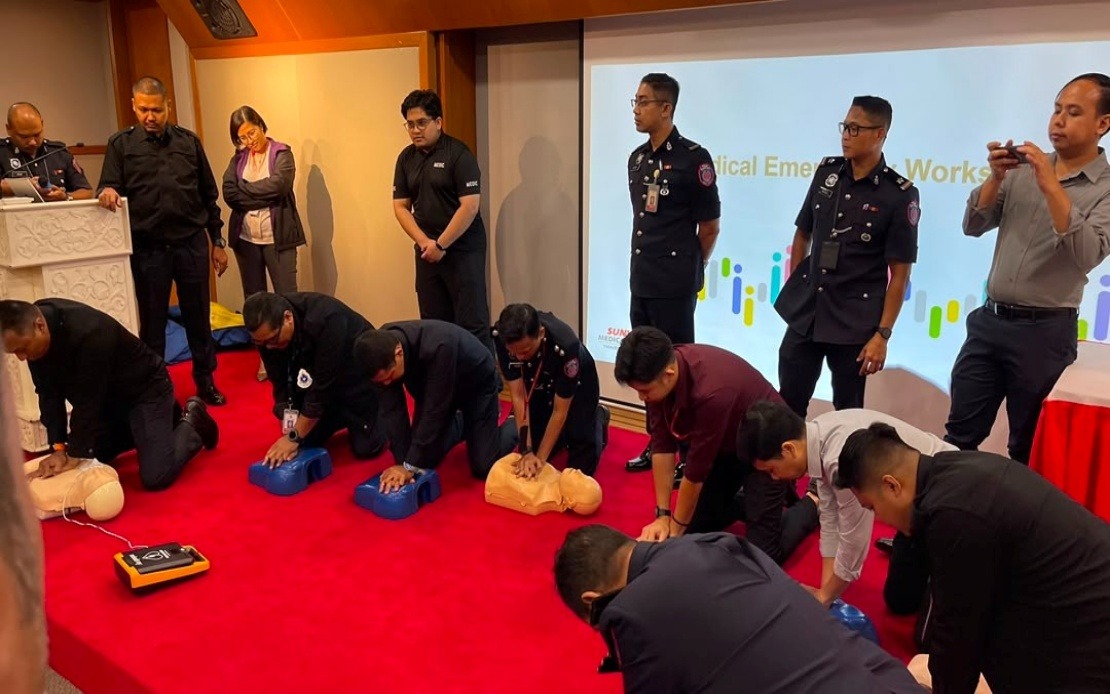
The infrastructure alone, however, represents only half the solution. Sunway Medical Centre Chief Executive Officer Susan Cheow emphasises that equipment means nothing without knowledge. The hospital has paired physical installations with targeted on-site training sessions and Accident and Emergency awareness talks, transforming the initiative from a hardware deployment into a comprehensive public health campaign. These sessions teach the general public to recognise cardiac arrest symptoms—a critical skill, as many bystanders freeze or misidentify the condition during actual emergencies. Participants learn hands-on Cardiopulmonary Resuscitation techniques, understanding compression depth, hand placement, and rhythm, converting nervous untrained bystanders into capable first responders.
For Malaysian readers, the significance extends beyond Kuala Lumpur's boundaries. The National Heritage Building placement within Stadium Merdeka's Merdeka 118 Precinct and locations spanning from Jalan Sultan Sulaiman to Public Bank's IT & Training Centre indicate that major employers and cultural institutions are being integrated into this survival infrastructure. This pattern suggests a model that other Malaysian cities—Penang, Johor Bahru, Melaka—could feasibly replicate, creating a nationwide network of cardiac emergency preparedness. Companies operating at these linked locations gain competitive advantage in corporate wellness and duty-of-care obligations, while employees and visitors benefit from dramatically improved survival odds should catastrophe strike. The initiative implicitly challenges other Malaysian healthcare providers and corporate sector leaders to adopt similar programmes.
Dr Wee articulates a fundamental principle underlying this initiative: timing supersedes all other factors in cardiac arrest survival. Delay of just minutes translates directly into neurological damage or death. Traditional emergency response systems, dependent on ambulance dispatch and hospital transportation, introduce delays incompatible with cardiac arrest physiology. By placing defibrillators throughout urban spaces and enabling untrained bystanders to deploy them, Sunway Medical Centre is effectively creating a decentralised first-response network that compresses the timeline from discovery to intervention from minutes to seconds. This represents a paradigm shift from waiting for professional rescuers to activating nearby members of the public as instant responders.
The psychological dimension of this initiative merits consideration as well. Many Malaysians report feeling paralysed during medical emergencies, believing that untrained intervention might cause harm or that professionals will arrive promptly enough. Sunway Medical Centre explicitly targets this helplessness through its messaging and training approach. By emphasising that "no one should feel helpless" and that equipment accessibility pairs with knowledge accessibility, the initiative reframes public bystanders from passive observers into empowered agents of survival. Training sessions build confidence, transforming abstract fear into concrete competence. This psychological shift—from helplessness to agency—may prove as significant as the physical infrastructure in improving outcomes.
The initiative also highlights corporate social responsibility's potential when applied with strategic intentionality. Sunway Medical Centre's "Save A Number, Save A Life" campaign transcends typical CSR performativity, instead addressing a measurable gap between Malaysia's cardiac arrest survival rates and those achievable through systematic intervention. The naming convention itself—saving a number that could be any Malaysian—emphasises universal vulnerability and collective responsibility. By embedding defibrillators within public infrastructure and commercial spaces rather than limiting access to hospital grounds, the hospital demonstrates that genuine public health impact requires surrendering control and trusting communities to deploy life-saving tools effectively.
For healthcare policy makers observing this initiative, the evidence suggests that Malaysia's survival rate statistics need not remain static. Successful international models consistently combine three elements: accessible defibrillators in public spaces, trained responders capable of deployment, and system-wide coordination ensuring rapid ambulance dispatch follows bystander intervention. Sunway Medical Centre is addressing the first two; broader systemic improvement would require health ministry coordination to standardise defibrillator placement nationally, mandate emergency response training in schools and workplaces, and integrate public access defibrillation into ambulance dispatch protocols. The hospital's initiative provides a template and proves the concept while implicitly challenging government and private sectors to scale the approach.
The timing of this initiative reflects both opportunity and urgency. As Kuala Lumpur's commercial and cultural infrastructure expands—evidenced by developments like Merdeka 118—incorporating life-saving equipment into urban planning represents optimal integration. Rather than retrofitting existing spaces, new developments can architect emergency preparedness from conception, standardising defibrillator locations as basic amenities alongside water fountains and emergency exits. This forward-looking approach suggests that Sunway Medical Centre envisions cardiac arrest preparedness not as an exceptional intervention but as fundamental urban infrastructure, as ordinary and expected as fire extinguishers or first aid kits.
Ultimately, this initiative confronts a uncomfortable Malaysian reality: systematic underinvestment in public health infrastructure outside hospital walls costs lives measurably and preventably. Sudden cardiac arrest victims need intervention within minutes; Malaysia's current system largely fails to deliver this timeline. Sunway Medical Centre's programme demonstrates that improvements remain achievable through coordinated deployment of technology, training, and strategic thinking. Whether this initiative catalyses broader systemic change or remains an isolated urban project will partly determine whether Malaysia's cardiac arrest survival rates improve from their current tragic lows toward international standards where trained communities armed with accessible defibrillators save half of cardiac arrest victims rather than fewer than one in ten.

