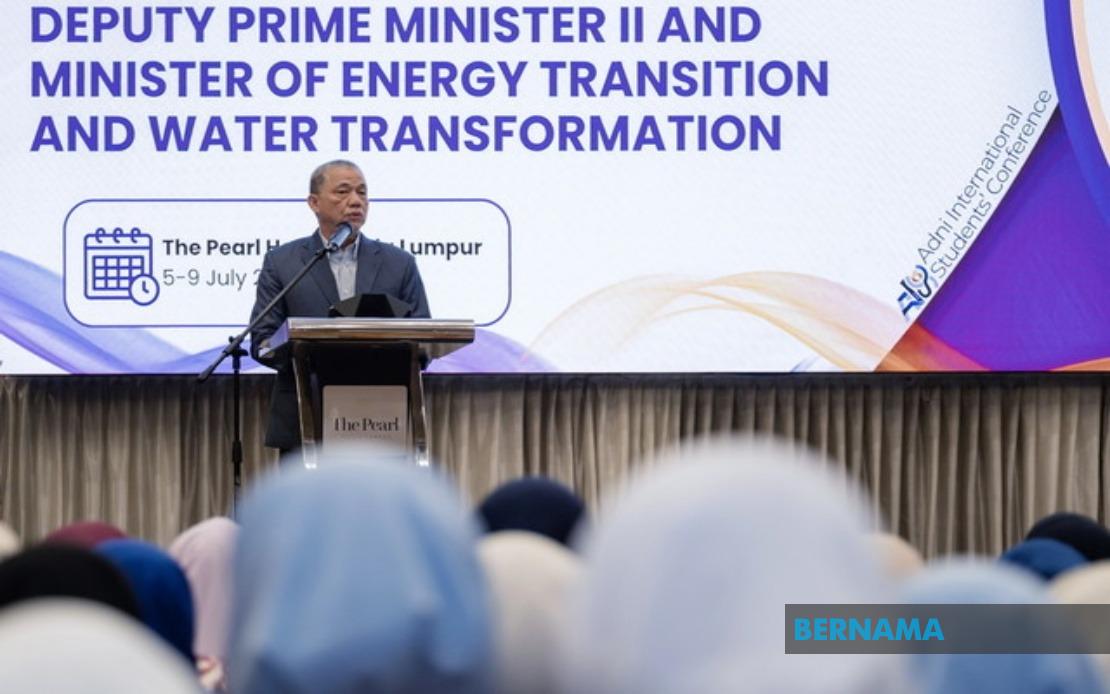
Malaysia's trajectory in the coming decades will be shaped more by the calibre of its workforce and society than by conventional measures of economic output or technological prowess, according to Deputy Prime Minister Datuk Seri Fadillah Yusof. Speaking at the opening of the ADNI International Students' Conference (AISC) 2026 in Kuala Lumpur, Fadillah articulated a vision that repositions human development as the cornerstone of national progress, signalling a strategic pivot in how policymakers view the nation's competitive positioning in an increasingly complex global landscape.
The Deputy Prime Minister outlined the specific competencies that will distinguish successful societies from those that stagnate. Beyond technical proficiency or traditional academic achievement, Fadillah highlighted the necessity for individuals equipped with critical thinking abilities, sophisticated communication skills, and the flexibility to navigate continuous transformation. These capabilities have become essential as economies worldwide grapple with interconnected challenges that transcend borders and sectors, making adaptability a fundamental rather than supplementary skill in professional and civic life.
Fadillah's remarks reflect an emerging consensus among Southeast Asian leadership that the region's future depends less on accumulating capital or infrastructure and more on cultivating populations capable of solving multifaceted problems collaboratively. The challenges he identified—climate disruption, pandemics, the digital revolution, and persistent socioeconomic disparities—share a common thread: they cannot be resolved through unilateral action or within institutional silos. Addressing these requires coordinated effort spanning governmental bodies, universities, commercial enterprises, community organisations, and youth movements, each contributing distinctive perspectives and resources.
The MADANI Government's positioning of human capital development as its philosophical centrepiece echoes historical governance principles articulated by Malaysia's third Prime Minister Tun Hussein Onn, who emphasised that national strength ultimately derives from the unity and integrity of its citizenry rather than material accumulation alone. This framing carries particular resonance for Malaysia, a nation whose demographic diversity and multicultural composition represent both a distinctive asset and a continuous challenge. Fadillah's invocation of shared values, reciprocal respect, and institutional trust as society-binding forces addresses the reality that technological infrastructure, while valuable, proves insufficient for cohesive nation-building.
The Deputy Prime Minister expanded his conception of development beyond narrowly economic parameters to encompass education quality, population health and wellbeing, ethical foundations, intellectual creativity, environmental stewardship, and social integration. This multidimensional framework acknowledges that sustainable national progress requires attending simultaneously to multiple dimensions of human flourishing. Countries that excel in economic metrics while neglecting education infrastructure, public health, or social trust ultimately underinvest in long-term competitiveness and regional influence.
AISC 2026, which convened approximately 150 domestic and international participants under the banner 'Thriving Together: Diversity, Education and Wellness in a Digital World', embodied principles aligned with the United Nations' Sustainable Development Goals framework. The conference structure itself—bringing together young people from across Southeast Asia including Thailand, the Philippines, and Indonesia—creates conditions for cross-cultural understanding and knowledge exchange that transcend governmental and institutional boundaries. Such platforms facilitate the emergence of networks and shared perspectives among future leaders across the region, potentially influencing policy trajectories for decades.
Fadillah underscored that opportunities for rigorous intellectual engagement and cross-border cultural interaction constitute investments in human capital formation. By exposing students to diverse viewpoints and collaborative problem-solving experiences, such conferences cultivate individuals who can operate effectively within international contexts while maintaining strong connections to national identity and values. The emphasis on both global competency and rooted identity reflects sophisticated understanding that the most effective regional actors balance cosmopolitan outlook with cultural grounding.
A particularly noteworthy dimension of Fadillah's address involved his meditation on artificial intelligence and technological displacement. While acknowledging that algorithmic systems will inevitably become increasingly sophisticated in narrow domains, he articulated a boundary distinguishing computational capability from human wisdom—the synthesis of knowledge, experience, and judgment that technology cannot replicate. Similarly, he identified compassion, inherently tied to human experience and embodied understanding, as irreplaceable by algorithmic systems. This positioning does not reject technological advancement but rather locates it within a framework where human attributes remain primary and technology serves instrumental purposes.
For Malaysia specifically, and the Southeast Asian region broadly, Fadillah's emphasis on human capital quality carries substantial implications. The region faces intensifying competition from established economies in technology and capital-intensive manufacturing, and from lower-cost jurisdictions in labour-dependent sectors. Competitive advantage increasingly accrues to nations that can develop workforces capable of innovation, adaptation, and complex problem-solving across multiple domains. Malaysia's aspirations to achieve high-income status and regional influence depend fundamentally on this capacity development rather than on incremental improvements to existing economic structures.
The MADANI Government's rhetorical prioritisation of human capital development signals recognition that previous policy approaches, while generating growth, may have underinvested in education quality, social cohesion, and institutional trust. This reorientation could influence resource allocation, curriculum development, and institutional reform across educational and governmental sectors. However, translating rhetorical emphasis into systemic change requires sustained commitment and substantial investment, particularly in regions and demographics historically marginalised within development frameworks.
The international composition of AISC 2026 reflects Malaysia's positioning as a regional convener and intellectual hub. By hosting conferences that bring together young people from across Southeast Asia, Malaysia enhances its soft power and cultivates networks of future leaders who have experienced Malaysian hospitality, educational institutions, and professional environments. These intangible benefits complement more measurable economic advantages, contributing to regional influence through relationship-building and cultural diffusion.
Fadillah's address ultimately articulates a vision of national development in which human flourishing—encompassing education, ethics, creativity, health, and social connection—constitutes the foundation upon which economic prosperity and regional competitiveness rest. This perspective inverts conventional development hierarchies that treat social investment as secondary to economic growth, instead proposing that sustainable advancement requires simultaneous attention to material conditions and human capabilities. For Malaysia and its Southeast Asian neighbours, embracing this integrated approach to human capital development may prove determinative in navigating regional competition and addressing shared challenges in the decades ahead.

