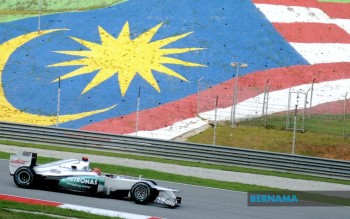
Malaysia is set to welcome Formula 1 back to the Sepang International Circuit when it hosts the Bahrain Grand Prix from October 2–4, 2026, in what motorsport insiders describe as both an economic opportunity and a crucial test for the country's motorsport future. The one-off arrangement, confirmed by Formula 1 and the Fédération Internationale de l'Automobile (FIA), will position Malaysia between the Azerbaijan and Singapore legs of the championship calendar, potentially capturing considerable tourism and spending across Southeast Asia's established hospitality corridor.
For Malaysian policymakers and industry stakeholders, the prospect carries particular significance as a barometer for whether permanent F1 operations might resume in the country after a nine-year absence. Datuk Razlan Razali, former chief executive officer of Sepang International Circuit, outlined the strategic logic underpinning Malaysia's selection as host venue. His analysis centred on cost efficiency—a critical factor when alternative European circuits such as Portimão were under consideration. The Sepang facility's established operational standards and proven capacity to handle world-class motor racing events position it as the economically pragmatic choice, irrespective of which promotional entity stages the race.
The technical requirements for hosting an F1 event at Sepang present manageable challenges, according to Razali's assessment. While the circuit currently lacks FIA homologation for Formula 1 racing, he characterised the gaps as resolvable without substantial infrastructure overhaul. The FIA's mandatory pre-race inspection will determine whether modifications are necessary, though he suggested that most essential facilities already meet championship standards. Should Bahrain choose to fund facility upgrades as part of its hosting arrangement, such investments would generate lasting benefits for Malaysia's motorsport infrastructure—a potential secondary gain beyond the immediate event weekend.
The compressed timeline between announcement and execution introduces legitimate planning constraints, particularly regarding international visitor recruitment. Formula 1 enthusiasts typically commence travel arrangements at least six months ahead, creating a narrow window for overseas promotional campaigns. Razali nonetheless expressed confidence that dedicated motorsport fans would prioritise attendance, drawn by the rare opportunity to experience F1 competition at a Southeast Asian venue. Domestic tourism offers more reliable momentum, with Malaysian spectators requiring shorter lead times for attendance decisions and travel logistics.
Beyond spectator attendance, the race weekend is anticipated to catalyse economic activity across multiple domestic sectors. Local food and beverage operators, construction contractors, hospitality providers, and event services suppliers stand to benefit from increased demand and spending. Razali suggested that appointing Malaysian contractors and workforce during the racing weekend represents a straightforward commercial logic for Bahrain's organising entity, particularly given local expertise availability and cost competitiveness. The rental arrangement—wherein Bahrain bears operational costs—positions Malaysia to capture economic spillovers with minimal financial exposure or public expenditure risk.
Tan Sri Mokhzani Mahathir, president of the Motorsports Association of Malaysia, framed the event as particularly significant for younger motorsport enthusiasts who have no memory of Malaysia's previous championship era. The association's regulatory role will focus on ensuring FIA compliance, safety standards, and circuit readiness—functions leveraging Malaysia's established protocols and experience. Mokhzani's assessment of economic multipliers extended across hospitality, airline operations, and tourism sectors, noting that international spectators typically constitute approximately 30 per cent of Formula 1 audiences. The calendar positioning immediately preceding Singapore's Grand Prix creates a natural routing opportunity: global F1 followers will gravitate toward Malaysia's lower cost structures while retaining their regional presence, benefiting both countries' tourism economies.
From a financial perspective, Malaysia's risk profile differs fundamentally from traditional host arrangements. With Bahrain assuming promotional and operational expenses, Malaysia's return on investment effectively becomes open-ended, concentrated in secondary economic benefits rather than contingent on gate revenues or broadcast income. Mokhzani articulated this asymmetry explicitly: external funding eliminates the downside exposure that typically constrains small nations' willingness to host major sporting spectacles. This structural advantage positions Malaysia to harvest genuine economic stimulus without bearing the substantial financial burdens that historically rendered F1 hosting economically questionable.
The permanent return of Formula 1 to Malaysia remains contingent on circumstances beyond the immediate October 2026 event. Razali characterised this prospect as remote given championship hosting's notoriously escalating cost trajectory. However, he suggested that Prime Minister Datuk Seri Anwar Ibrahim might explore future possibilities during the race weekend itself, should political appetite and economic modelling support renewed commitment. The single-race arrangement thus functions as both immediate opportunity and exploratory platform for deeper engagement with Formula 1's organisational apparatus.
Former F1 driver Alex Yoong introduced a counterbalance to prevailing optimism regarding one-off racing spectacles. His perspective emphasised that singular events, while generating short-term economic activity, should constitute components within broader motorsport ecosystem development strategy. Yoong advocated for leveraging F1's platform visibility to strengthen grassroots driver development programmes, junior racing infrastructure, and regional motorsport investment architectures. His experience navigating both elite championship competition and Malaysia's motorsport growth challenges informed his argument that championship-calibre facilities should anchor systematic talent cultivation and industry expansion rather than function primarily as venue rentals.
The strategic implications of Malaysia's F1 return extend beyond conventional tourism metrics and near-term revenue projections. Championship racing carries symbolic weight within national sporting narratives and regional positioning. Malaysia's demonstrated capacity to host international motor racing at championship level reinforces competitive messaging regarding national infrastructure quality, operational competence, and investment-grade governance. For policymakers calibrating Malaysia's positioning within Southeast Asia's competitive landscape, motorsport excellence functions as tangible evidence of technical sophistication and institutional capacity—dimensions that resonate within global investor communities and multinational corporate decision-making.
Industry consensus converges on the reasonable assessment that October 2026 represents genuine opportunity with manageable execution risk. Technical infrastructure exists. Regulatory frameworks operate effectively. International sporting governance procedures are established and functional. The compressed planning horizon presents challenges but not insurmountable impediments given Malaysia's experience and resource availability. Whether this event becomes catalyst for deeper championship engagement or remains an isolated episode depends substantially on decisions to be made during the race weekend itself—underscoring the significance of ensuring promotional sophistication and strategic positioning alongside operational excellence.

