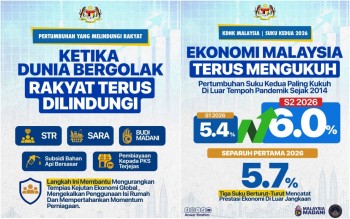
Malaysia's economy delivered robust expansion in the second quarter of 2026, with gross domestic product growth reaching six per cent, a performance that defied expectations even as global economic momentum faltered. Prime Minister Datuk Seri Anwar Ibrahim announced the result on Thursday, describing the acceleration as a testament to the MADANI Government's approach to insulating the domestic economy from external shocks. The second-quarter reading represents the most vigorous expansion during the same period in over a decade when excluding years affected by the pandemic-driven volatility, an achievement particularly noteworthy given the turbulent international environment.
The global economy has cooled considerably in recent quarters, burdened by persistent supply chain disruptions stemming from geopolitical tensions in West Asia and inflationary pressures that have swept through international markets. Several major trading partners have experienced slower growth trajectories, yet Malaysia managed to post acceleration that exceeded what market analysts had forecast. This performance suggests that deliberate policy choices and domestic demand have provided enough momentum to sustain economic momentum despite headwinds that would typically constrain growth in export-dependent developing economies.
Anwar attributed the result directly to the MADANI Government's suite of social assistance and price-stabilisation initiatives introduced to mitigate the impact of external inflationary shocks on ordinary Malaysians. The government has deployed targeted cash transfers including BUDI MADANI, Sumbangan Tunai Rahmah (STR), and Sumbangan Asas Rahmah (SARA)—programmes designed to preserve household purchasing power during periods of elevated international commodity prices. These measures reflect a deliberate countercyclical approach, injecting purchasing power into the hands of lower and middle-income groups whose consumption patterns drive domestic economic activity.
Beyond the visible cash assistance programmes, the prime minister highlighted the government's less publicised efforts to maintain price stability and ensure adequate supply of essential goods across the archipelago. These behind-the-scenes interventions likely include strategic price controls on staple goods, coordination with major retailers and distributors, and possibly subsidies on key commodities. The combination of direct income support and supply-side management appears to have created conditions where household consumption remained resilient even as global economic conditions deteriorated, allowing domestic demand to compensate for any softening in export demand.
The Q2 2026 result carries significant implications for Malaysia's economic trajectory heading into the remainder of 2026 and beyond. Achieving six per cent growth in an environment where many developed and emerging-market peers struggled to maintain momentum demonstrates the underlying strength of Malaysia's diversified economy. The manufacturing sector, which has traditionally been the engine of Malaysian growth, appears to have maintained vitality, while services including tourism and finance appear to have benefited from domestic spending patterns as well as returning international travel flows.
However, Anwar struck a cautious tone regarding future prospects, emphasising that sustained momentum cannot be assumed without continued policy attention and structural improvements. The prime minister signalled that the MADANI Government intends to move beyond mere cyclical support measures to address longer-term challenges around income distribution, employment quality, and support for vulnerable populations. This framing suggests recognition that one quarter of strong growth, whilst encouraging, does not automatically ensure that the benefits of economic expansion reach all segments of society equally.
The challenge ahead involves maintaining this growth trajectory whilst simultaneously addressing structural concerns about inequality and social mobility. Malaysia's economy has historically generated solid headline growth figures, yet household income growth has lagged productivity gains in some sectors, and employment creation has not always translated into higher-quality job opportunities offering career progression and skills development. The MADANI Government's emphasis on "meaningful income" and "quality job opportunities" signals intention to move away from pure growth maximisation towards growth that creates genuine improvements in living standards across different socioeconomic groups.
Regional observers will closely watch whether Malaysia's outperformance persists in subsequent quarters, particularly if global economic conditions deteriorate further. The six per cent growth rate positions Malaysia among the faster-expanding economies in Southeast Asia, a distinction that could attract both foreign investment and policy attention from neighbouring countries seeking to replicate success. However, sustainability will depend on whether the underlying factors driving Q2 performance—domestic demand resilience, effective price management, and continued business confidence—remain in place as external conditions evolve.
For Malaysian households, the six per cent growth rate offers some reassurance that policymakers have successfully navigated the difficult balance between supporting vulnerable populations and maintaining macroeconomic stability. Yet the prime minister's acknowledgement that "a lot still needs to be implemented" suggests the government views this performance as an opening to push deeper reform agendas rather than a signal to declare victory. The focus on reform and elevation of living standards indicates that the MADANI Government intends to use the current growth window to advance longer-term structural transformation of the Malaysian economy.

