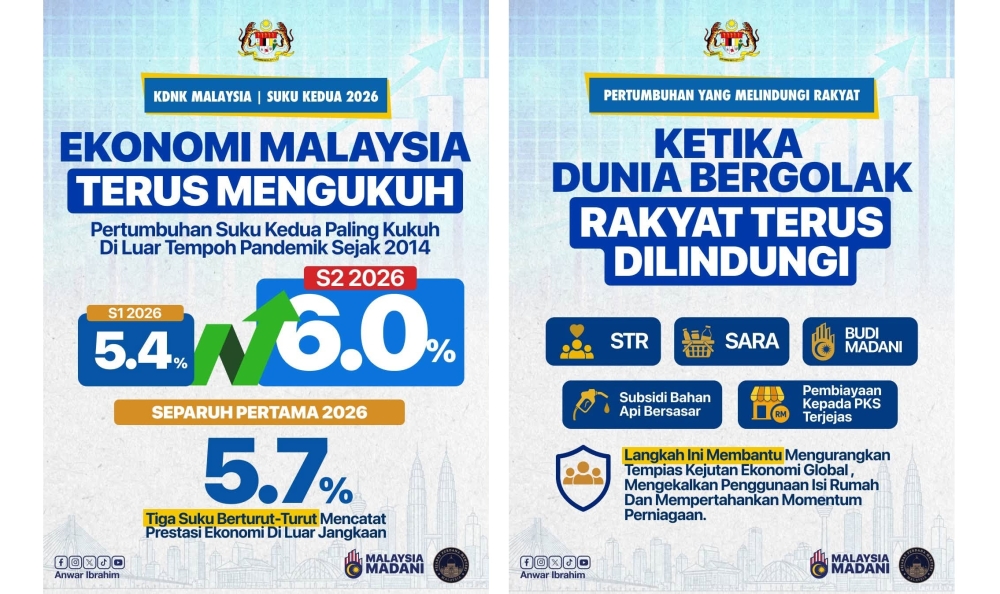
Prime Minister Datuk Seri Anwar Ibrahim on Wednesday praised Malaysia's accelerated economic expansion during the second quarter, framing the outcome as validation of the government's protective measures against the global inflation wave that has destabilised consumer spending across multiple regions. The stronger-than-anticipated growth trajectory reflects sustained momentum in Malaysia's key economic drivers, even as monetary authorities worldwide grapple with persistent price pressures on ordinary families.
Anwar's remarks underscore a strategic pivot in how the administration communicates its economic management record. Rather than focusing solely on headline growth figures, the Prime Minister has deliberately emphasised the government's role in preserving household purchasing power—a narrative designed to resonate with Malaysian voters concerned about cost-of-living dynamics. This messaging reflects recognition that raw GDP numbers, while positive, often fail to translate into political goodwill if ordinary citizens perceive their real incomes deteriorating or their essential expenses climbing faster than wages.
The timing of Anwar's comments carries particular significance given Malaysia's position within Southeast Asia's broader economic landscape. The region has experienced divergent recovery trajectories since the pandemic, with some economies struggling to contain inflation while others have achieved more balanced growth. Malaysia's apparent success in both expanding output and moderating price impacts on households positions it favourably relative to neighbours like Thailand and Indonesia, which have faced steeper inflation challenges affecting purchasing power across income groups.
Government interventions credited with shielding households likely encompass multiple policy levers deployed simultaneously. These measures have ranged from targeted fuel subsidies that prevent petrol and diesel price volatility from cascading through transport and logistics costs, to price controls on selected essential commodities, and potentially enhanced social safety nets for vulnerable populations. The cumulative effect of such measures, when coordinated effectively, can indeed create insulation from international commodity shocks that would otherwise transmit rapidly through supply chains and consumer price indices.
However, the government's anti-inflation strategy carries embedded trade-offs that merit scrutiny. Subsidy programmes, while protecting household budgets in the immediate term, create fiscal pressures that constrain resources available for infrastructure investment, education upgrades, or healthcare expansion. Prolonged reliance on such measures can also distort market signals and create inefficiencies that ultimately burden future administrations. This tension between short-term household relief and long-term economic dynamism reflects a perennial challenge in Malaysian economic policymaking.
The Q2 expansion must be contextualised within Malaysia's sectoral composition and external vulnerabilities. Growth driven primarily by construction, services, and domestic consumption differs qualitatively from expansion rooted in manufacturing exports or high-value technology sectors. The former proves more susceptible to future disruption if domestic demand softens or government spending contracts, while the latter builds more resilient foundations for sustained prosperity. Understanding which sectors contributed most to recent growth therefore becomes crucial for assessing trajectory sustainability.
Global headwinds remain a structural concern despite Malaysia's near-term performance. The international environment characterised by slower growth in major trading partners, persistent geopolitical tensions affecting energy prices, and potential further interest rate increases by central banks creates genuine risks for future quarters. Malaysian policymakers must balance celebrating current achievements against preparing contingency responses should external conditions deteriorate unexpectedly, particularly given the country's dependence on global trade flows.
Anwar's public confidence in the government's economic stewardship carries electoral implications as Malaysia approaches future polls. Opposition parties will likely scrutinise the distributional impact of growth, questioning whether prosperity has been shared equitably across regions and income strata. Anecdotal evidence of rising living costs for lower-income Malaysians, despite inflation-dampening measures, could undermine the administration's narrative that households have been meaningfully protected. The government must therefore ensure that its communication aligns closely with lived experience rather than relying on macro-level statistics that mask localised hardship.
The comparative regional context adds weight to Malaysia's Q2 narrative. Vietnam and Thailand, both significant Southeast Asian economies, have confronted inflation rates that proved stubbornly resistant to policy interventions, forcing policymakers into difficult growth-price trade-offs. Malaysia's apparent success in decoupling moderate inflation from respectable growth expansion, if sustained, would genuinely distinguish it as a regional outlier and potentially attract investor interest seeking stable operating environments amidst regional uncertainty.
Looking forward, the sustainability of Malaysia's dual achievement—growth without severe inflation—depends on several contingent factors. Commodity prices, particularly crude oil affecting both government revenues and import costs, remain subject to geopolitical shocks beyond Kuala Lumpur's control. Domestic wage pressures, currently modest, could accelerate if labour markets tighten further, potentially unravelling the inflation-control gains achieved through subsidies and price management. Additionally, the government's ability to maintain subsidy programmes without fiscal deterioration faces mounting pressure as global economic conditions evolve.
Anwar's emphasis on household protection reflects sophisticated understanding that economic legitimacy ultimately rests not on growth rates but on citizens' tangible experience of improving or stable living standards. This framing appropriately prioritises the distributional dimensions of prosperity, acknowledging that unconstrained inflation devastates savers and fixed-income earners while enriching asset owners and commodity producers. By positioning the government as guardian of ordinary household welfare against international forces beyond Malaysia's borders, the Prime Minister has articulated a compelling narrative—provided that concrete reality continues validating the claims.

