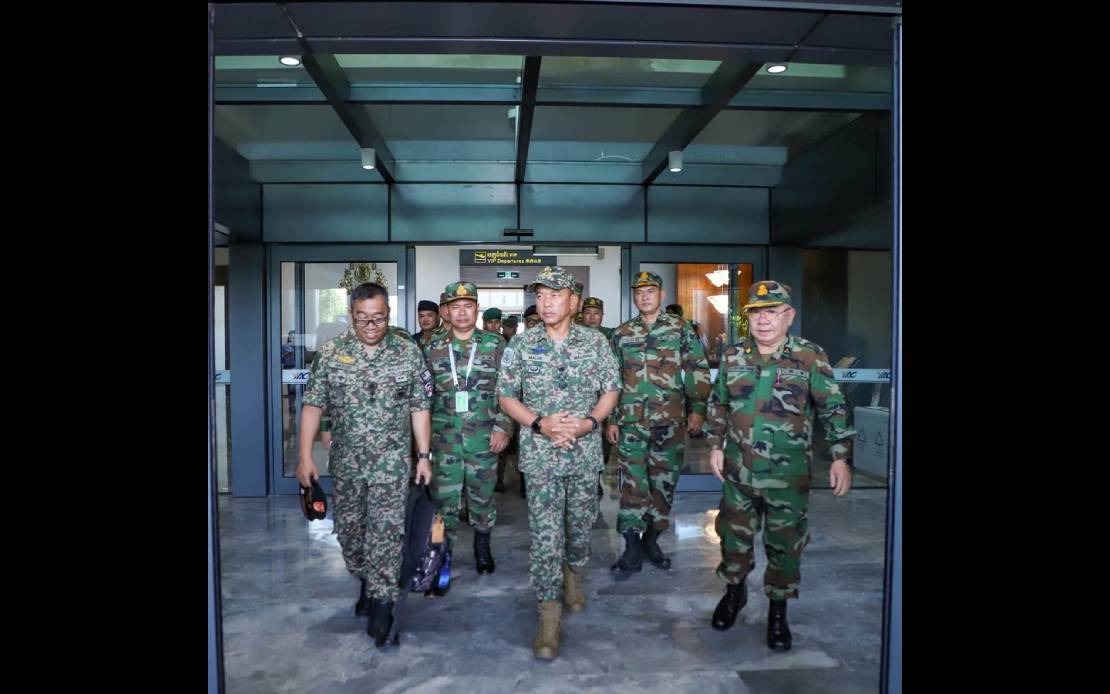
Malaysia's top military official, Chief of Defence Force General Tan Sri Malek Razak Sulaiman, has travelled to Cambodia's Banteay Meanchey province to gain direct insight into the security environment along the kingdom's northwestern border. The visit, which runs from July 8 to 11, follows an official invitation from General Vong Pisen, Commander-in-Chief of the Royal Cambodian Armed Forces, underscoring the deepening military cooperation between the two nations amid evolving regional security dynamics.
During his time in the border area, General Malek Razak met with members of the ASEAN Observer Team (AOT), a multinational contingent stationed to monitor conditions in one of Southeast Asia's most volatile flashpoint zones. The AOT briefed the Malaysian defence chief on the current security situation in the region, providing him with ground-level perspectives on developments since the establishment of the monitoring mission. This direct engagement reflects Malaysia's strategic interest in understanding the complexities of border management and conflict prevention in a region where territorial disputes have historically sparked military tensions.
The ASEAN Observer Team was established last year specifically to oversee implementation of the Cambodia-Thailand ceasefire agreement. That accord followed a significant military confrontation that erupted on July 24, 2025, when border disputes between the two countries escalated into armed clashes. The establishment of the AOT represented a collective ASEAN effort to prevent further deterioration and to build confidence between Cambodia and Thailand through transparent, on-the-ground monitoring of the contested frontier.
Currently, the AOT operates under the leadership of the Philippines, which holds the ASEAN chair during this period. The appointment of a fellow Southeast Asian nation to lead the observer mission reflects ASEAN's commitment to leveraging internal expertise and regional solidarity in managing transnational security challenges. Malaysia's engagement through its defence chief demonstrates the broader principle that border stability in one part of the region has implications for all members, particularly those with significant cross-border populations or economic interests.
General Malek Razak's firsthand assessment of the Banteay Meanchey area carries significance beyond ceremonial value. As the highest-ranking military official in Malaysia, his visit signals serious attention to the Cambodia-Thailand situation at the policy level. The insights he gathers will inform Malaysian strategic planning and bilateral defence engagements with both Cambodia and Thailand, as well as contribute to ASEAN's collective understanding of the security environment in the subregion. Such visits also serve to strengthen personal relationships between senior military leaders, which often prove crucial in times of diplomatic tension or miscommunication.
The location of this visit—Banteay Meanchey, a northwestern province that borders Thailand—remains a sensitive area despite the ceasefire agreement. The province has witnessed recurring tensions along the disputed frontier where both countries claim sovereignty over certain territories. The presence of an ASEAN observer mission in the area represents an important confidence-building measure, though the underlying territorial disputes remain unresolved. By visiting this zone, Malaysia's defence chief demonstrates ASEAN's continued commitment to maintaining peace even as fundamental disagreements persist.
For Malaysian policymakers and regional observers, the visit illustrates how border management has evolved in contemporary ASEAN practice. Rather than allowing bilateral disputes to fester, the organisation has developed mechanisms for multilateral oversight and periodic assessment. Malaysia's participation in these mechanisms through senior military representation ensures that the country maintains influence over regional security architecture and can advocate for approaches aligned with its own interests in maritime and terrestrial border management.
The timing of General Malek Razak's visit also reflects ASEAN's broader efforts to maintain internal stability as the grouping faces external pressures and evolving geopolitical challenges. With the Philippines holding the chair, there appears to be emphasis on robust implementation of peacekeeping mechanisms and regular assessment by all member states. Malaysia's active engagement signals that despite other pressing concerns—including maritime security challenges in the South China Sea and internal development priorities—the nation remains invested in ASEAN cohesion and regional stability architecture.
The visit additionally highlights the practical challenges of border security in Southeast Asia. Both Cambodia and Thailand maintain legitimate concerns about territorial integrity and sovereignty, yet both recognise that military confrontation serves neither nation's interests. The AOT model represents a pragmatic compromise: external monitoring that respects national sovereignty while providing assurance to both parties and to the broader ASEAN community. Malaysia's defence chief's engagement with this mechanism suggests that Kuala Lumpur views such confidence-building measures as essential to long-term regional peace.
Looking forward, Malaysia's continued participation in ASEAN observer missions and border security arrangements will likely remain important. As regional tensions over maritime and terrestrial boundaries persist, mechanisms like the AOT offer potential templates for managing disputes through dialogue and transparency. The presence of Malaysia's top defence official in Cambodia sends a message about the country's commitment to these principles and its willingness to contribute actively to collective security efforts, even when direct Malaysian interests may not be immediately apparent.

