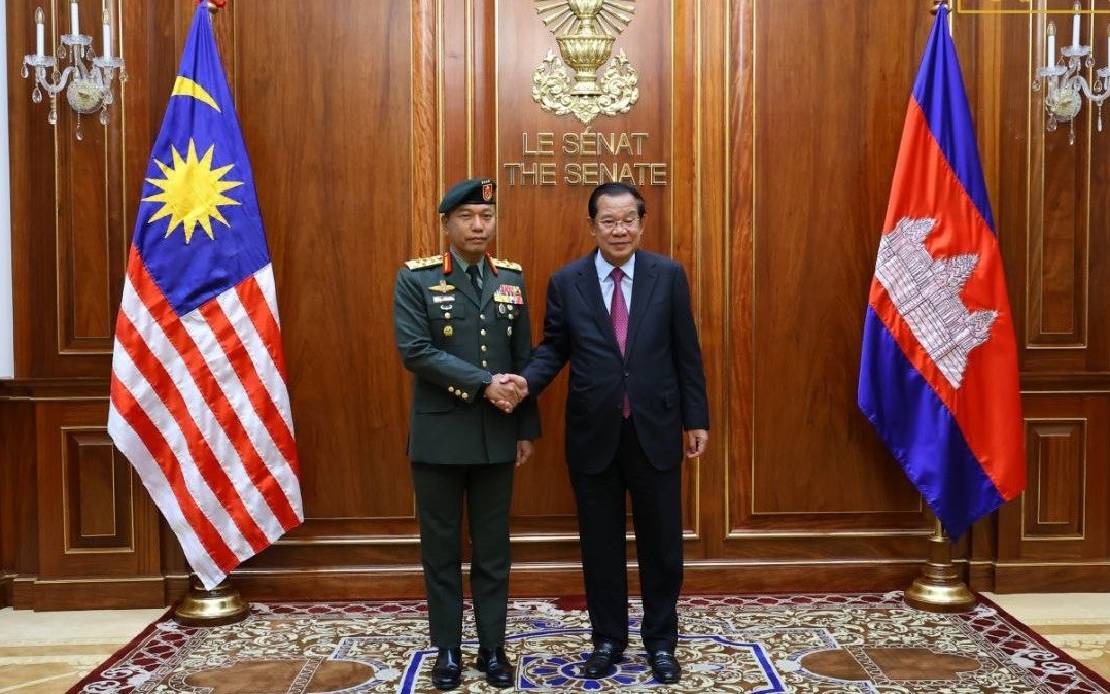
Malaysia's military leadership travelled to Cambodia this week in a carefully orchestrated diplomatic move aimed at consolidating defence ties between the two neighbouring Southeast Asian nations. Chief of Defence Force General Tan Sri Malek Razak Sulaiman spent four days in Phnom Penh from July 8 to 11, conducting a series of high-level engagements with Cambodian military and civilian officials. The visit, mounted at the formal invitation of Cambodia's top military commander, signals the importance both countries place on defence cooperation as regional security pressures mount across Southeast Asia.
During his stay, General Malek Razak met with General Vong Pisen, Commander-in-Chief of the Royal Cambodian Armed Forces, in bilateral talks that centred on practical measures to enhance military coordination. Beyond the capital, the Malaysian defence chief also made a notable trip to Cambodia's northwestern border region in Banteay Meanchey province, where he assessed security conditions at the sensitive Thailand-Cambodia frontier. This border visit underscores Malaysia's interest in understanding cross-border security dynamics that could affect broader regional stability, particularly given the ongoing tensions in that area.
The Malaysian delegation's discussions with Cambodian Deputy Prime Minister and National Defence Minister Tea Seiha on Friday focused on concrete ways to advance the two nations' defence partnership. Both sides explored mechanisms to broaden collaboration by implementing existing bilateral defence frameworks that have accumulated over years of engagement. The conversations reflect a pragmatic approach to military diplomacy, moving beyond symbolic gestures toward substantive programmes that would benefit both armed forces through enhanced professional military education, training exchanges, and technical capacity-building initiatives.
In a Facebook statement, General Malek Razak articulated the strategic rationale underpinning these discussions, emphasising that Malaysia and Cambodia share a common vision as ASEAN member states. He highlighted the necessity of maintaining mutual understanding and fostering institutional collaboration that extends across the broader military establishment, rather than relying solely on top-level relationships. This framing reflects contemporary thinking within Southeast Asian defence circles, where regional countries increasingly recognise that sustainable partnership requires diverse, multi-layered engagement across different ranks and service branches.
The defence chief's remarks specifically underscored ASEAN's centrality to both nations' security strategies. By stressing the importance of ASEAN-led defence platforms, General Malek Razak was positioning Malaysia and Cambodia within the broader regional architecture that shapes strategic interactions among the ten member states. This emphasis on regional frameworks becomes increasingly significant as traditional security concerns intersect with emerging challenges such as maritime disputes, cybersecurity threats, transnational crime, and climate-related instability.
For Malaysia, the Cambodia visit reflects a consistent diplomatic strategy of maintaining strong bilateral military relationships while simultaneously advancing the ASEAN agenda. Cambodia's geographical position and its relationships with other regional powers make it a strategically important partner. By investing in enhanced defence ties, Malaysia reinforces its network of allied relationships and strengthens its capacity to contribute to regional peace maintenance efforts under ASEAN auspices.
The emphasis on military exchanges and professional education carries particular weight in the regional context. When defence forces develop personal relationships through training programmes and educational exposure, institutional understanding deepens and the likelihood of misunderstanding during crises diminishes. Both Malaysia and Cambodia stand to gain from such interaction, particularly as their respective defence establishments work to modernise and adapt to contemporary security threats that often transcend national borders.
Cambodia's receptiveness to Malaysia's overtures reflects its own interest in maintaining balanced relationships with regional partners. As a smaller nation surrounded by larger powers, Cambodia's defence strategy emphasises maintaining stability through diplomatic engagement and multilateral cooperation rather than unilateral military buildups. This convergence of interests creates fertile ground for substantive defence cooperation that benefits both nations without creating destabilising dynamics that might provoke concern among other regional actors.
The visit also carries implications for Malaysia's broader Southeast Asian diplomacy. By actively engaging militaries across the region, Malaysia positions itself as a stabilising force committed to regional peace. This diplomatic footwork becomes particularly valuable as geopolitical tensions periodically spike throughout Southeast Asia, whether arising from maritime boundary disputes, great power competition, or internal instability in any member state. Malaysia's consistent investment in military-to-military relationships provides channels for communication and understanding that can prove invaluable during crisis periods.
The timing of this visit, occurring in July when regional security discussions intensify, suggests careful coordination between Phnom Penh and Kuala Lumpur. Both nations appear intent on demonstrating their commitment to ASEAN solidarity and regional mechanisms precisely when external pressures and internal challenges threaten cohesion within the bloc. By showcasing bilateral defence cooperation, they contribute to narratives of ASEAN unity and functional collaboration that counter perceptions of regional fragmentation.
Looking ahead, the concrete initiatives discussed during this visit will require sustained follow-through from both defence establishments. Military exchanges, training programmes, and institutional collaboration succeed only when both sides commit resources and personnel to implementation. The test of this visit's significance will be measured in the coming months through the launch of new exchange programmes, the expansion of military professional education partnerships, and the deepening of institutional ties at multiple organisational levels.
For Malaysian policymakers and defence officials, the Cambodia engagement represents one component of a comprehensive regional strategy that seeks to maintain stable relationships with all ASEAN partners while addressing the complex security environment that characterises contemporary Southeast Asia. The emphasis on ASEAN-led mechanisms and regional frameworks demonstrates recognition that in an era of multipolar competition and non-traditional security threats, no single nation can address regional challenges unilaterally. Sustained, substantive bilateral cooperation, supported by multilateral ASEAN platforms, remains the most viable approach to maintaining the peace and stability that underpin prosperity for all regional nations.

