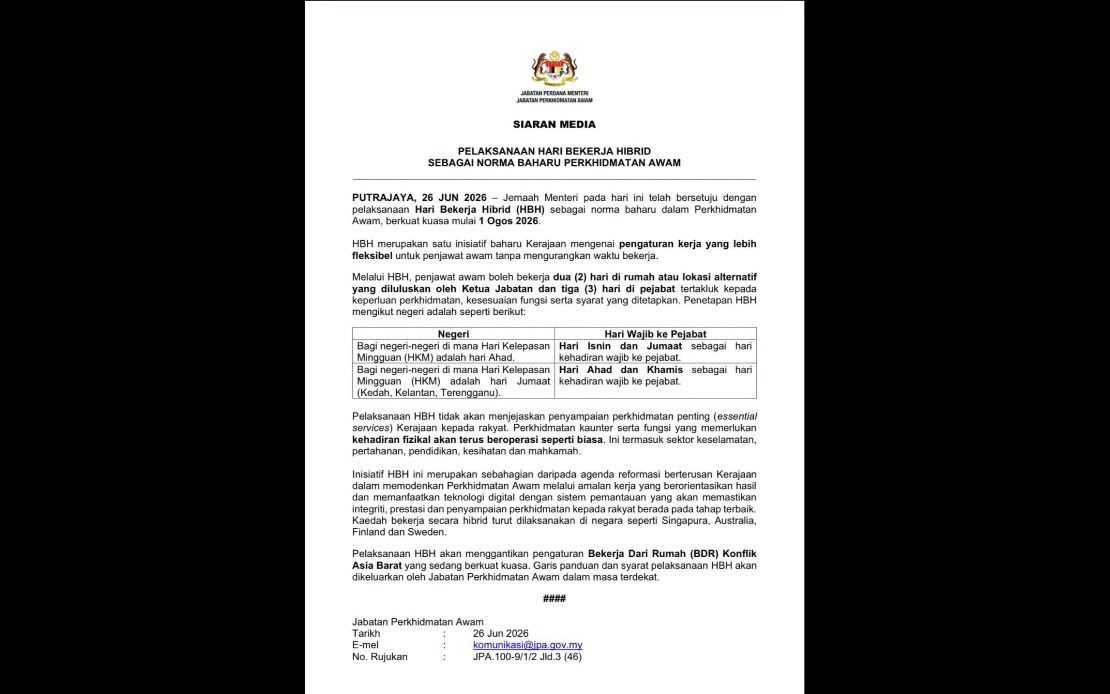
Malaysia's Cabinet has given the green light to a significant restructuring of work arrangements across the civil service, with the Public Service Department announcing on June 26 that a Hybrid Work Day scheme will commence on August 1. The initiative marks a deliberate shift from the pandemic-era Work From Home arrangements that have dominated government offices since 2020, signalling the government's intent to establish a more structured yet flexible approach to public sector employment that balances operational effectiveness with workforce preferences.
The new arrangement permits civil servants to spend two days working remotely or at alternative approved locations, while maintaining a mandatory three-day presence in physical offices each week. This configuration remains subject to departmental service requirements, the functional suitability of individual roles, and established conditions set by each agency's leadership. The framework acknowledges that not all government functions can operate effectively in a fully remote capacity, particularly those involving direct citizen interaction and sensitive operations requiring on-site coordination and oversight.
The PSD's framework represents a considered attempt to modernise public sector work culture without sacrificing service delivery standards. Rather than adopting a uniform remote-first model, the government has recognised that hybrid arrangements must accommodate the diverse operational needs across its sprawling bureaucracy. Essential functions in security, defence, education, healthcare, and judicial sectors will continue operating according to their existing protocols, with counter services and frontline operations maintaining regular physical presence to ensure citizens can access government services without disruption.
A critical operational detail embedded in the policy addresses Malaysia's complex landscape of varying weekend schedules across different states. For the majority of states observing Sunday as the weekly rest day, Monday and Friday have been designated as mandatory office attendance days, ensuring administrative continuity at the beginning and end of each working week. Conversely, in Kedah, Kelantan, and Terengganu, where Friday serves as the weekly holiday, Sunday and Thursday will function as compulsory office days, demonstrating the government's sensitivity to regional administrative differences.
The PSD has positioned this initiative as integral to a broader modernisation agenda within the public service, emphasising that the shift involves not merely changing where employees work but fundamentally adopting results-based performance metrics and accelerating digital technology adoption. This framing suggests the government views hybrid arrangements as a catalyst for broader institutional transformation, moving away from traditional presence-based assessment towards outcome-focused evaluation of civil servant productivity. Such a transition carries implications for performance management systems, digital infrastructure investment, and the cultural expectations placed on government workers.
International benchmarking features prominently in the government's justification for the policy change. The PSD explicitly references hybrid work adoption in developed nations including Singapore, Australia, Finland, and Sweden, positions that carry symbolic weight for Malaysian policymakers aspiring to align with high-performing governance systems. This international framing serves to legitimise the initiative while suggesting that Malaysia is pursuing globally-recognised best practices rather than experimental approaches, potentially addressing concerns from traditionalist observers who might view remote work with scepticism.
A critical safeguard embedded within the policy framework addresses the legitimate concerns of government efficiency advocates. Rather than implementing the arrangement without oversight, the PSD has committed to establishing monitoring mechanisms designed to preserve integrity, performance standards, and service delivery quality at optimal levels. These mechanisms remain undefined in the initial announcement, with the department promising detailed guidelines and implementation conditions to follow in due course. The deliberate vagueness suggests the government recognises the need for flexibility in how different agencies operationalise the framework while maintaining accountability.
The timing of the announcement and August 1 implementation date provides government departments with approximately five weeks to prepare systems, communicate policies to staff, and adjust operational protocols. This timeframe, while not extensive, aligns with Malaysian bureaucratic decision-making patterns and suggests the government sought to avoid protracted transition periods that might reduce policy momentum or create prolonged uncertainty among the estimated 1.6 million civil servants affected by the change.
For Malaysian workers in the private sector, this policy carries indirect significance as a legitimisation of hybrid arrangements within the national employment context. Government adoption of hybrid models often influences broader corporate practices, particularly among multinational companies and large domestically-owned enterprises competing for talent. The policy may accelerate private sector normalisation of flexible work arrangements, potentially reshaping employment practices across the Malaysian labour market and improving work-life balance considerations that have gained prominence in post-pandemic hiring decisions.
The policy announcement arrives amid global reassessment of remote work following the initial pandemic pivot. Whereas some international companies have mandated return-to-office policies, Malaysia's government has charted a middle course that acknowledges both the productivity benefits of remote work and the irreplaceable value of physical workplace presence for certain functions. This nuanced approach reflects lessons learned from three years of pandemic-era remote work, during which government agencies accumulated empirical data about which functions operate effectively remotely and which suffer from absence of in-person coordination.
Implementation success will largely depend on departmental leadership commitment to flexible interpretation within the framework's parameters. The emphasis on service requirements and functional suitability as determining factors for individual role arrangements suggests that some civil servants may experience more restrictive remote work access than others, depending on their department's operational model. This differentiation, while administratively sound, may generate grievances among employees in departments with more stringent in-office requirements, necessitating clear communication about the rationale behind varying implementation approaches.
The absence of specific discussion regarding salary adjustments, allowances for alternative work locations, or technology provisions for remote workers represents a notable gap in the initial announcement. As detailed implementation guidelines emerge, clarity on whether government will provide home office equipment support or connectivity allowances will significantly influence employee perception of the policy's genuine flexibility and the government's commitment to enabling effective remote work rather than simply shifting risk to employees.
Looking forward, this policy positions Malaysia within international trends toward workplace flexibility while maintaining public sector distinctiveness through rigorous service delivery requirements. The approach suggests the government perceives hybrid arrangements not as a permanent concession to employee preferences but as a deliberate structural change designed to modernise operations, enhance recruitment competitiveness, and establish performance management systems aligned with contemporary organisational best practices. Success metrics will ultimately determine whether hybrid work becomes an entrenched feature of Malaysian civil service employment or an interim experiment subject to revision.

