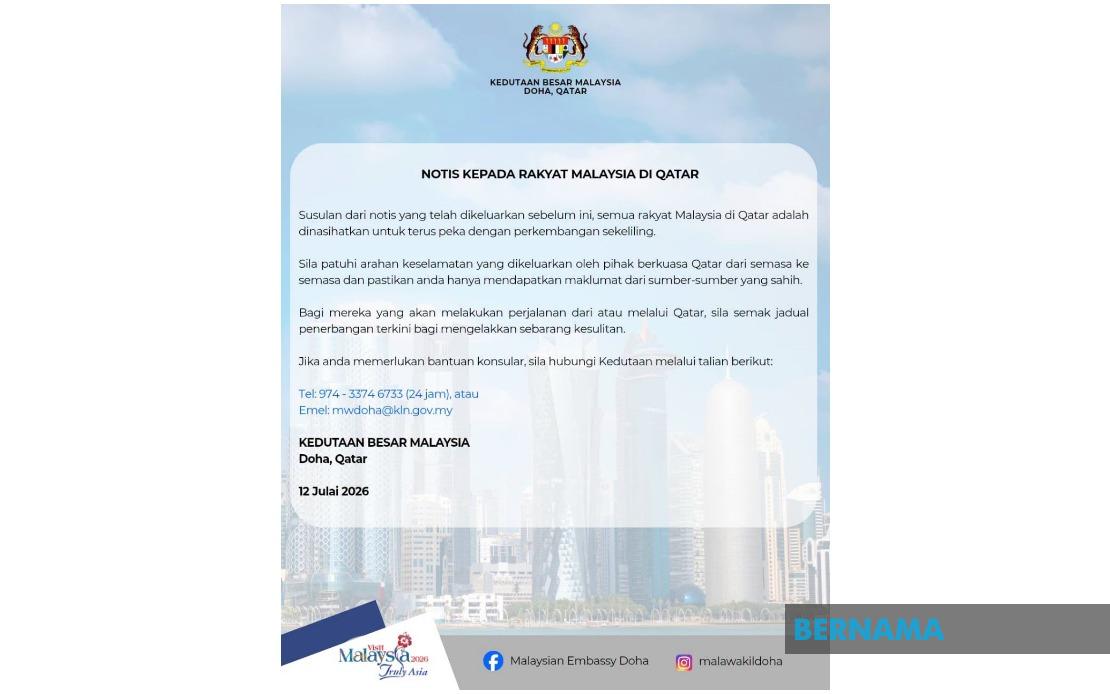
The Malaysian Embassy in Doha has issued a formal advisory to all Malaysian nationals residing in or passing through Qatar, directing them to strictly adhere to security protocols established by Qatari authorities in response to escalating military tensions between the United States and Iran. The diplomatic mission, operating from the Qatari capital, took to its official Facebook channel to communicate the guidance, underscoring the seriousness with which it regards the current security environment affecting the broader Middle Eastern region.
Among the key directives released by the embassy is an instruction for Malaysians to maintain heightened awareness of their immediate surroundings and to obtain news exclusively from credible and officially verified sources. This cautionary measure reflects growing concern about misinformation that often proliferates during periods of geopolitical instability, which can fuel panic among civilian populations and complicate diplomatic efforts to de-escalate tensions. The embassy's emphasis on information verification is particularly relevant given the speed at which unconfirmed reports can spread through social media channels, potentially misleading expatriate communities about actual threat levels.
The advisory extends practical guidance to Malaysian travellers who are either departing from Qatar or transiting through its airspace. Citizens have been instructed to check the most current flight schedules with airlines to mitigate the risk of experiencing travel disruptions, which have become increasingly common as regional instability affects commercial aviation operations. Such disruptions can strand passengers, disrupt business activities, and create logistical nightmares for families and enterprises reliant on predictable air connectivity.
For Malaysians in need of immediate diplomatic assistance or facing emergencies, the embassy has maintained round-the-clock availability through a dedicated hotline accessible at +974-3374 6733, complemented by email support channels. This 24-hour operational capacity ensures that Malaysian citizens experiencing difficulties have immediate recourse to their government's protective services, a critical safeguard when geopolitical circumstances create unpredictable security situations.
The advisory came in the immediate aftermath of the United States military executing its third major bombing campaign targeting Iranian positions within a single week. These strikes were precipitated by Iranian naval forces firing upon a commercial vessel navigating the Strait of Hormuz, one of the world's most strategically significant maritime chokepoints through which approximately one-third of globally traded oil passes daily. The escalation represents a dangerous intensification of military confrontation between two major regional powers with profound implications for global energy security and international trade.
Compounding the security situation, Iran's Islamic Revolutionary Guard Corps announced the closure of the Strait of Hormuz to all maritime traffic, declaring the blockade would persist indefinitely until American military intervention in the region ceases entirely. This unilateral closure of a crucial international waterway directly contravenes established principles of freedom of navigation enshrined in international maritime law and threatens the economic interests of nations worldwide that depend on unfettered passage through these waters. For Malaysia, a trading nation with significant energy import requirements, such disruptions carry serious economic implications through potential oil price volatility and supply chain complications.
The current escalation is particularly striking given that Tehran and Washington had ostensibly reached a breakthrough in June through a Pakistan-mediated memorandum of understanding designed to terminate hostilities that had commenced in late February. That agreement explicitly called for an immediate cessation of combat operations across all theatres, removal of the American naval blockade constraining Iranian commerce, and restoration of navigation rights through the Strait of Hormuz. The resurgence of military action despite this accord suggests profound distrust between the parties and raises troubling questions about whether any diplomatic framework can successfully constrain their mutual hostility.
The apparent collapse of the June peace arrangement, evidenced by this week's renewed exchanges of military strikes ostensibly centred on commercial shipping disputes, demonstrates how fragile truces remain in regions characterized by deep historical grievances and competing strategic interests. For Malaysia and other Southeast Asian nations with substantial expatriate populations in the Middle East and significant economic interests tied to Gulf stability, these developments underscore the vulnerability of their citizens and economic welfare to forces beyond their control.
The situation carries particular relevance for Malaysian corporate interests operating throughout the region and for the thousands of Malaysian workers employed in Qatar and neighbouring Gulf states. Any sustained regional conflict threatens employment stability, increases security risks for expatriates, and could precipitate mass departures that would disrupt Malaysia's remittance inflows and deplete regional human capital investments. The advisory from Malaysia's diplomatic mission represents an important acknowledgment of these risks and a demonstration of government responsiveness to citizen safety concerns during turbulent international circumstances.
Longer-term, the failure of the Pakistan-brokered ceasefire to endure highlights the limitations of external mediation when fundamental strategic incompatibilities persist between major powers. For Malaysia and the broader Southeast Asian region, these developments serve as a reminder of the imperative to maintain strong diplomatic channels and to avoid being drawn into external conflicts whilst simultaneously protecting nationals caught in unstable zones. The embassy's measured but firm security advisory represents a prudent balance between vigilance and avoiding unnecessary alarm.

