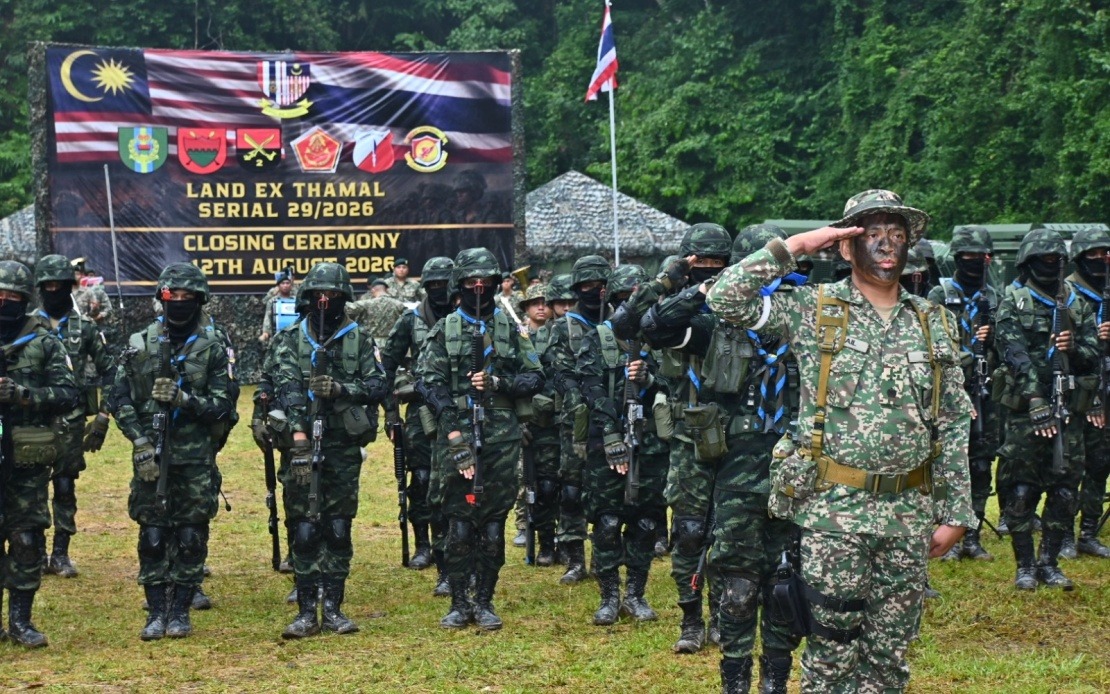
A major joint military exercise involving 252 personnel from the Malaysian Army and the Royal Thai Army is underway in Gerik, marking another significant milestone in the two nations' deepening defence partnership. The exercise, which commenced on August 5 and is being overseen by the 2nd Malaysian Infantry Division Headquarters, brings together 197 Malaysian soldiers with 55 Thai counterparts to conduct an intensive programme of tactical development and operational coordination. This initiative demonstrates the commitment both countries maintain toward strengthening military interoperability in an increasingly complex regional security environment.
The Exercise LAND THAMAL Series 29/2026 represents a structured approach to military cooperation, organised across three distinct phases designed to maximise learning outcomes and practical application. The Cross Training Exercise component provides foundational knowledge exchange, while the Field Training Exercise exposes both contingents to realistic combat scenarios and logistical challenges. The third phase, Combined Military Civil Action under the Jiwa Murni Programme, integrates community engagement as a broader strategic objective, with personnel from both armies conducting joint development activities at Sekolah Menengah Kebangsaan Sultan Idris Shah II in Gerik.
Through the field training component, participating soldiers experience a comprehensive range of tactical disciplines essential to modern military operations. These include combat procedures and techniques specific to jungle and border terrain, obstacle-crossing methodologies that enhance mobility in challenging environments, and the establishment and protection of forward operating bases. Personnel also engage in patrolling operations, ambush scenarios, and coordinated attacks on simulated enemy positions, all designed to simulate realistic conditions that may arise along shared borders or during joint regional operations. This hands-on exposure is crucial for building muscle memory and confidence in executing complex manoeuvres under pressure.
The bilateral exercise framework places particular emphasis on the exchange of tactical knowledge and operational doctrine between the two armed forces. Rather than a one-way knowledge transfer, LAND THAMAL facilitates genuine reciprocal learning, allowing Malaysian personnel to understand Thai Army procedures while Thai soldiers gain insight into Malaysian operational methods. This mutual understanding proves invaluable during joint operations, disaster response efforts, or coordinated security initiatives. The emphasis on transparent communication and cooperative spirit reflects a maturation in Malaysia-Thailand military relations, moving beyond ceremonial exchanges toward substantive professional development.
The formal opening ceremony on August 5 at the Gerik Airstrip underscored the political significance of the exercise. Jointly conducted by Brigadier General Datuk Mohd Zaini Hashim, Commander of the 30th Malaysian Infantry Brigade, and Senior Colonel Taweeporn Kanatong, Commander of Thailand's 5th Infantry Brigade, the ceremony signalled high-level commitment from both nations. Taweeporn's remarks during the opening emphasised that LAND THAMAL extends beyond military capability development to address broader regional challenges including natural disasters, transnational security threats, organised conflict, and the complex web of security issues affecting Southeast Asia.
The choice of Gerik as the exercise location holds particular strategic significance for Malaysian defence planners. Located in northern Perak near the Thai border, Gerik sits at the geographical nexus of Malaysia-Thailand security concerns. The terrain and proximity to the international boundary make it an ideal training ground for developing tactics relevant to cross-border challenges, whether involving insurgency, smuggling networks, or other transnational threats. Training in this location ensures that the skills developed carry direct applicability to actual operational environments where these soldiers may be deployed.
Regional security dynamics provide important context for understanding why Malaysia and Thailand continue investing in such joint exercises. Both nations face evolving security threats ranging from maritime piracy and drug trafficking to terrorism and internal insurgency. Climate-related disasters such as floods also require coordinated cross-border responses. The ability to operate seamlessly with allied forces during crises multiplies the effectiveness of each nation's military and civilian response capabilities. LAND THAMAL contributes directly to building these operational synchronicities, ensuring that when crisis strikes, joint action proceeds smoothly rather than being hampered by procedural misunderstandings or incompatible systems.
The integration of community relations through the Jiwa Murni Programme within this military exercise reflects a sophisticated understanding of modern civil-military operations. By having soldiers engage directly with local communities, the exercise builds goodwill and demonstrates military utility beyond combat functions. For Malaysian-Thai relations, this component carries additional value, reinforcing public perception that defence cooperation brings tangible benefits to civilians in border regions. Community engagement at schools like Sultan Idris Shah II helps develop comprehensive understanding of military personnel and their role in national development.
The success of LAND THAMAL Series 29/2026 should be understood within the context of Malaysia-Thailand defence cooperation trajectory over recent decades. The bilateral relationship has evolved from periodic tensions to one of genuine strategic partnership, with regular high-level visits, intelligence sharing, and increasingly sophisticated joint operations. These exercises serve as visible manifestations of deeper institutional ties and shared strategic interests. For Malaysian defence officials, the exercise demonstrates that the country maintains strong partnerships not only with far-distant allies like the United States and Australia, but with immediate neighbours whose cooperation is essential for regional stability.
Looking forward, the continuation of LAND THAMAL as an annual series reflects institutional commitment that transcends political cycles. The numbering convention, currently at Series 29 for 2026, indicates decades of accumulated experience and institutional memory. This institutional regularity matters significantly in military affairs, where trust and predictability form the foundation of effective cooperation. Malaysian defence planners can confidently plan operational doctrine knowing that Thai counterparts will be proficient in coordinated procedures, having trained together repeatedly.
The exercise also carries implications for Malaysia's broader Southeast Asian security posture and its role within regional frameworks like the ASEAN Defence Ministers' Meeting. Thailand represents a crucial anchor in Malaysia's northern security architecture, and demonstrating robust defence cooperation sends signals about regional stability to other nations. It also reinforces Malaysia's commitment to bilateral defence relationships as the foundation for multilateral security arrangements. The success of LAND THAMAL validates the approach of building strong paired relationships that collectively strengthen the entire regional security fabric.
For the 252 participating personnel, the exercise offers career-development opportunities and international exposure that enhances their professional credentials. Officers and non-commissioned officers who complete joint exercises carry forward enhanced capabilities and personal networks that benefit their respective militaries over decades of service. These individuals become vectors through which institutional learning is distributed throughout both armies, multiplying the exercise's strategic impact far beyond the immediate training period. The personal relationships forged between Malaysian and Thai soldiers during LAND THAMAL create informal channels of communication and mutual understanding that prove invaluable during actual operations or crises.

