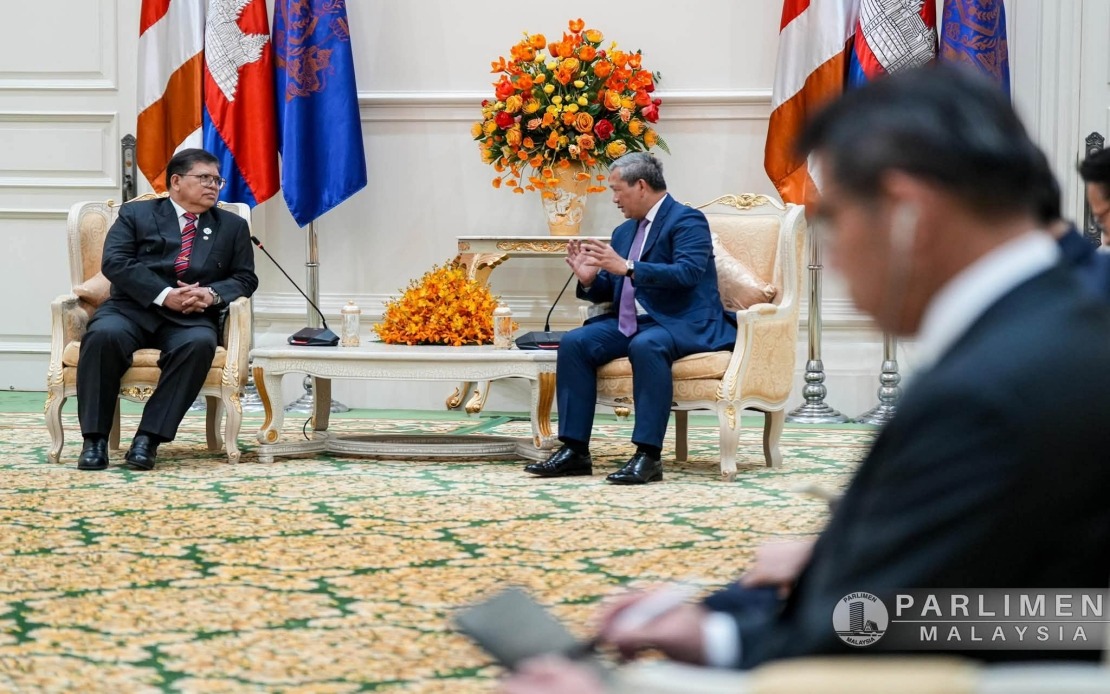
Malaysia's Dewan Rakyat Speaker Tan Sri Johari Abdul has called for sustained diplomatic engagement and dialogue-based approaches to address the protracted border tensions between Cambodia and Thailand, emphasising that such measures remain essential to safeguarding peace and stability across Southeast Asia. Speaking during his visit to Phnom Penh for the Second Inter-Parliamentary Speakers' Conference, Johari underscored Malaysia's position that bilateral disputes should not compromise the collective strength of ASEAN, the regional bloc that has long relied on consensus-building and constructive engagement to navigate complex geopolitical challenges.
The border question has long festered as a source of friction between Phnom Penh and Bangkok, occasionally flaring into military confrontations that alarm neighbouring nations and underscore the fragility of regional security arrangements. Johari's remarks signal Malaysia's determination to play a stabilising role, positioning itself as a voice for restraint at a moment when international attention on the ASEAN region is intensifying. His intervention reflects a broader Malaysian strategy of leveraging its diplomatic influence through parliamentary and ministerial channels to encourage peaceful resolution mechanisms rather than escalatory tactics.
During his discussions with Cambodian Prime Minister Hun Manet, Johari expressly raised the border situation, acknowledging Cambodia's legitimate concerns regarding the humanitarian impact on border communities and the broader strategic implications of unresolved territorial questions. Malaysia's understanding of Cambodia's perspective suggests a nuanced approach that validates Phnom Penh's grievances while simultaneously advocating for multilateral frameworks and negotiation protocols. By framing the issue within an ASEAN context, Malaysia implicitly appeals to the bloc's established norms of non-interference and the primacy of peaceful settlement mechanisms, principles that have underpinned regional relations since ASEAN's founding.
The Inter-Parliamentary Speakers' Conference itself represents an important channel for informal diplomacy, allowing senior legislative figures to build rapport and explore solutions outside formal governmental structures. Johari's presence at this gathering, hosted jointly by Cambodia's National Assembly and Senate from August 26 to 28, underscores Parliament's role in Malaysia's foreign policy architecture. Parliamentary diplomacy often proves more flexible than official state interactions, permitting candid discussions and creative problem-solving that can subsequently inform government policy.
Malaysia has committed to supporting confidence-building measures and encouraging all disputants to return to negotiation tables where sustained dialogue can address root causes of the dispute. This stance reflects Malaysia's broader commitment to the ASEAN Way, a diplomatic philosophy emphasising consultation, consensus-building and the resolution of differences through peaceful means rather than coercion. For Malaysia, the stakes are substantial: regional conflict undermines ASEAN's credibility, complicates trade flows, and risks drawing in external powers whose involvement could fundamentally alter Southeast Asian geopolitical dynamics.
Beyond the border issue, Johari and Hun Manet explored opportunities for deepening Malaysia-Cambodia bilateral cooperation across multiple sectors. Parliamentary collaboration emerged as a priority, with both nations recognising that stronger legislative ties can facilitate policy coordination and people-to-people exchanges. Technical and Vocational Education and Training initiatives represent a particularly promising avenue for engagement, offering Cambodian youth access to Malaysian expertise while creating pathways for skills development that benefit both economies.
Youth empowerment programmes featured prominently in the discussions, reflecting growing recognition that generational engagement is crucial for sustaining long-term regional relationships. Exchange initiatives, whether through parliamentary visits, educational scholarships or professional secondments, build networks of mutual understanding among younger leaders who will shape Southeast Asian affairs in coming decades. Malaysia's emphasis on these dimensions suggests a sophisticated understanding that diplomatic stability requires sustained investment in human capital and cross-national professional networks.
Economic cooperation constituted another focal point, with Johari expressing appreciation for Cambodia's conducive investment environment for Malaysian enterprises. Malaysia's business community has established significant operations in Cambodia across manufacturing, services and technology sectors, and Johari's remarks signal government support for continued commercial expansion. The recognition that Cambodia has created a stable business climate suggests that economic interdependence, properly cultivated, can reinforce political cooperation and create mutual incentives for maintaining peaceful relations.
Malaysia's position on the Cambodia-Thailand border issue reflects its traditional role as a bridge-builder within ASEAN, a self-appointed responsibility that has sometimes yielded diplomatic dividends when crises threatened regional cohesion. By consistently advocating for dialogue over confrontation, Malaysia maintains its credibility as a neutral mediator while signalling to both disputants that ASEAN solidarity depends on their restraint. This balancing act becomes more delicate when border tensions spike, but Johari's intervention suggests Malaysia remains committed to championing conflict prevention mechanisms even when bilateral relations between other member states deteriorate.

