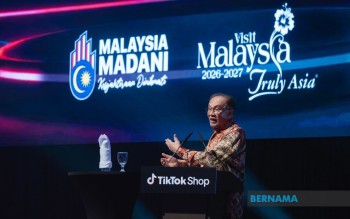
Prime Minister Datuk Seri Anwar Ibrahim has signalled a shift towards tighter scrutiny of foreign investment, declaring that Malaysia will systematically review new applicants to verify they deliver genuine employment opportunities and economic contributions to the nation. Speaking after inaugurating the TikTok Shop Summit 2026 in Kuala Lumpur on Tuesday, Anwar underscored the government's determination to prevent exploitative business models from hollowing out Malaysia's domestic economy while maintaining the country's open-trade credentials.
The announcement reflects growing concerns within the Ministry of Investment, Trade and Industry (MITI) about a troubling pattern: multinational enterprises and opportunistic operators establishing operations here primarily to leverage Malaysia's geographic and regulatory advantages without investing substantively in local employment or procurement. Anwar revealed that MITI has documented cases where foreign companies operate warehouses and transit facilities solely for logistics purposes, generating minimal direct employment and contributing negligibly to the Malaysian economy. The government has already begun halting such activities, but the Prime Minister emphasized the need for forward-looking preventive measures.
The timing of Anwar's comments is significant, coming in response to a direct question from a TikTok Shop participant concerning the inflow of inexpensive products from overseas e-commerce platforms including Temu and Pinduoduo. These Chinese-based marketplaces have disrupted traditional retail and local commerce by offering rock-bottom prices that often undercut locally-produced goods. Anwar acknowledged Malaysia's position as a free-trade economy where digital commerce has fundamentally altered market dynamics, but he also pointedly characterized the pricing strategies employed by some foreign sellers as predatory dumping designed to commandeer market share before establishing sustainable operations.
A particularly troubling phenomenon Anwar highlighted involves the deliberate misrepresentation of supply chains through deceptive business registration practices. Some entities register nominally as local enterprises—adopting names evoking traditional Malaysian coffee shops or family businesses—while the actual merchandise consists entirely of imported products. Anwar cited the example of businesses ostensibly selling domestic coffee, tea, and biscuits that in reality source everything from overseas suppliers. This regulatory arbitrage allows foreign enterprises to exploit consumer assumptions about local origin while contributing nothing to Malaysian agriculture, manufacturing, or employment.
The warehouse scenario at Port Klang, Malaysia's busiest container port and a critical regional logistics hub, encapsulates the core problem driving policy reassessment. Large foreign investors have leased warehouse facilities at Port Klang with no corresponding requirement or expectation to employ Malaysian workers or source from local suppliers. These operations function purely as transshipment points or distribution centres for re-exporting goods throughout Southeast Asia, capturing value entirely within foreign corporate structures. The arrangement amounts to utilizing Malaysian infrastructure and regulatory permissions while extracting minimal fiscal or employment benefits for Malaysian society.
Anwar's framing of these practices reflects an evolving understanding within Malaysian policymaking circles that foreign direct investment should be evaluated not simply by capital inflow or asset registration, but by tangible outcomes for ordinary Malaysians. Investment that generates no jobs, sources no local inputs, and pays minimal tax represents a form of economic parasitism that undermines the government's commitment to inclusive growth. This perspective increasingly influences how MITI evaluates new applications, particularly those in logistics, wholesale distribution, and e-commerce infrastructure.
The Prime Minister's emphasis on balancing openness with strategic gatekeeping resonates with broader regional trends. Across Southeast Asia, governments have grown more cautious about investment models that privilege foreign capital mobility over local economic development. Thailand, Vietnam, and Indonesia have similarly implemented screening mechanisms targeting investments that fail to meet employment or technology transfer thresholds. Malaysia's approach aligns with this regional pattern while acknowledging its specific vulnerabilities as a major trade and logistics corridor.
For Malaysian small and medium enterprises, particularly retailers and manufacturers in traditional sectors, Anwar's stance signals potential relief from unfair competition. Local coffee producers, biscuit manufacturers, and family-run retailers have complained bitterly about being undercut by foreign entities masquerading as local businesses while importing everything. Stricter investment review could reduce regulatory arbitrage and create a more level playing field, though implementation will determine whether commitments translate into genuine protection or merely rhetorical reassurance.
The government has confirmed that enforcement officers have commenced taking action against problematic existing operations, suggesting the review process encompasses both prospective applications and current violators. This dual approach—preventive screening and reactive enforcement—indicates MITI is building institutional capacity to police investment quality continuously rather than at entry alone. However, critics will likely question whether the necessary additional resources and expertise have been allocated to sustain rigorous oversight.
Anwar's comments also implicitly acknowledge the limitations of Malaysia's existing regulatory framework in distinguishing between valuable foreign investment and superficial opportunism. The current system, designed primarily to attract capital, lacks sufficient mechanisms to assess whether inbound investment genuinely strengthens Malaysia's economy or merely exploits its position in global supply chains. Closing this gap requires harmonizing investment incentives with measurable development outcomes, a technical and political challenge that MITI must address through revised guidelines and enforcement protocols.

